

Why Nasal Steroid Sprays Cause a Bitter Taste in Your Throat (And How to Prevent It)
Written by: Dr. Muhammad Ihsan Ullah, PhD
Medically reviewed by: Dr. Ali Raza Dogar, MBBS, D-LO — ENT Specialist
Last updated on September 16, 2026
Nasal steroid sprays are among the most commonly used treatments for allergic rhinitis and nasal inflammation. They work by reducing inflammation inside the nasal passages, helping improve symptoms such as congestion, sneezing, and nasal irritation. However, many users notice an unexpected problem after spraying: a bitter, metallic, or medicine-like taste at the back of the throat.

This unpleasant aftertaste can be frustrating, especially when you are using the medication regularly. In most cases, the taste occurs because a small amount of the spray travels from the nasal cavity toward the throat through normal drainage pathways. Understanding why this happens and how to use the spray correctly can help reduce the problem.
Quick Answer
A bitter taste after using a nasal steroid spray usually happens when some medication moves from the nasal passages into the throat, where taste receptors detect it. This is generally a harmless effect of medication drainage. Correct spray positioning, gentle breathing, and avoiding forceful sniffing can help reduce the unpleasant aftertaste.
Why Does My Nasal Steroid Spray Taste Bitter in My Throat?
A nasal steroid spray is designed to deposit medication on the lining of the nasal passages. However, not every droplet remains in the intended area. A portion of the spray may move backward through the nasopharynx, the upper part of the throat connected to the nose.
When the medication reaches the throat:
- Taste receptors detect the active ingredient or inactive ingredients in the formulation.
- The medication mixes with saliva.
- A bitter, chemical, or unpleasant taste may develop.
This experience is often described by users of intranasal corticosteroids such as fluticasone propionate, mometasone furoate, triamcinolone acetonide, and budesonide.
Sensory characteristics such as taste, aftertaste, and throat runoff can influence how comfortable patients find nasal corticosteroid treatments and may affect their willingness to continue therapy (1).
Why Does Flonase Leave a Bitter Taste in My Mouth or Throat?
Flonase (fluticasone propionate) is one of the most widely used nasal steroid sprays, and some users notice a bitter taste after application.
This usually happens because:
- A small amount of spray drains toward the throat.
- The medication comes into contact with taste receptors.
- Individual sensitivity to taste varies between people.
Some people describe the taste as bitter, metallic, chemical-like, or similar to medicine. The experience does not necessarily mean that the medication was used incorrectly or that the treatment is not working.
Different nasal corticosteroid formulations can have different sensory characteristics, including taste and aftertaste, which may influence patient preference and comfort (2).
How to Stop Nasal Spray from Going down Your Throat and Causing a Bitter Taste
Proper technique is one of the most effective ways to reduce throat drainage and unpleasant taste.
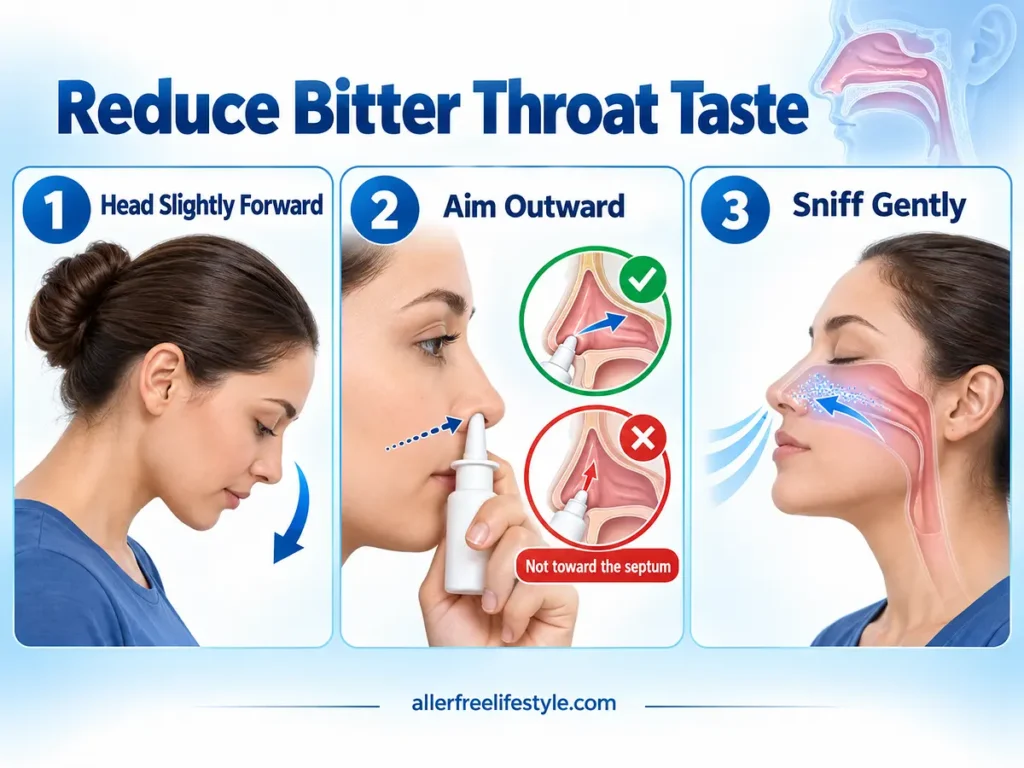
Try these steps:
- Keep your head slightly tilted forward rather than backward.
- Point the nozzle slightly outward toward the ear on the same side instead of aiming toward the nasal septum.
- Spray gently and avoid inhaling forcefully after application.
- Allow the medication to remain inside the nose rather than pulling it into the throat with a strong sniff.
- Use only the prescribed number of sprays.
The goal is to coat the nasal lining, not send the medication toward the back of the throat.
Why Does My Allergy Spray Taste Like Chemicals?
A chemical or unpleasant taste after using an allergy spray is usually related to the formulation and the medication reaching areas where it can be detected by taste receptors.
Factors that may influence taste perception include:
- The active medication molecule
- Inactive ingredients within the spray
- The amount of medication reaching the throat
- Individual differences in taste sensitivity
Common nasal steroid spray ingredients include:
- Fluticasone propionate
- Fluticasone furoate
- Mometasone furoate
- Triamcinolone acetonide
- Budesonide
Research evaluating intranasal corticosteroids has shown that sensory factors, including taste and aftertaste, can influence patient acceptance of different formulations (3).
Do Different Nasal Steroid Sprays Have Different Taste Profiles?
Although nasal steroid sprays work through similar anti-inflammatory mechanisms, users may experience different taste sensations depending on the formulation.
Nasal steroid spray | Active ingredient | Possible taste experience |
Flonase | Fluticasone propionate | Some users notice a bitter or medicine-like aftertaste |
Flonase Sensimist | Fluticasone furoate | Some users perceive a smoother mist experience |
Nasacort | Triamcinolone acetonide | Taste may occur if medication reaches the throat |
Nasonex | Mometasone furoate | Taste perception varies between individuals |
Rhinocort | Budesonide | Some users report temporary aftertaste |
Taste experience is highly individual. A formulation that feels comfortable for one person may not taste the same to another person.
Does a Bitter Taste Mean My Nasal Spray Is Not Working?
No. A bitter taste does not mean that your nasal steroid spray has failed.
The effectiveness of nasal corticosteroids depends on:
- Correct application technique
- Regular use
- Appropriate dosing
- Sufficient time for the medication to reduce inflammation
A small amount of throat drainage can happen even when the spray is being used properly.
How Can I Prevent Bitter Taste From Nasal Steroid Spray?
To make nasal spray use more comfortable:
- Check your spray technique regularly.
- Keep the nozzle aimed away from the nasal septum.
- Avoid deep inhalation immediately after spraying.
- Do not tilt your head backward.
- Follow the product instructions carefully.
- Ask a pharmacist or healthcare professional to demonstrate proper technique if needed.
Small changes in administration technique can significantly improve comfort while maintaining the effectiveness of treatment.
Why Does My Nasal Spray Leave a Bad Taste That Won’t Go Away?
A temporary bitter taste is usually not concerning. However, if the taste is persistent or accompanied by discomfort, it may be helpful to review your technique or discuss your experience with a healthcare professional.
Possible reasons for ongoing unpleasant taste include:
- Excess medication reaching the throat
- Incorrect spray direction
- Sensitivity to a specific formulation
- Throat irritation from repeated drainage
A healthcare professional can help determine whether a different approach or formulation may be appropriate.
When Should You Talk to a Healthcare Professional?
Seek medical advice if you experience:
- Persistent throat irritation
- Significant throat pain
- Frequent nosebleeds
- Swelling or signs of an allergic reaction
- Difficulty breathing
- Symptoms that worsen despite treatment
Most cases of bitter taste from nasal steroid sprays are mild and can often be improved by adjusting spray technique.
Medical Disclaimer
This article provides general information about nasal steroid sprays and is not a substitute for personalized medical advice, diagnosis, or treatment. Always follow the instructions for your specific medication and consult a qualified healthcare professional if you have concerns about side effects, persistent symptoms, or treatment decisions.
Frequently Asked Questions
Why does my nasal steroid spray taste bitter in my throat?
A bitter taste usually occurs when a small amount of medication moves backward from the nasal passages into the throat, where taste receptors detect it.
How can I stop tasting my nasal spray after using it?
Use the correct spray technique by keeping your head slightly forward, aiming away from the nasal septum, and avoiding forceful sniffing.
Is it normal to taste Flonase or other nasal steroid sprays?
Yes. Some people notice a bitter, metallic, or medicine-like taste after using nasal corticosteroid sprays.
Does a bitter taste mean my nasal spray is not working?
No. The taste is usually related to medication drainage and does not indicate whether the treatment is effective.
Is the bitter taste from nasal steroid spray harmful?
In most cases, it is a temporary and harmless effect. Persistent irritation or unusual symptoms should be evaluated by a healthcare professional.
References
- Mahadevia PJ, Shah S, Leibman C, Kleinman L, O’Dowd L. Patient preferences for sensory attributes of intranasal corticosteroids and willingness to adhere to prescribed therapy for allergic rhinitis: a conjoint analysis. Ann Allergy Asthma Immunol. 2004;93(4):345-350. doi:10.1016/S1081-1206(10)61393-2.
- Bachert C, El-Akkad T. Patient preferences and sensory comparisons of three intranasal corticosteroids for the treatment of allergic rhinitis. Ann Allergy Asthma Immunol. 2002;89(3):292-297. doi:10.1016/S1081-1206(10)61957-6.
May JR, Dolen WK. Evaluation of intranasal corticosteroid sensory attributes and patient preference for fluticasone furoate for the treatment of allergic rhinitis. Clinical Therapeutics. 2019;41(8):1589-1596. doi:10.1016/j.clinthera.2019.05.017.