

Is It a Deviated Septum or Chronic Allergy Congestion? How to Tell the Difference at Home
Written by: Dr. Muhammad Ihsan Ullah, PhD
Medically reviewed by: Dr. Ali Raza Dogar, MBBS, D-LO — ENT Specialist
Last updated on September 16, 2026

A blocked nose that never seems to clear can make it difficult to sleep, exercise and breathe comfortably. Chronic allergy congestion and a deviated septum can feel similar, but their patterns are often different. Paying attention to when the blockage occurs, whether it changes sides and which other symptoms appear can help you decide what type of medical evaluation you may need.
At a Glance
Allergy congestion usually fluctuates with exposure to pollen, dust mites, mold, or pets and may occur with sneezing, nasal itching, and watery eyes. A deviated septum more often causes persistent, uneven airflow that repeatedly affects the same nostril. These patterns offer useful clues, but only a clinical examination can confirm the cause.
How Do I Know If I Have a Deviated Septum or Allergies?
The clearest distinction is whether the congestion behaves like inflammation or a fixed obstruction.
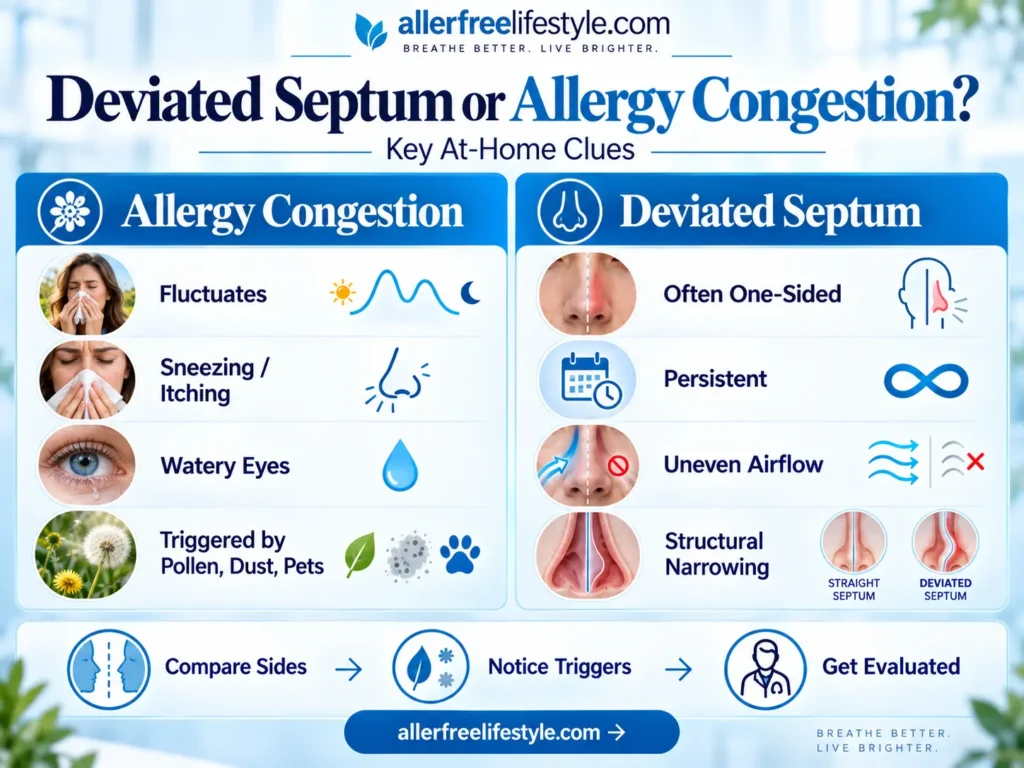
Allergic rhinitis develops when the immune system reacts to an airborne allergen. The resulting inflammation can swell the nasal mucosa and turbinates, reducing the space available for airflow. Nasal congestion, clear rhinorrhea, sneezing, and nasal itching are characteristic features; red, itchy, or watery eyes provide additional support for an allergic pattern (1).
A deviated nasal septum is a structural difference in the bone and cartilage separating the nasal passages. When the deviation is substantial, one passage may be narrower, producing persistent nasal obstruction or consistently uneven airflow.
At-home clue | Chronic allergy congestion | Deviated septum |
Congestion pattern | Often fluctuates with exposure | Usually persistent or repeatedly worse on the same side |
One or both nostrils | Commonly affects both, although one side may temporarily feel worse | Often creates consistently unequal airflow |
Sneezing and nasal itching | Common | Uncommon unless allergies coexist |
Watery or itchy eyes | Common | Not caused by septal deviation |
Nasal discharge | Often clear and watery | Not a defining feature |
Environmental pattern | May worsen around pollen, pets, mold or dust mites | Usually persists regardless of allergen exposure |
Seasonal changes | May worsen during particular seasons | Generally present throughout the year |
Response to allergy medicine | May improve with appropriate treatment | Structural narrowing remains, although associated swelling may improve |
Airflow comparison | The more congested side may change | The same side may repeatedly feel restricted |
These differences are clues rather than diagnostic rules. Allergies can produce uneven congestion, and a deviated septum can restrict both nasal passages.
Is One Blocked Nostril Allergies or a Deviated Septum?
A nostril that remains more restricted even when you do not have sneezing, itching, or watery eyes may point toward a structural obstruction. Suspicion increases when the same side feels blocked during the day, at night, and away from suspected allergens.
Allergy congestion is more likely to change with your surroundings. For example, it may worsen after entering a dusty room, sleeping in a bedroom with dust-mite exposure, spending time around an animal or going outdoors during a high-pollen period.
One-sided nasal blockage does not automatically confirm a deviated septum. Enlarged turbinates, nasal polyps, nasal valve narrowing, and, less commonly, other growths can produce a similar sensation. Persistent unilateral congestion therefore deserves a professional examination rather than prolonged self-treatment.
Why Does My Blocked Nostril Change Sides?
A blockage that alternates between nostrils may be part of the nasal cycle. During this normal process, tissue inside one passage temporarily swells while tissue on the opposite side becomes less congested. The dominant side changes periodically.
The nasal cycle can become more noticeable when allergic inflammation has already narrowed both passages. Sleeping on one side, exposure to dry air, irritants or a respiratory infection can also affect which nostril feels more open.
Alternating congestion is therefore not proof of an allergy. However, a changing blockage accompanied by sneezing, itching, clear discharge or a recognizable environmental pattern is more consistent with allergic rhinitis than a purely fixed obstruction.
How Can I Check for a Deviated Septum at Home?
A simple nostril breathing comparison can help you identify uneven airflow. It cannot determine why that difference exists.
Perform the check when you do not have a cold or a severe allergy flare:
- Sit upright and breathe normally for several minutes.
- Keep your mouth closed.
- Gently press one nostril closed without pulling your nose sideways.
- Take several quiet breaths through the open nostril.
- Repeat the process on the opposite side.
- Record whether one side feels substantially more restricted.
- Repeat the check at different times over several days.
A significant difference that repeatedly affects the same side may indicate structural narrowing. If the restricted side changes, the nasal cycle or fluctuating inflammation may be contributing.
Do not insert a finger, cotton swab or other object into the nose. A mirror may show external asymmetry, but it cannot reveal the deeper nasal septum. A straight-looking nose can have an internal deviation, while unequal-looking nostrils do not prove that one is present.
If Antihistamines Help Congestion, Does That Mean Allergies?
Improvement after an antihistamine may support an allergic explanation, particularly when itching, sneezing and watery eyes improve at the same time. It does not establish a diagnosis.
Oral antihistamines may control itching and sneezing more effectively than nasal obstruction. Intranasal corticosteroids are generally more effective for persistent allergic congestion, but they require correct and consistent use. Current management recommendations emphasize matching treatment to the clinical pattern rather than using a single medication response as a diagnostic test (2).
Do not use decongestant nasal sprays repeatedly to test the cause of your blockage. Prolonged or excessive use can cause rebound congestion, making the original pattern harder to interpret.
Can Allergies and a Deviated Septum Occur Together?
Yes. A deviated septum reduces the physical space available for airflow, while allergic rhinitis causes inflammation and swelling of the nasal lining. When both occur, even moderate allergic swelling can make an already narrow passage feel severely blocked.
A combined pattern may be present when:
- One nostril usually feels narrower, but both sides worsen around allergens
- Sneezing, itching or watery eyes accompany temporary flares
- Allergy treatment improves some congestion but unequal airflow remains
- Symptoms worsen seasonally without disappearing between seasons
Recent evidence confirms that allergic rhinitis and septal deviation can coexist and jointly contribute to nasal obstruction, although the best management depends on careful patient selection and clinical evaluation (3).
When Should Persistent Nasal Blockage Be Examined?
Arrange an assessment if the obstruction remains mainly on one side, interferes with sleep or exercise, persists despite appropriately guided allergy care, or began after an injury. Recurrent nosebleeds, repeated sinus problems and progressively worsening airflow also require evaluation.
Seek prompt medical attention if one-sided obstruction occurs with unexplained bleeding, blood-stained discharge, marked facial swelling, severe facial pain, visual changes or a neck mass.
An allergist can evaluate whether symptoms and exposure patterns support allergic rhinitis and decide whether skin-prick or specific-IgE testing is appropriate. An ear, nose and throat specialist can examine the septum, turbinates, nasal valve and deeper nasal passages, sometimes using nasal endoscopy. Because structural narrowing and allergic inflammation may occur together, some people benefit from both assessments.
Medical Disclaimer
This article is for general educational purposes and does not replace professional medical advice, diagnosis, or treatment. Consult a qualified healthcare professional about persistent, worsening, or one-sided nasal obstruction.
Frequently Asked Questions
Can allergies make one nostril feel more blocked?
Yes. Allergic swelling may temporarily affect one side more than the other, although the more congested side may change during the day.
Does constant one-sided congestion confirm a deviated septum?
No. It suggests possible structural obstruction, but enlarged turbinates, nasal polyps and other conditions can cause a similar pattern.
Can someone have allergies and a deviated septum at the same time?
Yes. Allergic inflammation can further narrow a nasal passage already restricted by a deviated septum.
Is an at-home nostril breathing test accurate?
It can identify uneven airflow but cannot determine its cause. A healthcare professional must examine the nose to confirm a septal deviation.
Which specialist should assess ongoing nasal obstruction?
An allergist evaluates suspected environmental allergies, while an ENT specialist examines the septum and other nasal structures. Some patients require both evaluations.
References
- Rosenfield L, Keith PK, Quirt J, et al. Allergic rhinitis. Allergy, Asthma & Clinical Immunology. 2024;20(Suppl 3):74. doi: 10.1186/s13223-024-00923-6.
- Klimek L, et al. Current management of allergic rhinitis. The Journal of Allergy and Clinical Immunology: In Practice. 2024;12(6):1399–1412. doi: 10.1016/j.jaip.2024.03.023.
- Wu Y, Yu T, Zhang Z, Wang X, Gao S. The benefits of septoplasty for patients with deviated nasal septum and allergic rhinitis: a meta-analysis. Scientific Reports. 2024;14:28855. doi: 10.1038/s41598-024-80377-3.