

Can Allergies Cause Dizziness and Vertigo? The Medical Explanation
Written by: Dr.Muhammad Ihsan Ullah, PhD
Medically reviewed by: Dr. Muhammad Mudassar Hassan Bhatti, MD
Last updated on May 29,2026
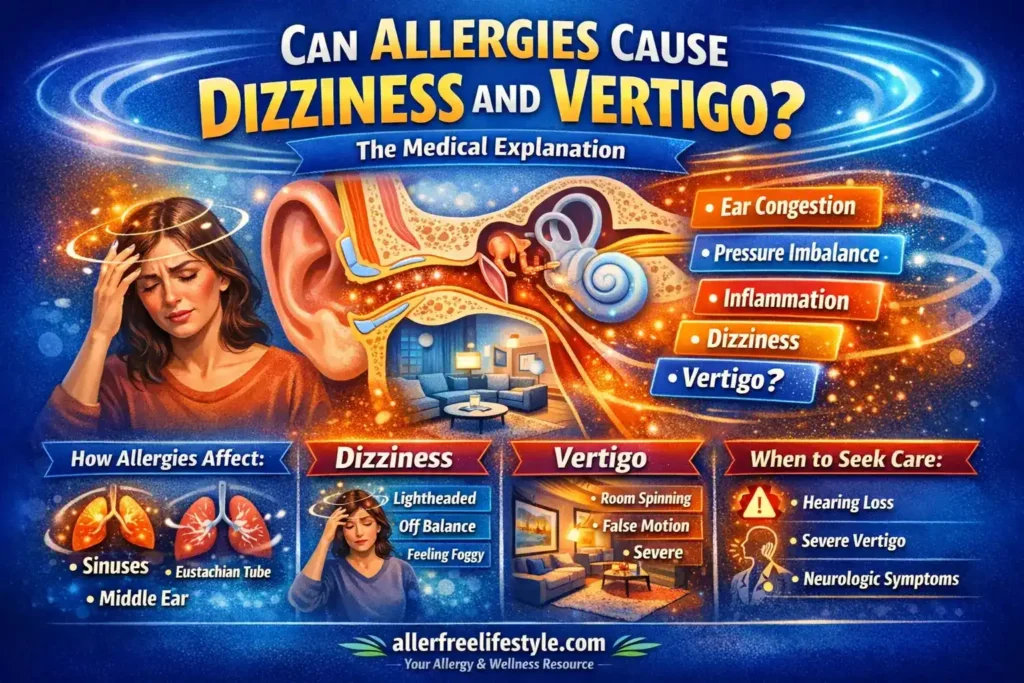
Sometimes allergies do not stop at sneezing, itchy eyes, or a blocked nose.
Sometimes they make you feel strange.
Your head feels heavy.
Your ears feel full.
Your balance feels slightly off.
And for a moment, it may even feel as if the room is moving.
That is often the point where people start asking a very specific question:
Can allergies cause dizziness and vertigo?
The answer is yes, they can.
But the real explanation is more layered than most articles make it sound.
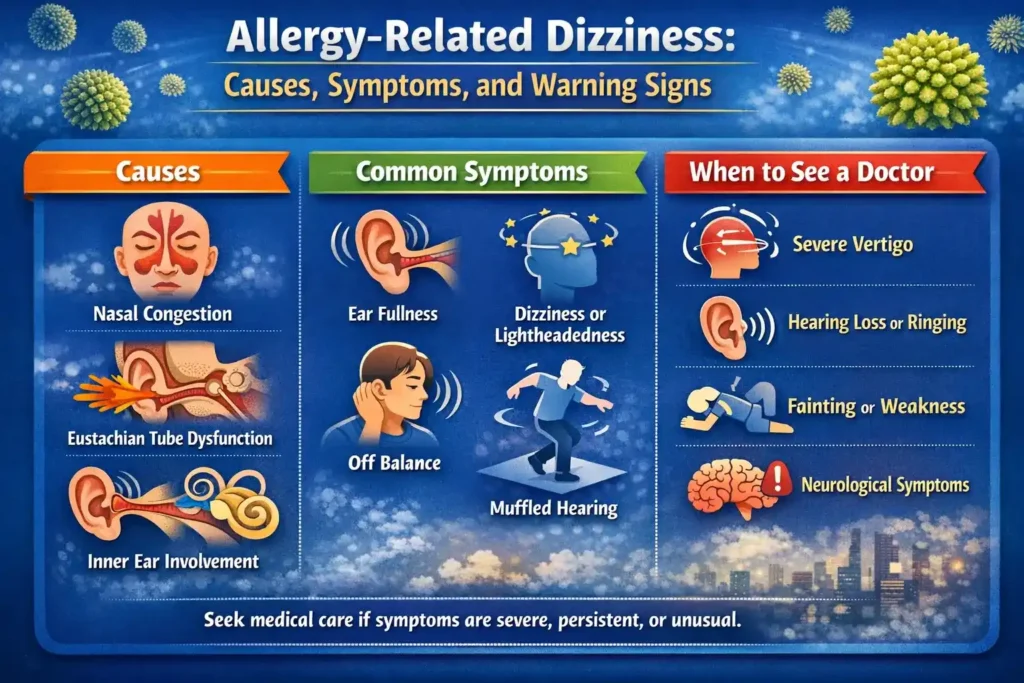
Allergies usually do not cause dizziness in a simple, direct, one-step way. Instead, they can trigger inflammation, nasal swelling, sinus congestion, Eustachian tube dysfunction, middle-ear pressure imbalance, and in some cases symptoms that affect the body’s sense of balance. That is why one person may feel only mild lightheadedness, while another feels distinctly off balance or even experiences a spinning sensation (Bernstein, J. A., et al. 2024; Yu, X., et al. 2024).
So yes, allergies can be part of the story.
But they are not always the whole story.
That is exactly why this topic deserves a careful medical explanation.
If you want the short version first, here it is:
- Allergies can make you feel dizzy.
- Allergies can sometimes contribute to vertigo.
- This usually happens through inflammation, congestion, and ear-pressure changes rather than through a simple direct effect.
- If you have true spinning vertigo, repeated attacks, hearing changes, or severe symptoms, allergies should not be assumed to be the only explanation.
That is the most medically honest answer.
Key points at a glance
- Allergy-related inflammation can affect the nose, sinuses, Eustachian tube, and middle ear.
- Pressure changes in and around the ear can cause imbalance, fullness, muffled hearing, and dizziness.
- Some newer research also suggests an association between allergic disease and selected inner-ear disorders in certain patients (Zeng, B., et al. 2024).
- Many people who think they have “vertigo from allergies” are actually experiencing pressure-related dizziness rather than classic vertigo.
- Severe, repeated, or clearly spinning vertigo should always be assessed more carefully.
Why allergies can affect more than just your nose
Most people think of allergies as a nose problem.
But allergies are really an immune and inflammatory response.
When your body reacts to pollen, dust mites, mold, or pet dander, it releases inflammatory mediators such as histamine. This leads to swelling in the lining of the nose and upper airway. That swelling may also affect the area around the Eustachian tube, which connects the back of the nose to the middle ear (Bernstein, J. A., et al. 2024).
That connection matters.
The ear does not just help you hear.
It also helps you stay balanced.
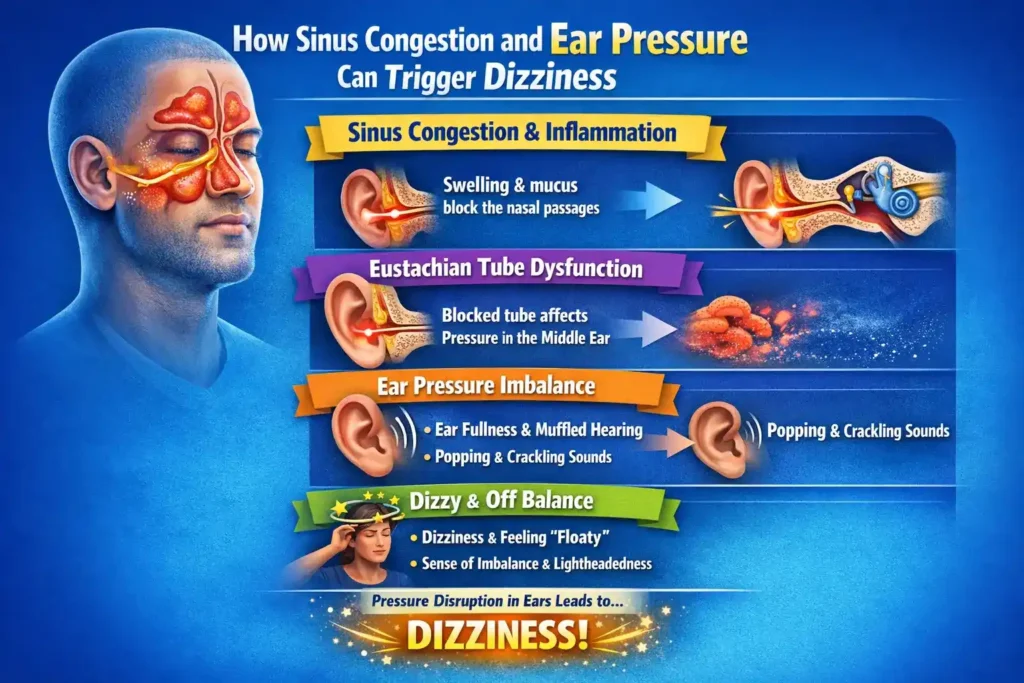
So when inflammation starts interfering with pressure regulation in or around the ear, you may notice symptoms such as:
- ear fullness
- pressure in the ears
- popping or crackling
- muffled hearing
- a floating feeling
- imbalance
- dizziness
- and sometimes vertigo
That is why the question is medically valid.
People are not imagining this connection.
The medical pathway: how allergies can lead to dizziness or vertigo
To understand this properly, it helps to follow the process step by step.
1.Allergens trigger an immune response
In allergic rhinitis, exposure to an allergen causes the immune system to react. This involves IgE antibodies, mast cells, histamine, and other inflammatory signals. The result is the familiar group of symptoms: sneezing, congestion, itching, runny nose, and swelling of the mucosal lining (Bernstein, J. A., et al. 2024).
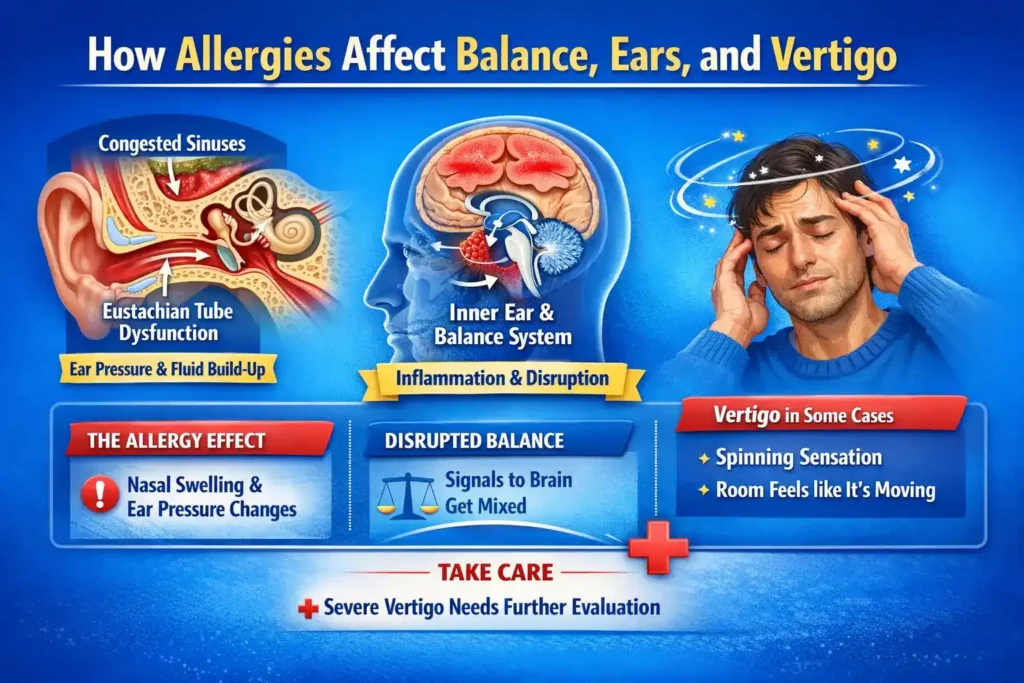
That swelling is where the dizziness story begins.
2.Swelling affects the Eustachian tube
The Eustachian tube helps equalize pressure in the middle ear. When inflammation disrupts its function, the middle ear may not ventilate properly. This is called Eustachian tube dysfunction, or ETD.
People with ETD often describe symptoms like:
- blocked ears
- aural fullness
- pressure
- popping
- muffled hearing
- feeling “off”
- dizziness or disequilibrium
A 2024 review reported that allergic disease appears to be closely related to the occurrence of Eustachian tube dysfunction, while also making it clear that the exact mechanisms are still being studied and not every case of ETD is caused by allergy (Yu, X., et al. 2024).
That is an important point.
Allergy is a believable contributor.
It is not a universal explanation for every dizzy spell.
3.Middle-ear pressure changes can make you feel off balance
This is one of the most practical explanations for allergy-related dizziness.
When pressure in the middle ear is not balanced properly, many people do not experience dramatic spinning. Instead, they describe:
- a heavy head
- pressure behind the ears
- fullness
- muffled sounds
- subtle imbalance
- a disconnected or swimmy feeling
A 2023 clinicopathological study found that nearly half of the studied patients with allergic rhinitis had middle ear dysfunction, and about 22% had Eustachian tube dysfunction. That does not mean allergies explain every balance problem, but it strongly supports the idea that allergic inflammation can disturb ear function enough to make people feel dizzy or unsteady (Sidam, S., et al. 2023).
4.In some people, the inner ear may also be involved
This is where the conversation becomes more serious.
The inner ear and vestibular system play a major role in balance. A 2024 systematic review found evidence supporting an association between type I hypersensitivity and certain inner-ear disorders, including Ménière’s disease, idiopathic sudden sensorineural hearing loss, and acute low-tone hearing loss. The review also noted that total IgE levels were elevated in some affected patients, suggesting that allergy-related immune activity may influence inner-ear disease in at least some cases (Zeng, B., et al. 2024).
This does not mean pollen directly causes every vertigo attack.
It means the relationship between allergies and balance disorders is medically meaningful, especially in a subset of patients where the ear seems to be involved more deeply.
Dizziness and vertigo are not the same thing
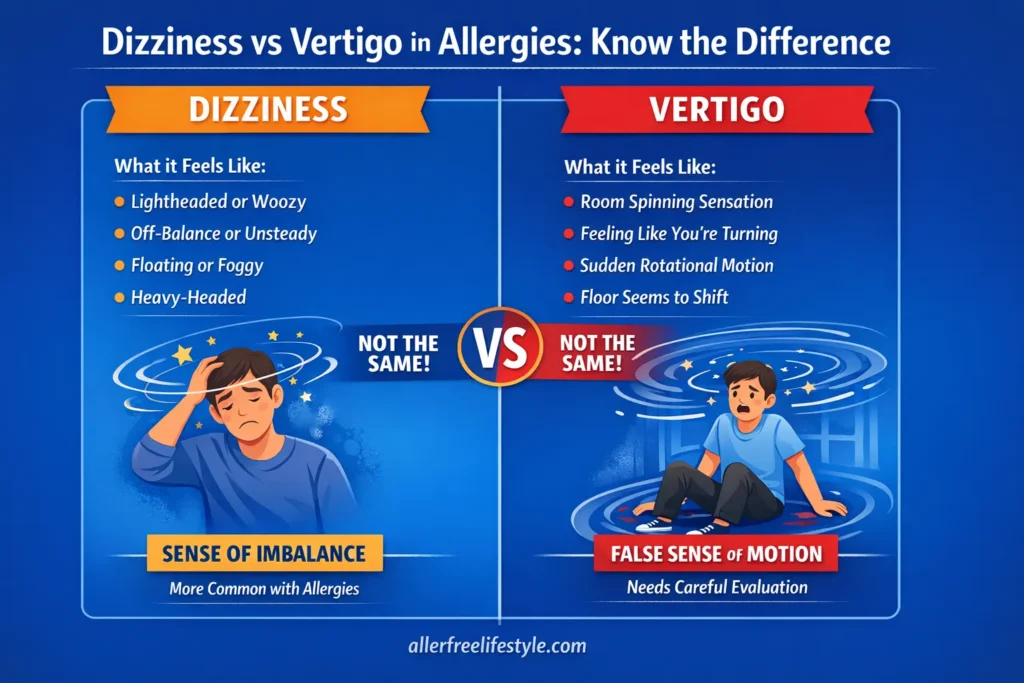
This distinction matters a lot.
Dizziness
“Dizziness” is a broad word. People may use it to describe:
- lightheadedness
- unsteadiness
- floating
- mental fog
- near-faintness
- feeling off balance
Vertigo
“Vertigo” is more specific. It usually means a false sensation of movement. People often describe it as:
- the room spinning
- their body turning
- the floor shifting
- a sudden sense of motion when nothing is moving
This matters because allergies are often more believable as a cause of:
- pressure-related dizziness
- heavy-headedness
- ear-related imbalance
- vague disequilibrium
But when someone has true rotational vertigo, especially if it is severe, recurrent, or paired with hearing changes, a broader medical evaluation becomes much more important.
What allergy-related dizziness often feels like
Many people do not use textbook language.
They say things like:
- “My ears feel blocked and I feel weird.”
- “My head feels full.”
- “I feel slightly off balance.”
- “I don’t feel normal when my allergies are bad.”
- “I feel swimmy or lightheaded.”
- “I’m not sure if it’s vertigo, but I feel unsteady.”
That kind of description fits very well with inflammation, ETD, and pressure-related ear dysfunction.
It also explains why so many people search terms like:
- can allergies make you dizzy
- can allergies make you feel off balance
- can sinus allergies cause dizziness
- can allergies cause lightheadedness
- can seasonal allergies cause vertigo
The symptoms behind those questions are very real.
When allergies are more likely to be the reason
Dizziness is more likely to be linked to allergies when it:
1.Flares during allergy season
If symptoms clearly worsen during pollen season or after exposure to dust, mold, or pets, the allergy connection becomes more likely.
2.Comes with congestion and ear symptoms
If dizziness appears alongside:
- a blocked nose
- sinus pressure
- postnasal drainage
- ear fullness
- muffled hearing
then allergy-related inflammation becomes a much more believable explanation.
3.Feels more like imbalance than violent spinning
Allergy-related dizziness often feels more like heaviness, fogginess, or pressure-related disequilibrium than intense rotational vertigo.
4.Improves when allergies improve
If symptoms settle as congestion settles, that pattern supports the connection.
Current guidance continues to support intranasal corticosteroids as major first-line treatment for allergic rhinitis, while second-generation oral antihistamines also remain useful depending on the patient’s symptom pattern and preferences (Ellis, A. K., et al. 2024; Bernstein, J. A., et al. 2024).
When it may be something else
This is just as important as everything above.
Not every dizzy episode during allergy season is caused by allergies.
Other possibilities include:
Benign paroxysmal positional vertigo
This usually causes brief spinning episodes triggered by head movement, such as rolling over in bed or looking upward.
Ménière’s disease
This becomes more likely when vertigo is paired with:
- tinnitus
- ear fullness
- fluctuating hearing changes
- repeated attacks
Vestibular neuritis or labyrinthitis
These disorders usually cause stronger vestibular symptoms and often follow an infection.
Medication side effects
Sometimes the real problem is not the allergy flare itself but the treatment being used.
Neurologic causes
Sudden severe vertigo with neurologic symptoms should never be casually blamed on allergies.
The key message is simple:
A person can have allergies and another vestibular disorder at the same time.
Can allergy medicine cause dizziness too?
Yes.
Sometimes the person asking “Can allergies make you dizzy?” is actually reacting to the medication rather than the allergy itself.
Older first-generation antihistamines are especially known for causing:
- drowsiness
- slowed thinking
- lightheadedness
- poor coordination
- a sedated or heavy feeling
That is one reason current guidance favors newer, second-generation antihistamines when an oral antihistamine is needed. They are generally better tolerated and less likely to make people feel mentally slowed or off balance (Ellis, A. K., et al. 2024).
So if dizziness started after a medication change, that possibility deserves attention.
What usually helps
If allergies are contributing to dizziness or vertigo, treatment works best when it targets the underlying process rather than only chasing the sensation.
That usually means focusing on allergy control, ear pressure issues, and trigger identification.
Common helpful steps may include:
- controlling allergic rhinitis properly
- reducing exposure to known triggers
- using intranasal corticosteroids
- using a second-generation antihistamine when appropriate
- reviewing medications if dizziness worsened after treatment started
- getting further assessment if ear fullness, tinnitus, or true vertigo continues
- discussing allergen immunotherapy when symptoms remain troublesome despite routine treatment
The 2024 focused Canadian practice parameter supports intranasal corticosteroids as first-line treatment for allergic rhinitis and also supports second-generation oral antihistamines and immunotherapy in selected patients (Ellis, A. K., et al. 2024).
For many people, the goal is not just to survive one allergy season.
It is to stop the same pattern from repeating year after year.
When to seek urgent medical care
Do not ignore dizziness or vertigo if it comes with any of the following:
- trouble breathing
- wheezing
- throat tightness
- lip or tongue swelling
- fainting or near-fainting
- chest tightness
- facial droop
- slurred speech
- severe weakness
- sudden trouble walking
- double vision
This matters because dizziness can also occur during a serious allergic reaction, and that should never be mistaken for ordinary congestion-related dizziness. The 2024 anaphylaxis practice parameter update emphasizes how important it is to recognize dangerous systemic allergic reactions quickly (Golden, D. B. K., et al. 2024).
Final takeaway
Allergies can absolutely cause dizziness.
And in some people, they may also contribute to vertigo.
But the most accurate explanation is not that allergies simply “cause spinning.” It is that allergic inflammation can trigger a chain of events involving the nose, sinuses, Eustachian tube, middle ear, and sometimes even the inner ear. That chain can leave a person feeling blocked, unsteady, lightheaded, or off balance. In a smaller group of patients, it may also overlap with true vestibular disease.
So if your allergies and dizziness seem to show up together, the connection may be very real.
Still, the safest approach is to stay thoughtful about it:
- mild, pressure-related dizziness may fit allergy-related ear dysfunction
- repeated or severe vertigo deserves closer medical attention
- and new red-flag symptoms should never be brushed aside
That is the real medical explanation.
And for most readers, it is also the most reassuring one:
your symptoms may have a logical cause, but they still deserve the right kind of attention.
Medical Disclaimer
This content is for educational and informational purposes only and is not a substitute for professional medical advice, diagnosis, or treatment. Always consult a qualified healthcare professional for symptoms such as dizziness, vertigo, breathing difficulty, hearing changes, or worsening allergy-related concerns, and seek urgent care for severe or emergency symptoms.
Frequently Asked Questions (FAQs)
1. Can seasonal allergies really cause vertigo?
Yes, they can contribute to vertigo in some cases, especially when allergic inflammation affects ear pressure regulation or when the inner ear appears to be involved. But not every case of vertigo during allergy season is caused by allergies alone.
2. Can allergies make you feel off balance without true spinning?
Yes. In fact, that is often how allergy-related dizziness feels. Many people describe heaviness, fullness, fogginess, or subtle imbalance rather than classic spinning vertigo.
3. Can sinus pressure from allergies make you dizzy?
Yes, it can. Sinus and nasal inflammation may contribute to pressure changes around the Eustachian tube and middle ear, which can affect balance and create a dizzy or “underwater” feeling.
4. Is dizziness from allergies dangerous?
Usually it is not dangerous by itself, but it should not be ignored if it is severe, recurrent, clearly spinning, or associated with hearing changes, fainting, breathing trouble, or neurologic symptoms.
5. Can antihistamines make dizziness worse?
Yes. Older first-generation antihistamines are more likely to cause drowsiness, lightheadedness, and a heavy or sedated feeling. Newer second-generation options are usually better tolerated.
References
- Bernstein, J. A., Bernstein, J. S., Makol, R., & Ward, S. (2024). Allergic rhinitis: A review. JAMA, 331(10), 866-877. https://doi.org/10.1001/jama.2024.0530
- Ellis, A. K., Cook, V., Keith, P. K., Mace, S. R., Moote, W., O’Keefe, A., Quirt, J., Rosenfield, L., Small, P., & Watson, W. (2024). Focused allergic rhinitis practice parameter for Canada. Allergy, Asthma & Clinical Immunology, 20(1), 45. https://doi.org/10.1186/s13223-024-00899-3
- Yu, X., Zhang, H., Zong, S., & Xiao, H. (2024). Allergy in pathogenesis of Eustachian tube dysfunction. World Allergy Organization Journal, 17(1), 100860. https://doi.org/10.1016/j.waojou.2023.100860
- Sidam, S., Arshed, M. P., Khurana, U., Gupta, V., & Bhan, B. D. (2023). Evaluation of the association between allergic rhinitis and middle ear dysfunction: A clinicopathological study. Cureus, 15(6), e40913. https://doi.org/10.7759/cureus.40913
- Zeng, B., Domarecka, E., Kong, L., Olze, H., Scheffel, J., Moñino-Romero, S., Siebenhaar, F., & Szczepek, A. J. (2024). A systematic review of the clinical evidence for an association between type I hypersensitivity and inner ear disorders. Frontiers in Neurology, 15, 1378276. https://doi.org/10.3389/fneur.2024.1378276
- Golden, D. B. K., Wang, J., Waserman, S., Akin, C., Campbell, R. L., Ellis, A. K., Greenhawt, M., Lang, D. M., Ledford, D. K., Lieberman, J., Oppenheimer, J., Shaker, M. S., Wallace, D. V., Abrams, E. M., Bernstein, J. A., Chu, D. K., Horner, C. C., Rank, M. A., & Stukus, D. R. (2024). Anaphylaxis: A 2023 practice parameter update. Annals of Allergy, Asthma & Immunology, 132(2), 124-176. https://doi.org/10.1016/j.anai.2023.09.015