

How Poor Sleep From Allergies Affects Child Brain Development
Written by: Dr.Muhammad Ihsan Ullah, PhD
Medically reviewed by: Dr. Muhammad Sohail,FCPS
Last updated on February 13,2026
Poor sleep caused by allergic rhinitis (hay fever) is not just a nighttime problem in children, it can directly interfere with brain development, learning capacity, emotional regulation, and long-term cognitive health.
When nasal congestion, mouth breathing, and nighttime allergy symptoms disrupt sleep repeatedly, the developing brain does not get the restorative processes it needs. Over time, this can affect memory, attention, growth, and school performance.
This article explains how allergy-related sleep disruption affects a child’s brain, the warning signs parents should recognize, and what can be done to protect healthy brain development.
Why Sleep Is Critical for a Child’s Brain Development
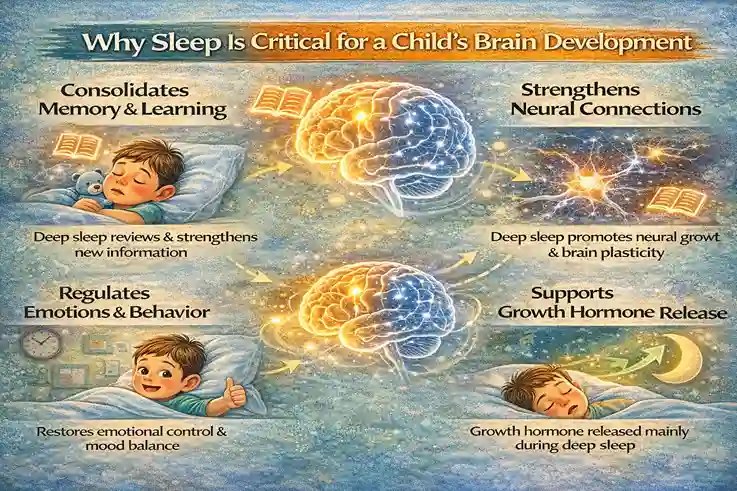
During sleep, a child’s brain consolidates memory, strengthens neural connections, regulates emotions, and supports growth hormone release, all of which are essential for healthy brain development. Chronic sleep disruption during childhood can alter these processes, especially in critical developmental windows (Owens & Weiss, 2017).
How Allergies Disrupt Sleep in Children
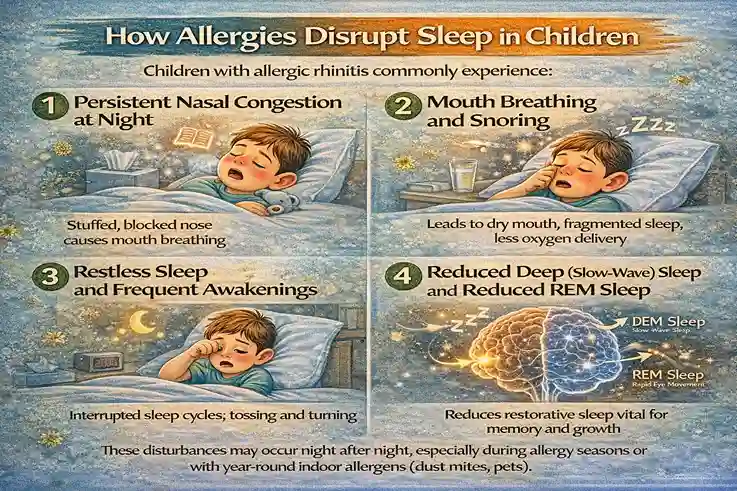
Children with allergic rhinitis commonly experience:
- Persistent nasal congestion at night
- Mouth breathing and snoring
- Restless sleep and frequent awakenings
- Reduced deep (slow-wave) sleep
- Reduced REM sleep
These disturbances may occur night after night, especially during allergy seasons or with year-round indoor allergens (dust mites, pets).
Brain Developmental Effects of Poor Sleep From Allergies
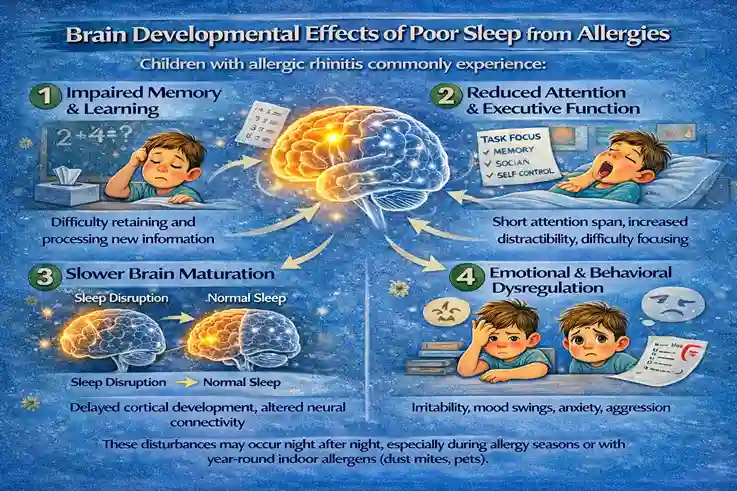
🧠 1️⃣ Impaired Memory and Learning
Chronic sleep disruption in children has been linked to impaired memory, reduced attention, slower cognitive processing, and altered brain maturation, particularly during critical developmental periods (Shochat et al., 2014).
📌 Children with chronic sleep loss show:
- Poor short-term memory
- Difficulty retaining lessons
- Slower learning speed
Studies show sleep-disrupted children perform worse in reading, math, and problem-solving tasks.
🎯 2️⃣ Reduced Attention and Executive Function
Executive functions include:
- Focus
- Planning
- Self-control
- Task switching
Sleep deprivation caused by allergies leads to:
- Short attention span
- Difficulty following instructions
- Increased distractibility
⚠️ This can mimic ADHD, leading to misdiagnosis in some children.
😵 3️⃣ Slower Brain Maturation
Chronic sleep disruption is associated with:
- Delayed cortical development
- Reduced synaptic efficiency
- Altered neural connectivity
The developing brain is more vulnerable than the adult brain to sleep loss.
😠 4️⃣ Emotional & Behavioral Dysregulation
Poor sleep affects brain regions responsible for emotion control (prefrontal cortex, limbic system).
Children may show:
- Irritability
- Mood swings
- Anxiety
- Aggression
- Poor frustration tolerance
Teachers may report:
- Behavioral issues
- Emotional sensitivity
- Social withdrawal
📉 5️⃣ Impact on Intelligence & Cognitive Performance
Even mild but chronic sleep deprivation in children has been associated with lower cognitive test scores, reduced executive function, and impaired academic performance (Beebe, 2011).
Role of Mouth Breathing and Oxygen Levels
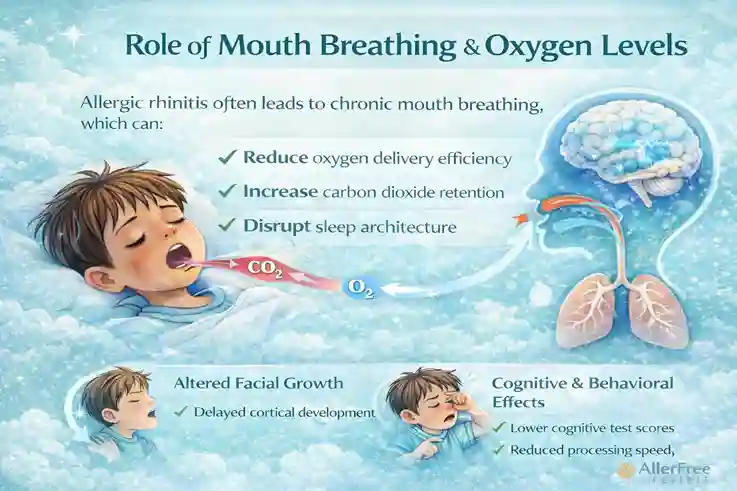
Allergy-related nasal obstruction often leads to mouth breathing, which can:
- Reduce oxygen delivery efficiency
- Increase carbon dioxide retention
- Disrupt sleep architecture
Chronic mouth breathing has been associated with:
- Altered facial growth
- Poor sleep quality
- Cognitive and behavioral effects
Growth Hormone & Brain Development Link
Growth hormone is primarily released during deep sleep, and persistent sleep disruption may interfere with normal physical growth and neurodevelopment in children (Owens & Weiss, 2017).
Warning Signs Parents Should Not Ignore
✔ Loud snoring or mouth breathing
✔ Frequent nighttime awakenings
✔ Morning headaches
✔ Daytime sleepiness
✔ Poor school performance
✔ Behavioral changes
✔ Dark circles under eyes
✔ Chronic nasal congestion
Can Treating Allergies Improve Brain Outcomes?
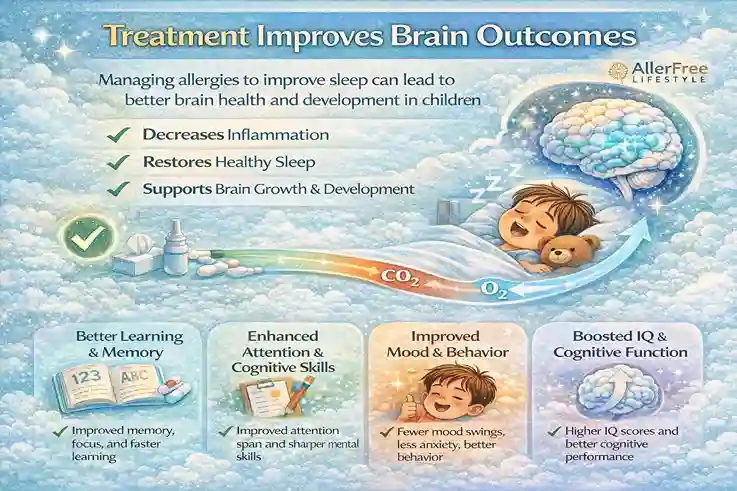
✅ Yes — significantly
Studies show that effective management of allergic rhinitis:
- Improves sleep quality
- Restores normal sleep stages
- Enhances attention and memory
- Improves behavior and mood
- Improves academic performance
📌 Early treatment helps protect normal brain development.
How Parents Can Protect Brain Development
🟢 1️⃣ Control Nighttime Allergy Symptoms
- Treat nasal congestion consistently
- Focus on nighttime symptom relief
🟢 2️⃣ Improve Sleep Environment
- Allergen-free bedroom
- Dust-mite control
- Proper humidity
- Quiet, dark sleeping area
🟢 3️⃣ Address Mouth Breathing Early
- Identify nasal blockage
- Seek ENT/allergy evaluation if persistent
🟢 4️⃣ Avoid Sedating Medications
- Sedating antihistamines worsen cognitive effects
- Prefer non-drowsy options under medical guidance
🟢 5️⃣ Monitor Sleep Patterns
- Track sleep duration and quality
- Note seasonal worsening
Key Takeaways
✔ Sleep is essential for child brain development
✔ Allergic rhinitis commonly disrupts sleep
✔ Chronic sleep loss affects memory, attention, and behavior
✔ Effects may resemble ADHD or learning disorders
✔ Treating allergies early protects cognitive health
Medical Review Disclaimer
This article is for informational and educational purposes only and does not constitute medical advice. The content is written by a qualified healthcare professional and medically reviewed for accuracy. However, it should not be used as a substitute for professional medical diagnosis, treatment, or advice. Always consult a licensed healthcare provider regarding any medical condition or health concern.
Frequently Asked Questions (FAQs)
1. Can allergies affect a child’s brain development?
Yes. Allergies can disrupt sleep, which is essential for healthy brain development.
2. How does poor sleep from allergies affect learning?
It can impair memory, attention, and learning ability.
3. Can allergy-related sleep problems mimic ADHD?
Yes. Poor sleep may cause attention and behavior issues similar to ADHD.
4. Does mouth breathing affect brain health in children?
Chronic mouth breathing can reduce sleep quality and oxygen delivery during sleep.
5. Can treating allergies improve brain outcomes?
Yes. Effective allergy management often improves sleep, behavior, and learning.
References
Beebe, D. W. (2011). Cognitive, behavioral, and functional consequences of inadequate sleep in children and adolescents. Pediatric Clinics of North America, 58(3), 649–665.
https://doi.org/10.1016/j.pcl.2011.03.002
Owens, J. A., & Weiss, M. R. (2017). Insufficient sleep in adolescents: Causes and consequences. Minerva Pediatrica, 69(4), 326–336.
https://doi.org/10.23736/S0026-4946.17.04914-3
Shochat, T., Tavor, I., Tsur, A., & Lavie, P. (2014). Sleep disruption and neurobehavioral functioning in children with allergic rhinitis. Journal of Pediatrics, 165(3), 546–551.
https://doi.org/10.1016/j.jpeds.2014.05.025