

Steam Inhalation for Allergy
Written by: Dr.Muhammad Ihsan Ullah, PhD
Medically reviewed by:Dr. Jamal Ud Din Khan,FCPS
Last updated on February 20,2026
A Clinically Accurate, Safety-First Guide
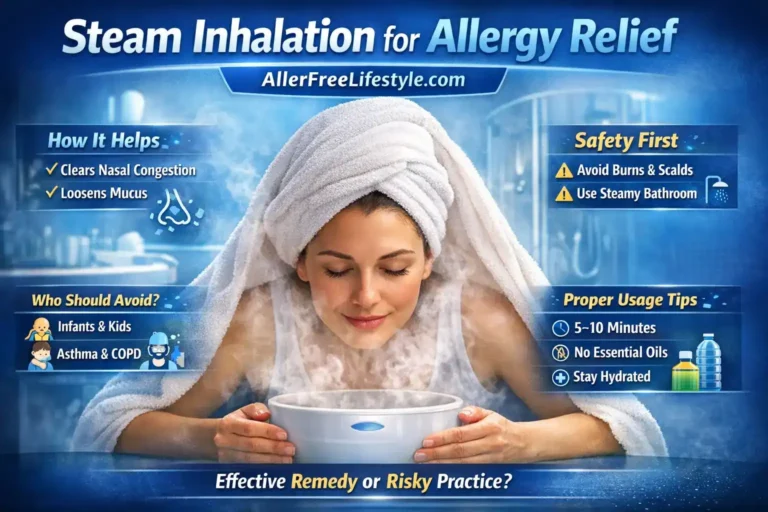
Steam inhalation for allergy is one of those remedies people swear by—usually because it can make your nose feel “open” within minutes. But the same practice is also linked to preventable burns, especially when bowls of hot water are involved (Royal Devon University Healthcare NHS Foundation Trust, 2025).
So what’s the truth?
Steam inhalation for allergy can offer short-term comfort for nasal stuffiness, thick mucus, and dryness—yet it does not treat the underlying allergic inflammation, does not block histamine, and does not “remove allergens” from your body (Healthify Editorial Team, 2025). It’s an adjunct—and only worth doing when it’s done safely and for the right reason.
This article stays focused on Steam inhalation for allergy and answer the common questions asked by patients to the clinicians i.e., why to use it, how to use it, when to avoid it, safety warnings, special population guidance (infants/pregnancy/breastfeeding/elderly), impact on sleep and driving, warning signs, and what to do if it doesn’t help.
Does Steam Inhalation Help Allergies?
Sometimes—temporarily. Steam inhalation for allergy may help you feel less congested by moisturizing the upper airway and loosening secretions, but it does not reduce allergic inflammation the way intranasal corticosteroids do (Healthify Editorial Team, 2025).
- Most important point: modern health authorities increasingly warn against bowl-and-towel steam inhalation, especially around children, because scald injuries are common and can be severe (Royal Devon University Healthcare NHS Foundation Trust, 2025).
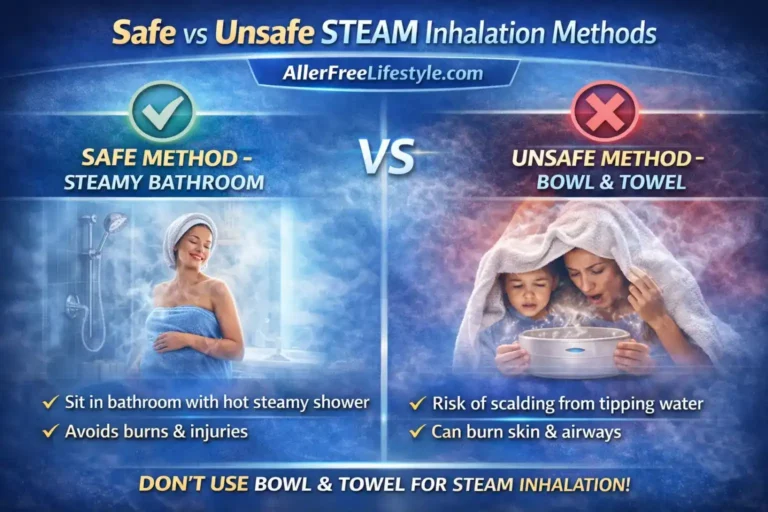
The safest “steam” method is a steamy bathroom (hot shower running) rather than leaning over hot water (Newcastle Hospitals NHS Foundation Trust, 2025).
Therapeutic Classification (Class, “Pharmacology,” and What It’s Used For)
Steam inhalation for allergy is not a medicine, but you can still classify it clinically:
- Therapeutic class: Non-pharmacological supportive therapy (humidification / thermal hydration)
- Mechanism type: Physical (thermal + moisture effect), sensory modulation
- Primary clinical use: Short-term symptomatic relief of nasal stuffiness and thick mucus sensation during allergy flares
- What it does not do: It does not block histamine, reduce IgE, stabilize mast cells, or reverse mucosal inflammation (Healthify Editorial Team, 2025).
Think of it as a comfort tool, not a disease-modifying intervention.
Mechanism of Action of Steam Inhalation in Allergy
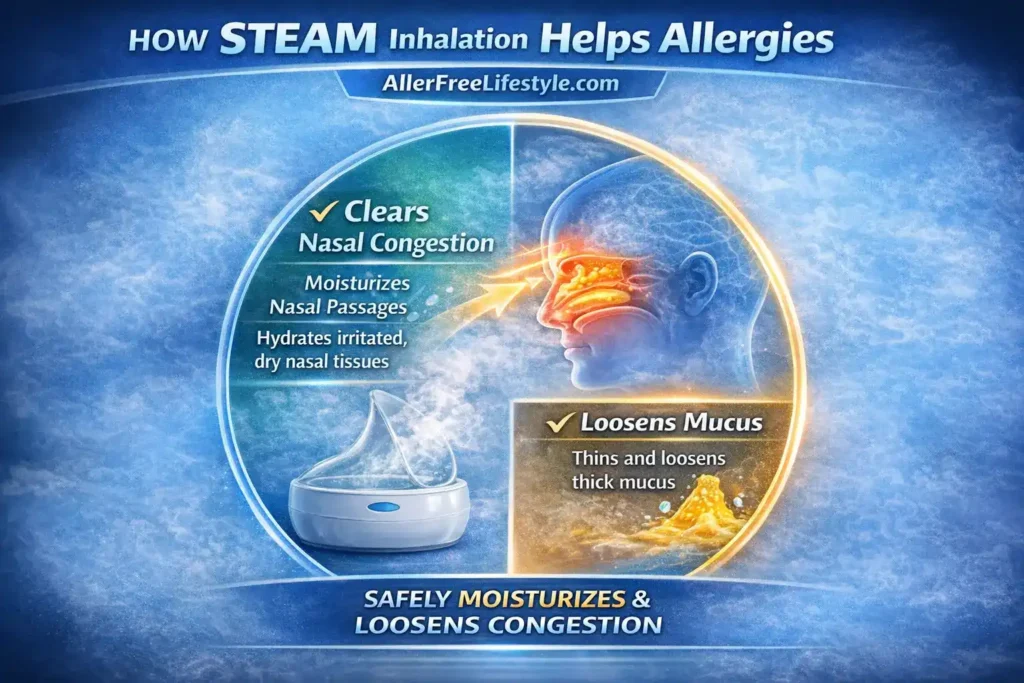
Steam inhalation for allergy works through upper-airway humidification and warmth:
- Hydration of nasal mucosa
Moist air can reduce dryness and irritation, improving perceived airflow. - Mucus “loosening”
Warm humidity can reduce mucus thickness, making it easier to clear (blow out or drain). - Sensory effect
Warm humid air can change how your brain perceives nasal obstruction—meaning you may feel relief even if objective airflow changes are small.
A newer device-based approach (“intranasal thermal steam spray”) has been studied in young adults with congestion and irregular sleep patterns, with reported improvements in subjective nasal congestion and sleep-related outcomes—though it is currently presented as a preprint (Kim et al., 2025).
Best Steam Methods for Allergy (Ranked by Safety)
1) Steamy Bathroom / Hot Shower Method (Safest)
This is the method burns specialists explicitly recommend as a safer alternative to bowls of hot water (Newcastle Hospitals NHS Foundation Trust, 2025).
How to do it
- Run a hot shower to create a steamy bathroom.
- Sit comfortably away from the direct hot water.
- Breathe normally through your nose for 5–10 minutes.
- Stop if you feel lightheaded.
Why it’s best
- No unstable bowl.
- Far lower risk of sudden spills and scalds (Royal Devon University Healthcare NHS Foundation Trust, 2025).
2) Regulated Steam Inhaler / Facial Steamer (Controlled Option)
A device can reduce risk if it regulates temperature and is used as directed. You still need caution and hygiene.
Best for
- Adults who want a repeatable routine
- People who dislike bathroom steam
Critical safety note
- Keep devices clean and dry between uses to reduce microbial contamination risk.
3) Bowl + Towel Method (Highest Risk, Not Recommended for Kids)
NHS-linked safety warnings emphasize avoiding bowls of hot water because spills happen quickly and burns can be life-changing (Royal Devon University Healthcare NHS Foundation Trust, 2025).
If you insist on doing it (adult-only), treat it like handling hot cooking liquid: stable surface, no children, no pets, no distractions.
“Dosing” (Session Time, Frequency, and Technique Parameters)
Because steam inhalation for allergy isn’t a drug, dosing is about time, distance, and frequency:
Adult session dosing (practical standard)
- Duration: 5–10 minutes
- Frequency: 1–2 times daily (during a flare)
- Best timing: evening if congestion disrupts sleep
Technique parameters (important for safety + comfort)
- Distance (if near steam source): stay far enough that it feels warm, not burning
- Breathing: slow nasal breathing; no forceful inhalation
- Eyes: closed if irritated
- Stop immediately if: coughing, wheezing, chest tightness, dizziness, burning sensation
If you have asthma or reactive airways, steam can worsen symptoms in some people (Healthify Editorial Team, 2025).
Who Should Use Steam Inhalation for Allergy
Steam inhalation for allergy is most reasonable when you have:
- Nasal stuffiness that feels “dry” or “stuck”
- Thick mucus that won’t clear
- Indoor dryness (air conditioning/heating)
- Short-term sleep disruption from congestion (Ichiba et al., 2019).
It is not a substitute for anti-inflammatory allergy treatment when inflammation is the main driver.
Who Should Avoid Steam Inhalation (High-Risk Groups and Contraindications)
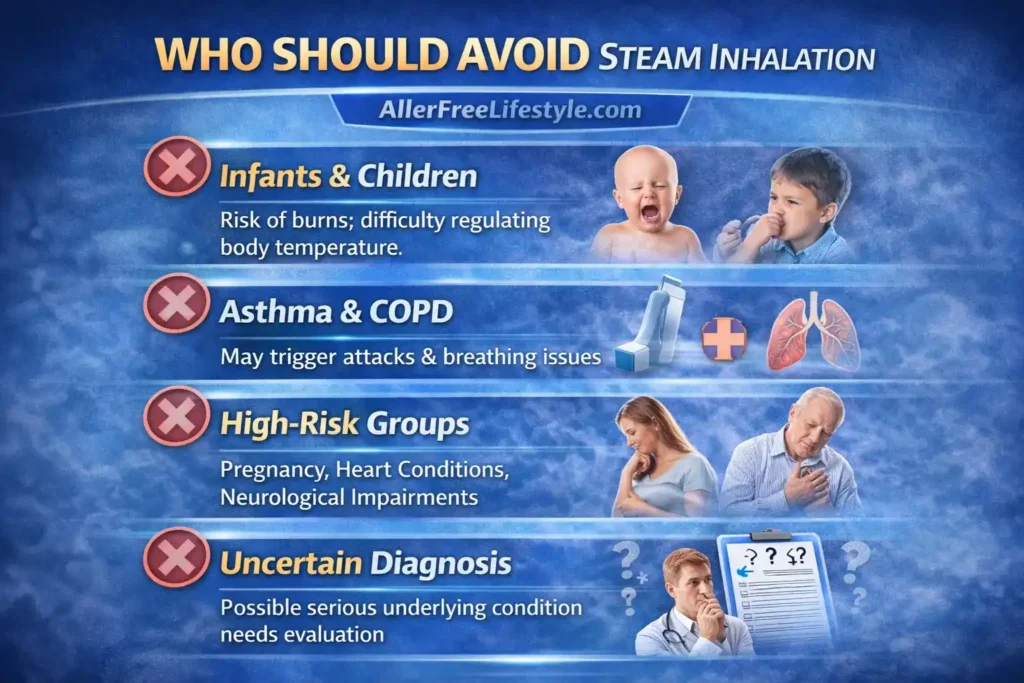
Infants (0–12 months)
Avoid direct steam inhalation. Infants are high-risk for burns and airway irritation. Use safer humidity strategies (ambient humidity, supervised steamy bathroom at a distance, if advised by a clinician) (Healthify Editorial Team, 2025).
Children
Avoid bowl methods completely. Burns teams warn that children are particularly vulnerable to scalds from spilled hot water (Royal Devon University Healthcare NHS Foundation Trust, 2025).
Asthma / Wheeze / Reactive Airways
Warm humid air can aggravate symptoms for some people, and very hot steam can irritate airways (Healthify Editorial Team, 2025). If steam triggers cough, tightness, or wheeze—stop.
Seizure risk + essential oils
Avoid adding essential oils to steam. Healthify warns that essential oil inhalation has been associated with seizures in some reports and can be risky, particularly for children (Healthify Editorial Team, 2025).
Anyone at high fall risk
If you’re prone to dizziness, fainting, or balance issues, avoid prolonged heat exposure and standing in hot steam.
Adverse Effects (What Can Go Wrong)
Mild and common
- Eye irritation or tearing
- Nasal irritation (“too hot / too dry after”)
- Lightheadedness
Serious risks
- Scalds and burns from hot water spills or overly hot steam exposure (Royal Devon University Healthcare NHS Foundation Trust, 2025).
- Worsening breathing symptoms in asthma-sensitive individuals (Healthify Editorial Team, 2025).
- Adult scald injuries and health-system burden have also been documented, not only pediatric cases (Dearden et al., 2022).
Reality check: burns teams across the NHS have repeatedly issued public warnings because these injuries keep happening and are preventable (Newcastle Hospitals NHS Foundation Trust, 2025).
Essential Oils in Steam (Eucalyptus, Peppermint, Menthol): Should You Add Them?
For steam inhalation for allergy, adding essential oils is not necessary and increases risk. Healthify specifically flags essential oil inhalation as potentially dangerous, with reports of seizures linked to eucalyptus inhalation and warnings that inhaling very hot steam can damage airway lining (Healthify Editorial Team, 2025).
Safer approach: skip oils. If you want a menthol sensation, use a properly labeled topical vapor product as directed (not in boiling water, not for infants), and keep it away from the nose/eyes unless the product explicitly allows that.
Impact on Sleep, Driving, and Daily Function
Sleep
If congestion is the barrier, steam (especially steamy bathroom) before bed may improve comfort and reduce mouth-breathing. Controlled warm-steam mask inhalation before bedtime has been associated with improved subjective sleep quality and physiological relaxation signals in adults (Ichiba et al., 2019).
Driving and alertness
Steam inhalation for allergy is not sedating, so it doesn’t inherently impair driving. The only concern is dizziness immediately after heat exposure—if you feel lightheaded, sit, hydrate, and wait until you’re steady.
Interactions With Medicines (Antihistamines, Nasal Sprays, Decongestants)
Steam inhalation has no systemic drug interactions because nothing is absorbed like a medication.
It generally pairs safely with:
- Oral non-sedating antihistamines
- Intranasal corticosteroids
- Saline spray or rinse
Tip: If you use a medicated nasal spray, don’t steam immediately afterward—give the spray time to stay in contact with nasal lining rather than being diluted by moisture.
Pregnancy and Breastfeeding Safety
Pregnancy
Steam inhalation for allergy is generally safe when done as ambient steam (steamy bathroom). Avoid essential oils in steam due to unpredictable irritation/sensitivity and limited safety clarity (Healthify Editorial Team, 2025).
Breastfeeding
Ambient steam is safe. No known impact on lactation physiology.
Age-Specific Guidance (Infants, Children, Adults, Elderly)
Infants
- Direct steaming: avoid
- If congestion interferes with feeding: discuss with a clinician; safer approaches include controlled ambient humidity (Healthify Editorial Team, 2025).
Children
- Use steamy bathroom only, supervised, at a safe distance.
- Never use bowls of hot water due to scald risk (Royal Devon University Healthcare NHS Foundation Trust, 2025).
Adults
- 5–10 minutes, 1–2 times daily as needed.
- Prefer steamy bathroom or regulated device.
Older adults
- Prefer steamy bathroom seated.
- Watch for dizziness and overheating.
- Ensure stable footing and hydration.
When Steam Inhalation Is a Bad Idea (Red Flag Scenarios)
Stop and seek clinical advice if you have:
- Shortness of breath, wheeze, chest tightness triggered by steam
- Severe facial pain or swelling
- High fever or worsening systemic symptoms
- Symptoms that feel “different than usual” for you
- Any burn or scald injury (Royal Devon University Healthcare NHS Foundation Trust, 2025).
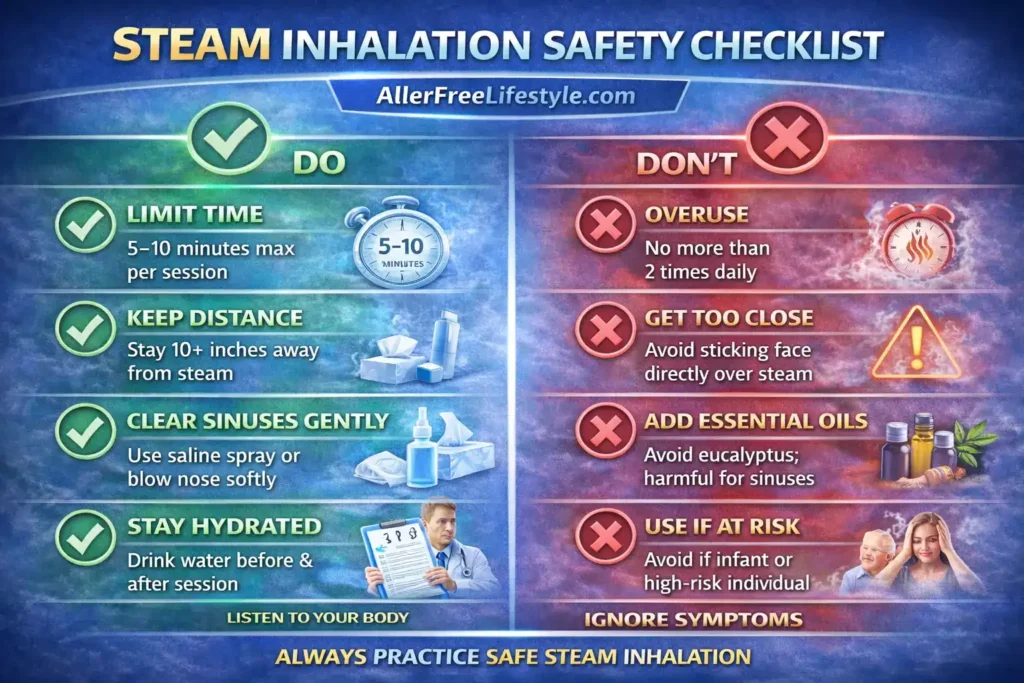
Safety Checklist
Before you start
- ✅ Choose steamy bathroom over bowl
- ✅ Remove children and pets from the area
- ✅ Sit down (especially if you’re heat-sensitive)
- ✅ Keep hot water away from edges and walkways
During
- ✅ Warm, comfortable steam only
- ✅ Normal breathing
- ✅ Stop if you cough, wheeze, burn, or feel dizzy
After
- ✅ Hydrate
- ✅ Rest for 10 minutes if you feel flushed
- ✅ Avoid going out into cold air immediately (can worsen nasal irritation)
Burns specialists explicitly advise avoiding bowls of hot water and using steamy bathrooms instead (Newcastle Hospitals NHS Foundation Trust, 2025).
Conclusion
Steam inhalation for allergy can give short-lived comfort for nasal blockage, especially when done as ambient bathroom steam, but it is not an allergy treatment and bowl methods carry real burn risk—particularly for children (Royal Devon University Healthcare NHS Foundation Trust, 2025). The safest approach is steamy bathroom steam, skip essential oils, and use proven anti-inflammatory therapy when symptoms persist (Healthify Editorial Team, 2025).
Medical Disclaimer
This content is for informational and educational purposes only and is not a substitute for professional medical advice, diagnosis, or treatment. Always consult a qualified healthcare professional before starting or changing any health-related practice, especially for children, pregnancy, or existing medical conditions.
Frequently Asked Questions (FAQs)
1) Does steam inhalation for allergy actually work?
It can provide temporary relief from nasal stuffiness by moisturizing the nasal passages and loosening thick mucus, but it does not treat the underlying allergy or inflammation.
2) What is the safest way to do steam inhalation for allergy?
The safest option is a steamy bathroom or hot shower method. Sit comfortably in the steam for 5–10 minutes. Avoid the bowl-and-towel method, especially around children.
3) How long and how often should steam inhalation be done?
Most adults can use steam for 5–10 minutes, once or twice daily during an allergy flare. Stop immediately if you feel dizziness, burning, coughing, or breathing discomfort.
4) Is steam inhalation safe for children, pregnancy, or breastfeeding?
- Infants: direct steam inhalation should be avoided.
- Children: only use ambient bathroom steam under supervision.
- Pregnancy & breastfeeding: generally safe with indirect steam; avoid adding essential oils.
5) Can steam inhalation make asthma or breathing problems worse?
Yes. In some people, warm humid air can trigger coughing or wheezing. If breathing symptoms worsen, stop steam inhalation and use safer humidity-based options instead.
References
- ealthify Editorial Team. (2025, December 8). Steam inhalation. Healthify (Health Navigator Charitable Trust). https://healthify.nz/health-a-z/s/steam-inhalation
- Royal Devon University Healthcare NHS Foundation Trust. (2025, November 18). NHS and British Burn Association issue public safety warning: steam inhalation causes burns. https://www.royaldevon.nhs.uk/news/nhs-and-british-burn-association-issue-public-safety-warning-steam-inhalation-causes-burns/
- Newcastle Hospitals NHS Foundation Trust. (2025, November 25). Burns specialists issue public safety warning about the risks of steam inhalation. https://www.newcastle-hospitals.nhs.uk/news/burns-warning-risks-of-steam-inhalation/
- Dearden, A. S., North, A. S., & Varma, S. (2022). Severe scalds sustained during steam inhalation therapy in an adult population: Analysis of patient outcomes and the financial burden to healthcare services. Journal of Plastic, Reconstructive & Aesthetic Surgery, 75(7), 2427–2429.
DOI: https://doi.org/10.1016/j.jpra.2021.12.004 - Ichiba, T., Kakiuchi, K., Uchiyama, M., & colleagues. (2019). Warm steam inhalation before bedtime improved sleep quality in adult men. Sleep Disorders, 2019, 2453483.
DOI: https://doi.org/10.1155/2019/2453483 - Kim, J., Hwang, J., Chung, K., Jin, Y., & Jee, Y.-S. (2025). A randomized controlled trial investigating the effect of thermal steam spray on nasal condition, neurological function, and sleep quality in young adults with nasal congestion and irregular sleep patterns (Preprint, under review). Research Square.
DOI: https://doi.org/10.21203/rs.3.rs-7253632/v1