

How to Stop Nasal Spray Rebound Congestion (Rhinitis Medicamentosa)
Written by: Dr.Muhammad Ihsan Ullah, PhD
Medically reviewed by: Dr Ali Raza Dogar ,MBBS, ENT
Last updated on August 22, 2026
When a decongestant nasal spray becomes the only thing that seems to open your nose, stopping it can feel worse before it feels better. That cycle is typical of rhinitis medicamentosa, or rebound congestion, and recovery is usually possible once the overused topical decongestant is withdrawn.
Quick Answer:
The way out of nasal spray rebound congestion is to stop the offending vasoconstrictor spray—commonly oxymetazoline (Afrin) or xylometazoline—while using appropriate non-rebound support when needed. There is no single evidence-based withdrawal schedule for everyone, so prolonged or heavy use is best managed with a clinician-guided plan rather than repeated stop-start attempts.
Should You Stop Afrin Cold Turkey or Taper It?
Both abrupt withdrawal and gradual reduction are used in practice, but current evidence does not establish one method as universally best. Recent clinical reviews emphasize stopping the offending medication while controlling residual congestion with alternatives such as intranasal corticosteroids or saline irrigation (1).
For people who have used Afrin repeatedly for weeks or months, sudden withdrawal can make nasal blockage feel intolerable and trigger immediate reuse. A structured taper may therefore be easier to complete.
The goal, however, is complete discontinuation—not indefinite tapering. There is no validated “Afrin taper schedule” that fits every patient.
How Do You Wean Off Afrin One Nostril at a Time?
The one-nostril method is a practical tapering strategy sometimes used when stopping both sides at once feels unmanageable. The decongestant is withdrawn from one nostril first; after that side begins to recover, the remaining spray is stopped.
This method may make withdrawal more tolerable, but it has not been proven superior to other approaches. A 2025 systematic review found substantial variation in rhinitis medicamentosa treatment and concluded that no standardized treatment algorithm has yet been established (2).
Long-term daily users or people unable to reduce oxymetazoline should consider clinician or ENT supervision rather than repeatedly changing the spray schedule themselves.
Can Flonase Help With Rebound Congestion?
Intranasal corticosteroids such as fluticasone (Flonase) may help during withdrawal. Unlike oxymetazoline, they do not work by rapidly constricting nasal blood vessels.
The 2025 systematic review found that intranasal corticosteroids, including budesonide and fluticasone, were the most frequently studied conservative treatments, although the evidence remains limited and heterogeneous (2).
Flonase should therefore be viewed as supportive treatment, not an instant substitute for Afrin or a guaranteed rapid cure. Correct spray technique and consistent use matter, and individual medical factors may affect whether a steroid spray is appropriate.
What Can You Use While Coming Off Afrin?
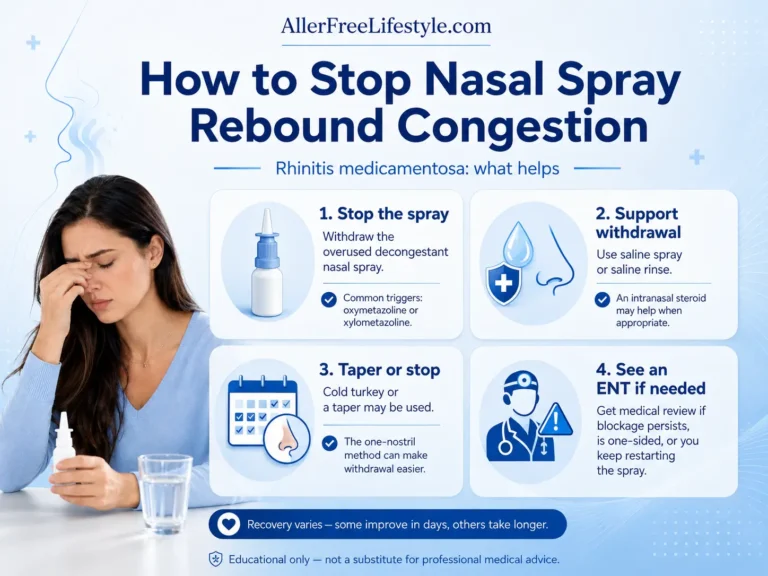
Supportive treatment should make withdrawal easier without restarting the vasoconstrictor cycle. Depending on the patient, options may include:
- Saline nasal spray
- Saline irrigation
- An intranasal corticosteroid when appropriate
- Treatment for underlying allergic or nonallergic rhinitis
- Assessment for structural nasal obstruction if blockage persists
Saline does not cause rhinitis medicamentosa and can moisturize the nasal lining during withdrawal.
Oral decongestants are not automatically a safe substitute. Medicines such as pseudoephedrine can affect heart rate or blood pressure and are unsuitable for some people.
Current reviews continue to describe decongestant withdrawal plus non-rebound supportive therapy as the core management approach (1).a
How Long Does Rebound Congestion Last After Stopping Afrin?
There is no exact Afrin withdrawal timeline. Some people begin to breathe more easily within several days, while established nasal mucosal swelling can take longer to settle.
Recovery varies with:
- duration and frequency of decongestant use;
- degree of turbinate swelling;
- individual nasal anatomy;
- presence of underlying rhinitis;
- structural nasal problems.
Feeling better and complete tissue recovery are also not the same thing. Nasal airflow may improve before the nasal mucosa fully normalizes.
This uncertainty matters because the evidence around rhinitis medicamentosa is more nuanced than a fixed “three-day” or “seven-day” rule suggests. A 2026 evidence review found that short-term use at recommended dosing is not equivalent to prolonged or excessive use, reinforcing the need to interpret rebound risk in context (3).
When Should You See an ENT for Rebound Congestion?
Seek medical assessment if you:
- repeatedly restart Afrin because you cannot breathe without it;
- have used a topical decongestant daily for a prolonged period;
- remain significantly blocked after withdrawal;
- have persistent one-sided obstruction;
- experience frequent nosebleeds or significant nasal pain;
- may have a deviated septum, polyps, chronic sinus disease, or enlarged turbinates.
Surgery is not first-line treatment for routine rebound congestion. However, current reviews recognize a role for nasal airway or turbinate procedures in selected patients with persistent obstruction or treatment-resistant rhinitis medicamentosa (1,2).
Medical Disclaimer
This article is for educational purposes only and is not a substitute for professional medical advice, diagnosis, or treatment. If rebound congestion is severe, persistent, or difficult to manage, consult a qualified healthcare professional or ENT specialist.
Frequently Asked Questions(FAQs)
1. Does Rebound Congestion Mean I Am Addicted to Afrin?
Not necessarily. Rhinitis medicamentosa is primarily a medication-induced rebound cycle rather than a classic substance-use disorder, although people may become behaviorally dependent on the rapid relief.
2. Can I Switch to Another Decongestant Nasal Spray?
Usually not as a solution. Switching to another topical vasoconstrictor such as xylometazoline may continue the same rebound cycle.
3. Is Saline Spray Safe During Afrin Withdrawal?
Saline sprays and rinses do not cause vasoconstrictor rebound and can help moisturize the nasal lining during withdrawal.
4. What if I Still Cannot Breathe After Stopping Afrin?
Persistent blockage may reflect unresolved rhinitis or a structural problem. An ENT can assess the turbinates, septum, sinuses, and other possible causes.
References
- Zheng YJ, Lin SY, Takashima M, Ahmed OG. Drug-Induced Rhinitis and Rhinitis Medicamentosa. Current Otorhinolaryngology Reports.2025;13(1):3. doi:10.1007/s40136-025-00520-0.
- Yang X, Eremeeva K, Svistushkin V, et al. Variants of rhinitis medicamentosa treatment: a systematic review. European Archives of Oto-Rhino-Laryngology.2025;282:4407–4416. doi:10.1007/s00405-025-09344-6.
- Hagen M, Varbiro G, Montanari E, Ballerini Fernandes M. Revisiting Rhinitis Medicamentosa: Examining the Evidence on Topical Nasal Decongestants. Journal of Pharmacy Practice.2026;39(2):117–139. doi:10.1177/08971900251350510.