

My Allergy Medicine Stopped Working: Is It Tolerance or Something Else?
Written by: Dr. Muhammad Ihsan Ullah, PhD (Pharmacologist)
Medically reviewed by: Dr. Ali Raza Dogar, MBBS, D-LO (ENT Specialist)
Medication review by: Dr. Asma Fareed Khan, PhD (Clinical Pharmacy)
Last updated on July 12, 2026
You take the same allergy pill that helped last season, expecting the sneezing to settle and your nose to open. Instead, you remain completely blocked, your eyes still itch, or the relief lasts only a few hours.
Naturally, you begin wondering:
- Has my body become immune to my antihistamine?
- Why did Zyrtec suddenly stop working?
- Is Claritin too weak for my symptoms?
- Why does Allegra do nothing anymore?
- Should I switch medicines, combine two allergy pills or double the dose?
- What can I do when over-the-counter allergy medicine does nothing?
The frustrating truth is that an allergy medicine can appear to stop working for many reasons. True medication tolerance is only one possible explanation—and often not the most likely one.
A heavier pollen season, poor medication timing, missed doses, incorrect nasal-spray technique, a treatment that does not match your main symptom, rebound congestion or an entirely different type of rhinitis can all make a previously helpful medicine seem useless.
Quick answer: Why is my allergy medicine not working anymore?
Your allergy medicine may appear to have stopped working because your allergen exposure has increased, the medication does not adequately treat nasal congestion, doses are being missed, the timing is inconsistent or another product is interfering with treatment. You may also have rebound congestion from a decongestant spray, nonallergic rhinitis, chronic sinus inflammation or a structural nasal blockage.
Clinically meaningful tolerance to modern second-generation antihistamines has not been consistently demonstrated. A published review reported that tachyphylaxis, tolerance and rebound had not generally been observed with this medication class.[1]
That does not mean every antihistamine will continue providing perfect relief forever. It means you should not assume that your body has become immune to the medicine before checking more common explanations.
Do not automatically double the dose or combine two oral antihistamines when one stops helping. First determine which symptom remains uncontrolled and why.
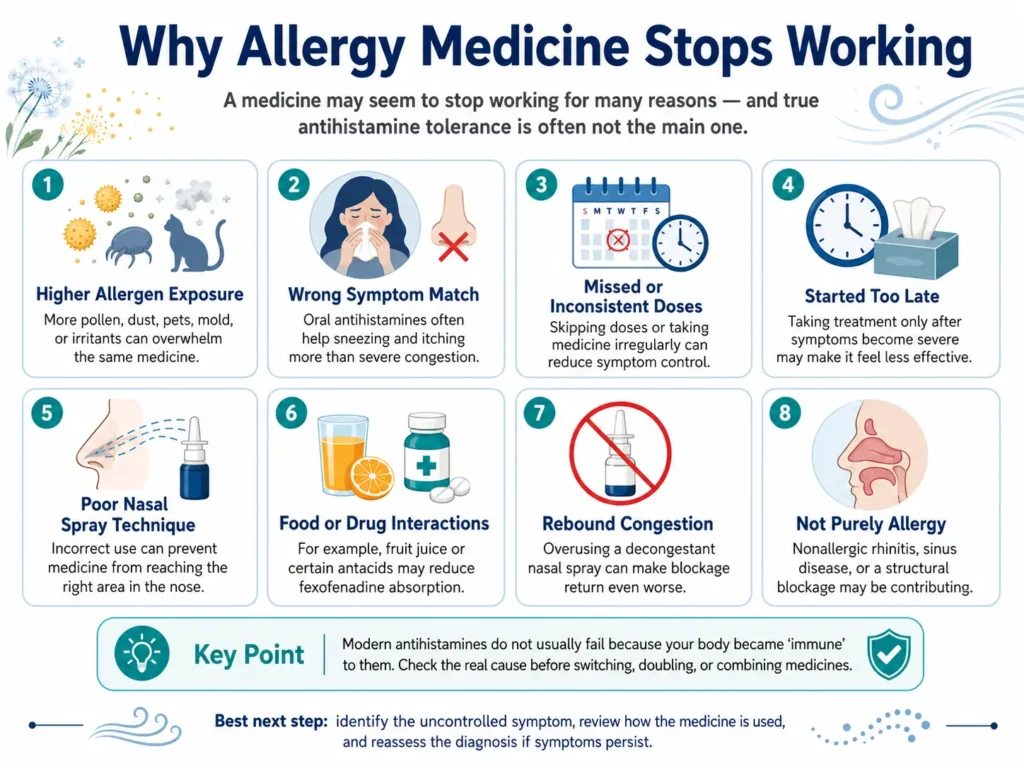
Allergy medicine failure: A quick symptom checker
What you are experiencing | What may be happening |
You are still sneezing and itching | Heavy allergen exposure, missed doses, poor timing or an irritant trigger |
Your nose remains completely blocked | An oral antihistamine may not adequately control nasal swelling |
Allegra seems to have stopped working | Incorrect administration, inconsistent use or an interaction may be reducing its effect |
A nasal spray works briefly, but the blockage returns worse | Possible rebound congestion from a topical decongestant |
Symptoms flare around perfume, smoke or cold air | Nonallergic or mixed rhinitis may be contributing |
One nostril remains blocked | A deviated septum, turbinate enlargement, polyp or another obstruction may be present |
Symptoms are worst in bed or early morning | Dust mites, positional congestion or uncontrolled nighttime rhinitis may contribute |
A “non-drowsy” pill makes you tired | Some second-generation antihistamines can still cause sedation |
You wake up snoring or gasping | Nasal obstruction or sleep-disordered breathing requires assessment |
You have fever, severe facial pain or thick discharge | An infection or another sinus condition may need consideration |
This table cannot diagnose the cause, but it can show why repeatedly changing allergy-pill brands is not always the right answer.
Can your body become immune to antihistamines?
Your immune system does not become immune to an antihistamine in the same way that bacteria become resistant to an antibiotic.
Patients often use the words “immunity,” “resistance” and “tolerance” interchangeably, but they do not mean exactly the same thing.
What is antihistamine tolerance?
Drug tolerance means that repeated use produces a smaller response, making it seem as though a larger dose is required to achieve the original effect.
Tachyphylaxis refers to a relatively rapid reduction in response after repeated exposure to a medication.
Treatment failure simply means that symptoms remain inadequately controlled. It does not explain why the medicine is failing.
You can experience treatment failure without developing pharmacological tolerance.
For example, your antihistamine may still block histamine receptors, but your pollen exposure may now be much higher. Alternatively, your sneezing may have improved while nasal swelling has become the dominant symptom.
In either case, the medicine may still be producing an effect even though you no longer feel adequately controlled.
Is antihistamine tolerance real?
Patients frequently report that cetirizine, loratadine or fexofenadine seemed effective initially but became less helpful over time.
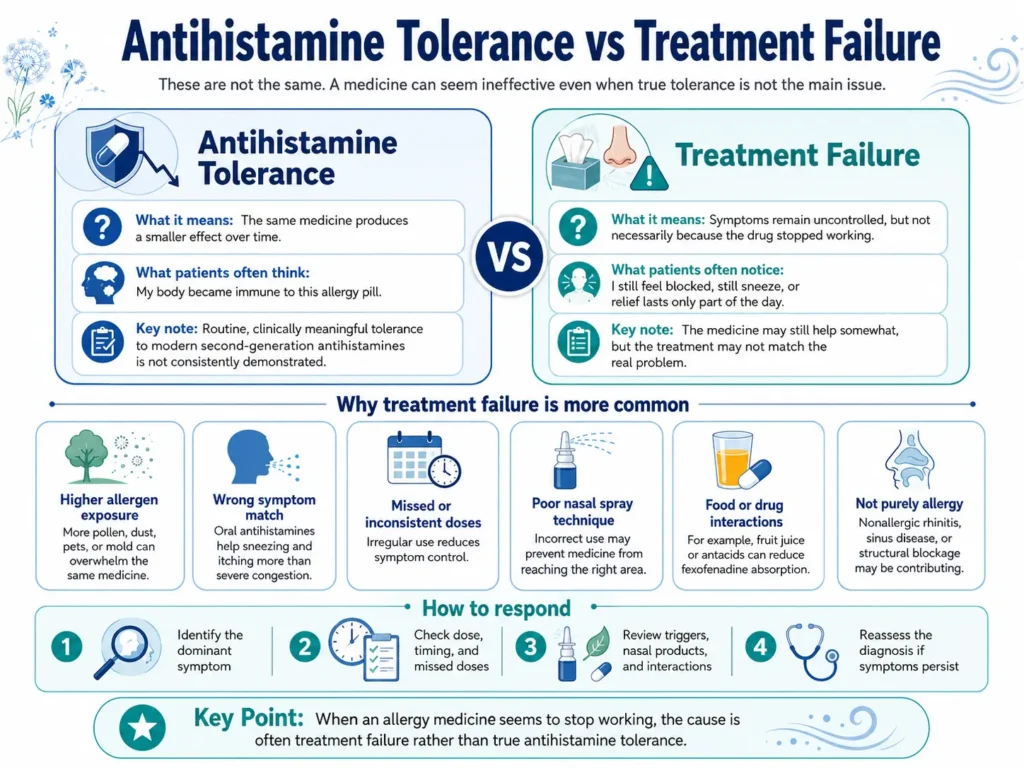
Their experience should not be dismissed. However, a perceived loss of effectiveness does not prove that the body has developed tolerance.
A review of second-generation oral antihistamines reported that tolerance, tachyphylaxis and rebound had not generally been observed with these medicines.[1]
The more likely explanations often include:
- Increased allergen exposure
- Irregular medication use
- Incorrect expectations
- A change in the dominant symptom
- Poor absorption or administration
- A nonallergic trigger
- Rebound congestion
- A structural nasal problem
- A respiratory infection
- Progression or poor control of the underlying rhinitis
The practical conclusion is not that tolerance is impossible. It is that tolerance should not be blamed until these other possibilities have been reviewed.
Can you become immune to cetirizine?
There is no strong evidence that most patients routinely become immune to cetirizine.
Cetirizine may nevertheless feel less effective when:
- Pollen or dust exposure increases
- Nasal obstruction becomes more severe
- Doses are missed
- Treatment is started only after symptoms become intense
- The patient develops mixed allergic and nonallergic rhinitis
- A structural problem contributes to blockage
- The main problem is no longer histamine-driven
Cetirizine may continue reducing itching or sneezing while leaving significant congestion untreated.
Can you become immune to fexofenadine?
Routine immunity to fexofenadine has not been established either.
When fexofenadine appears to stop working, review:
- How consistently it is being taken
- What it is being taken with
- Whether the dominant symptom is congestion
- Whether allergen exposure has intensified
- Whether another product or antacid is being used
- Whether the symptoms remain consistent with allergy
Do not assume that switching to a stronger-sounding brand will solve a problem caused by poor administration or incorrect diagnosis.
Can you become immune to loratadine?
Loratadine may not provide equally strong subjective relief for every person. Individual responses to different second-generation antihistamines vary.
However, a poor response does not automatically indicate immunity. The medicine may simply be insufficient for the severity or type of symptoms being experienced.
How do you reverse antihistamine tolerance?
There is no established universal method for “resetting” antihistamine receptors at home.
Online recommendations may suggest:
- Stopping antihistamines for several days
- Rotating brands every few months
- Taking two antihistamines together
- Doubling the dose
- Using an older sedating antihistamine
- Alternating medicines every morning and evening
These approaches should not be treated as general solutions.
A safer and more useful response is to review:
- The exact active ingredient
- The dose and timing
- The symptom you are trying to control
- Missed doses
- Allergen exposure
- Other medicines and nasal products
- Nasal-spray technique
- Possible rebound congestion
- Whether the diagnosis remains correct
If symptoms remain uncontrolled after correct use, the treatment plan and diagnosis need reassessment.
Why did my allergy medicine suddenly stop working?
A sudden decline in symptom control can feel alarming, but the cause may be practical and correctable.
The following are the most important explanations.
1. Your allergen exposure has increased
An antihistamine that controls mild exposure may feel ineffective during an intense pollen season or after a major change in your environment.
Your medicine may not have changed, but your exposure has.
Possible changes include:
- Entering peak tree, grass or ragweed season
- Spending more time outdoors
- Opening windows during high-pollen periods
- Beginning outdoor exercise
- Moving to a new home
- Sleeping in a different bedroom
- Starting work in a dusty building
- Bringing a pet into the home
- Discovering dampness or mould
- Turning on a fan or heating system
- Cleaning a heavily contaminated room
- Travelling to a region with a different pollen calendar
Think of it like using the same umbrella during a much heavier storm. The umbrella has not necessarily stopped functioning; it is being overwhelmed by a greater exposure.
How can you tell whether exposure is the problem?
Track where and when symptoms become worse.
Ask:
- Are symptoms worse at home, work or outdoors?
- Did they worsen after moving?
- Do they improve when you leave your bedroom?
- Are mornings worse than evenings?
- Are symptoms strongest after gardening or exercise?
- Do they flare after cleaning?
- Did they worsen when a pet entered the room?
- Are pollen counts currently high?
A seven-day symptom diary may reveal more than another random medication switch.
For detailed environmental control, read our guides on when pollen season occurs, how to control dust mites in the bedroom and how to make your home allergy-friendly.
2. Your medicine does not match your main symptom
This is one of the most common reasons people believe an antihistamine has stopped working.
Oral antihistamines are usually more helpful for symptoms such as:
- Sneezing
- Nasal itching
- Watery nasal discharge
- Itchy eyes
- Watery eyes
They may be less effective when the dominant symptom is severe, persistent nasal obstruction.
Allergic rhinitis involves more than histamine. Nasal blockage can result from broader inflammation, swollen blood vessels and enlargement of the nasal tissues.
A systematic review comparing intranasal and oral treatments found that intranasal treatments were generally more effective for improving nasal symptoms and quality of life in seasonal allergic rhinitis.[2]
This does not mean every blocked nose should be self-treated with a steroid spray. Product choice depends on age, medical history, symptom severity, technique and individual risk.
It means that an oral antihistamine should not automatically be labelled ineffective simply because it fails to fully open a severely blocked nose.
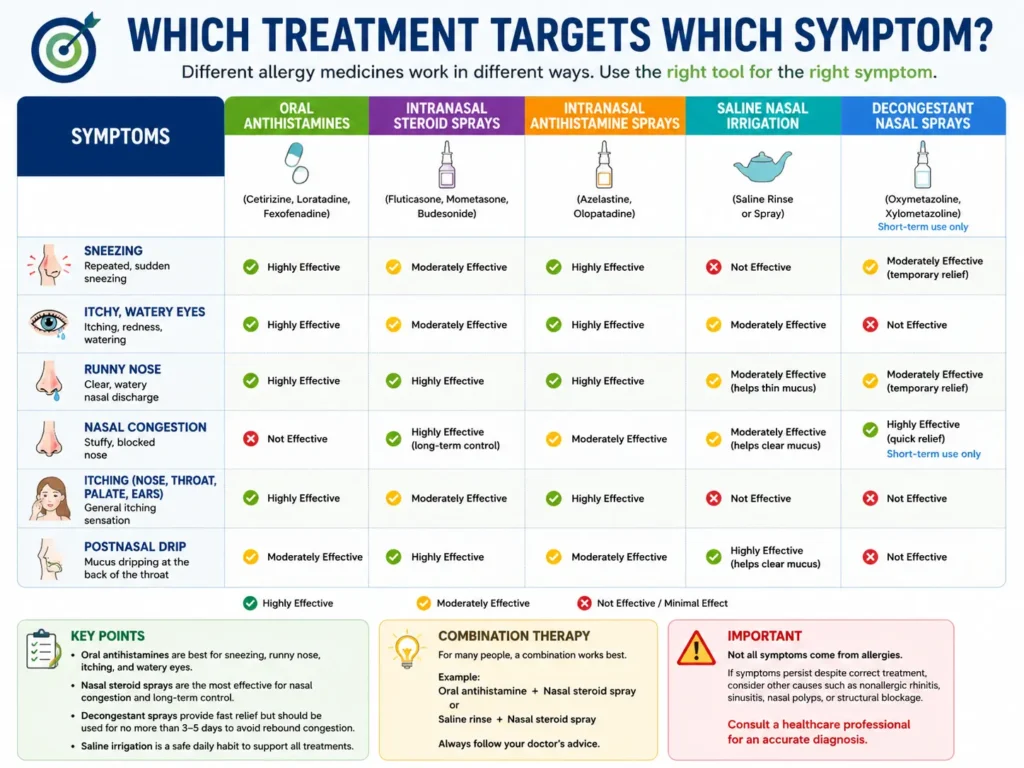
Read our detailed comparison of nasal sprays versus antihistamines for congestion for a complete explanation.
3. You expect one medicine to eliminate every symptom
No allergy medicine guarantees complete control of every symptom.
An antihistamine may reduce:
- Itching
- Sneezing frequency
- Watery eyes
- Nasal discharge
At the same time, you may remain dissatisfied because:
- Congestion persists
- Post-nasal drip continues
- Sleep remains disrupted
- Head pressure is still present
- Mouth breathing continues
Because the remaining symptom is distressing, you may overlook improvements elsewhere.
Ask yourself:
- Am I sneezing less often?
- Are my eyes less itchy?
- Has the discharge decreased?
- Has my worst symptom changed?
- Does the medicine help during mild exposure but fail during intense exposure?
- Does relief occur for part of the day?
Incomplete relief is not the same as no pharmacological effect.
4. You are taking the medicine inconsistently
Many patients unintentionally use allergy medication irregularly.
Common patterns include:
- Missing doses on busy days
- Taking the medicine at different times
- Stopping as soon as symptoms improve
- Restarting only when symptoms become severe
- Forgetting whether a dose was already taken
- Switching brands without checking the active ingredient
- Misunderstanding once-daily instructions
- Taking a child’s liquid formulation without checking its concentration
When asked, a patient may say, “I take it every day,” but further discussion reveals that this means most days or only on days with severe symptoms.
Do not identify a medicine only by its package colour or brand.
Record:
- The active ingredient
- The strength
- The formulation
- The time taken
- The number of doses
- Any missed doses
A store-brand product may contain the same active ingredient as the branded medicine you believe you are switching away from.
5. You are starting treatment after symptoms become severe
Medication timing can influence perceived effectiveness.
Some people wait until they are:
- Sneezing continuously
- Completely blocked
- Unable to sleep
- Experiencing severe eye symptoms
They then expect one tablet to reverse intense inflammation immediately.
Treatment plans differ, but medicines generally work more predictably when used according to the product instructions and the clinician’s plan rather than taken randomly after symptoms become unbearable.
A medicine should not be declared ineffective after one poorly timed dose during extreme exposure.
6. You are judging a nasal spray too quickly
Oral antihistamines and nasal corticosteroids do not work in exactly the same way.
Some symptoms may improve relatively quickly with an oral antihistamine. A nasal corticosteroid usually depends more heavily on:
- Regular use
- Correct technique
- Correct dosing
- Consistency
- Allowing sufficient time to evaluate the response
Taking one spray, waiting 20 minutes and declaring that it failed is not a fair test.
At the same time, patients should not continue a treatment indefinitely without reassessment if it is producing no meaningful benefit.
Follow the product instructions and discuss persistent symptoms with a clinician or pharmacist.
7. Your nasal-spray technique is incorrect
A properly selected nasal spray can fail when the medicine:
- Lands mainly on the nasal septum
- Immediately drips from the nostril
- Runs straight into the throat
- Is sprayed into a blocked passage without preparation
- Is not primed correctly
- Is used inconsistently
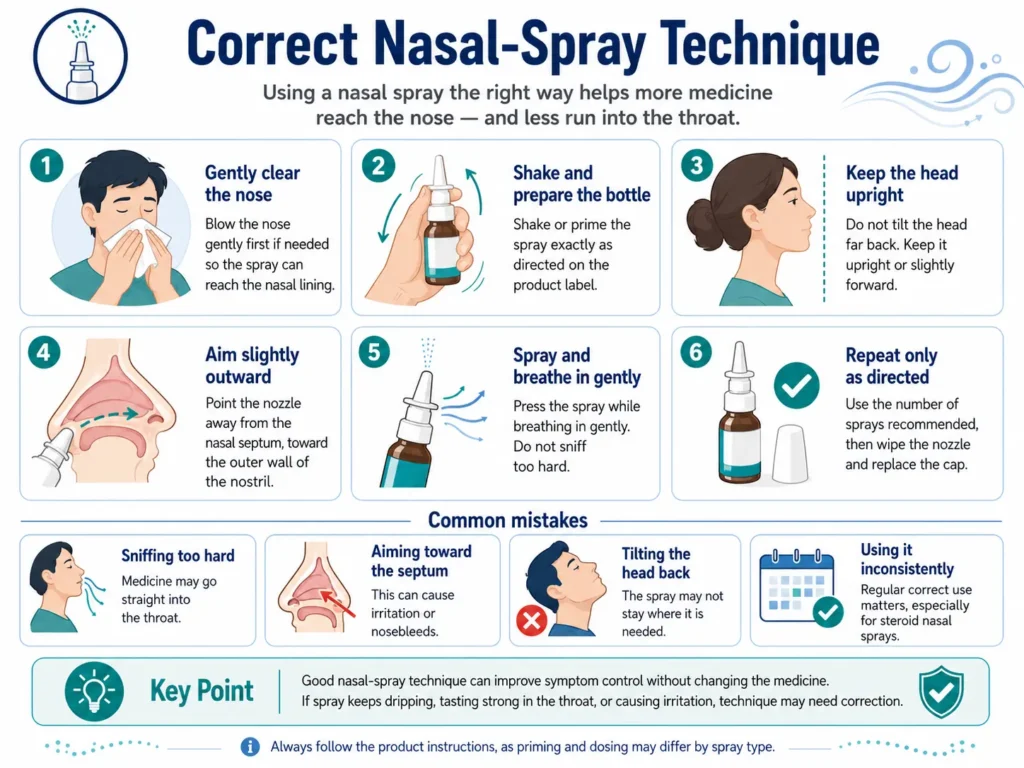
A practical general technique is:
- Gently clear the nose if necessary.
- Shake or prepare the bottle according to its instructions.
- Keep your head upright or slightly forward.
- Insert the nozzle only as directed.
- Aim slightly outward, away from the nasal septum.
- Spray while breathing in gently.
- Avoid sniffing so hard that the medicine immediately enters the throat.
- Clean the nozzle according to the product instructions.
Different products may have different priming and positioning requirements. Always check the leaflet.
Signs of poor technique can include:
- Medicine dripping from the nose
- A strong taste in the throat
- Irritation at the nasal septum
- Recurrent minor bleeding
- Inconsistent symptom control
Ask a pharmacist or clinician to observe your technique. A one-minute correction may be more useful than months of switching products.
8. Food or another product may be interfering
When fexofenadine appears ineffective, review what you are taking it with.
Product instructions commonly advise taking fexofenadine with water rather than fruit juice. Certain fruit juices can reduce the amount absorbed from the intestine, potentially weakening its effect.
Aluminum- or magnesium-containing antacids can also interfere when taken too close to fexofenadine.
Practical steps include:
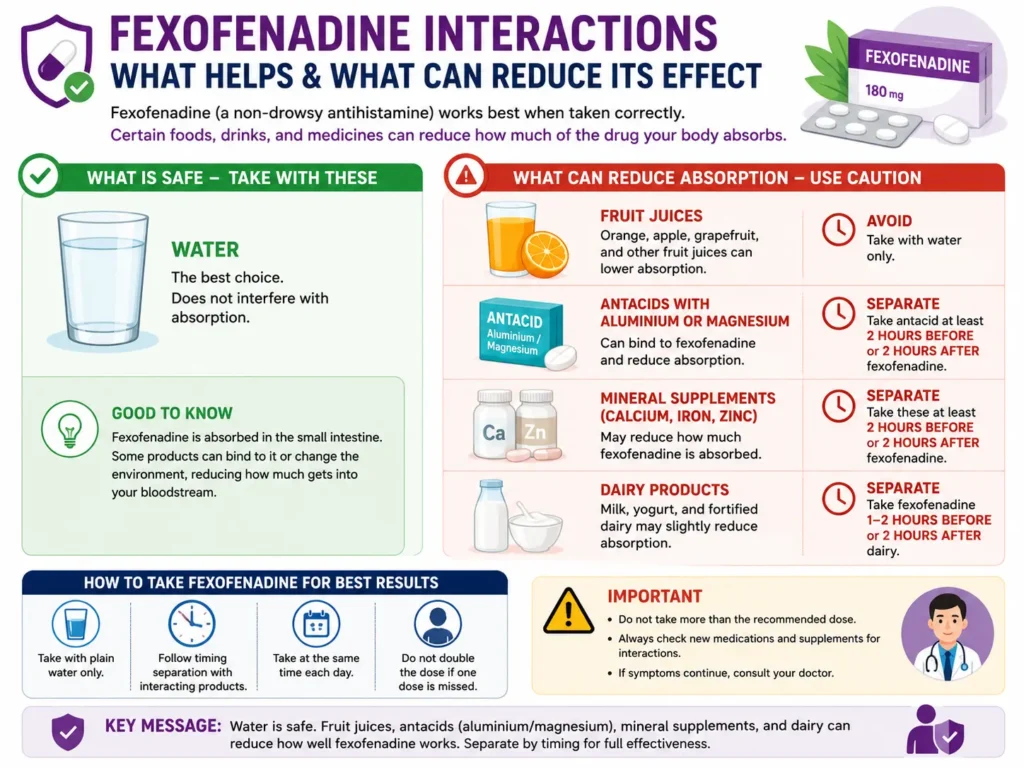
- Take fexofenadine with water.
- Check the product leaflet.
- Review antacid ingredients.
- Ask a pharmacist about spacing.
- List all prescription medicines, OTC products and supplements.
Do not assume that every antihistamine shares the same food interaction.
Why do grapefruit, orange and apple juice affect fexofenadine?
Certain fruit juices can interfere with intestinal transport systems involved in fexofenadine absorption.
This interaction is different from the well-known grapefruit interactions that increase the concentrations of some other medicines. In the case of fexofenadine, the concern is reduced absorption and weaker exposure to the medication.
This may explain why someone who previously swallowed the tablet with water notices poorer relief after beginning to take it with breakfast juice or a fruit smoothie.
Does coffee stop antihistamines from working?
Coffee is not known as a general antidote to antihistamine failure.
It does not correct:
- Severe nasal inflammation
- Poor medication absorption
- Rebound congestion
- A missed dose
- Incorrect diagnosis
- Inadequate treatment selection
Caffeine may temporarily make you feel more alert, but it should not be used to cancel medication-related drowsiness.
In susceptible people, caffeine may contribute to:
- Jitteriness
- Palpitations
- Anxiety-like symptoms
- Poor sleep
- Increased awareness of physical symptoms
Also check whether you are using an “allergy and congestion” combination product containing a decongestant. Combining a stimulating decongestant with large amounts of caffeine can feel unpleasant for some patients.
9. A decongestant spray is causing rebound congestion
A topical nasal decongestant may open the nose dramatically at first.
You spray it, the swelling decreases and you can finally breathe. Several hours later, however, the blockage returns. You spray again. Gradually, the relief becomes shorter and the congestion between doses becomes worse.
This pattern may indicate rebound congestion, also called rhinitis medicamentosa.
A critical review of nasal decongestant use describes rebound congestion and rhinitis medicamentosa as recognized consequences associated particularly with prolonged or inappropriate use of topical nasal decongestants.[3]
“I am addicted to nasal spray and cannot breathe without it”
Patients often describe the experience as nasal-spray addiction:
- “I panic when the bottle is empty.”
- “I cannot sleep without it.”
- “My nose closes completely when I stop.”
- “I wake up to use it.”
- “It only works for a few hours now.”
The experience can feel like dependence, but rhinitis medicamentosa is primarily a medication-induced nasal condition. It should not automatically be labelled a psychological addiction.
The important distinction is that topical decongestant sprays are not the same as:
- Saline sprays
- Intranasal corticosteroids
- Intranasal antihistamines
Do not stop every nasal product simply because one type can cause rebound.
Why is my nose completely blocked after using a decongestant spray for a week?
Repeated use can create a cycle in which temporary narrowing of nasal blood vessels is followed by renewed or worsened swelling as the effect wears off.
The exact risk depends on:
- The active ingredient
- Frequency of use
- Dose
- Duration
- The underlying nasal condition
- Individual susceptibility
This is why maximum-use directions on the label matter.
How long does rebound congestion take to improve?
Recovery varies.
Some people improve relatively quickly after stopping the offending spray. Others, especially those who have used it frequently or for a prolonged period, may experience significant obstruction during withdrawal.
Do not promise yourself that the nose will recover within an exact number of hours.
Medical support may be useful when:
- The spray has been used for a long time
- You cannot sleep without it
- You have severe obstruction
- You repeatedly restart it
- You experience bleeding
- You have other nasal disease
- You have cardiovascular conditions
- You are pregnant
- You are using several nasal products
The underlying reason the decongestant was started must also be treated. Otherwise, stopping it removes the rebound trigger but leaves the original congestion unresolved.
10. Your symptoms may not be entirely allergic
Antihistamines work poorly when the dominant problem is not caused by histamine-mediated allergy.
What is non allergic rhinitis?
Nonallergic rhinitis can cause:
- Nasal blockage
- Runny nose
- Post-nasal drainage
- Sneezing
- Nasal irritation
Common triggers include:
- Perfume
- Cleaning chemicals
- Tobacco smoke
- Air pollution
- Cold air
- Weather changes
- Spicy food
- Exercise
- Hormonal changes
- Certain medications
A person may react strongly to perfume or cold air but obtain little benefit from an oral antihistamine because the reaction is not primarily driven by an allergen-specific histamine response.
What is mixed rhinitis?
Mixed rhinitis means that allergic and nonallergic triggers occur together.
For example, a patient may have confirmed pollen allergy but also react to:
- Smoke
- Fragrance
- Air-conditioning
- Temperature changes
- Cleaning sprays
The antihistamine may improve the pollen-related sneezing and itching while doing little for irritant-triggered blockage.
Clues that symptoms may not be entirely allergic include:
- Little or no itching
- Strong reactions to perfume or smoke
- Immediate nasal drainage after spicy food
- Flares during temperature changes
- Year-round symptoms without a clear allergen pattern
- Limited benefit from correctly used antihistamines
Read our guides on cold air rhinitis and how hormonal changes affect allergy symptoms for a deeper explanation.
11. Another nasal condition is contributing
Persistent obstruction may result from a condition that an oral antihistamine cannot correct.
Possibilities include:
- Deviated nasal septum
- Enlarged turbinates
- Nasal polyps
- Chronic rhinosinusitis
- Adenoidal enlargement in children
- Medication-induced rhinitis
- Another local obstruction
Seek assessment when you have:
- Persistent blockage on the same side
- Recurrent nosebleeds
- Progressive loss of smell
- Severe facial pain
- Visible facial swelling
- Symptoms following trauma
- Obstruction that does not change with allergen exposure
- No meaningful response to correctly used treatment
Do not assume that every blocked nose is caused by allergy.
12. The “24-hour” effect is being misunderstood
A medicine labelled for once-daily use may continue acting in the body even when you experience breakthrough symptoms.
“Works for 24 hours” does not guarantee complete symptom freedom during every hour and under every exposure condition.
Symptoms may break through because:
- Pollen exposure becomes intense
- You enter a dusty environment
- Bedroom allergens worsen symptoms overnight
- Morning exposure is particularly heavy
- The tablet controls itching but not severe congestion
- The dose was taken later than usual
- Another trigger appears during the day
Do not shorten the dosing interval or add an extra dose without checking the label or obtaining professional advice.
Why is my nose still blocked after taking Zyrtec?
Zyrtec contains cetirizine, a second-generation antihistamine.
Cetirizine can help reduce allergic symptoms such as:
- Sneezing
- Nasal itching
- Watery nasal discharge
- Itchy or watery eyes
However, it may not fully control severe nasal obstruction.
A blocked nose after taking Zyrtec does not automatically mean that your body has become immune to cetirizine.
Consider whether:
- Sneezing improved despite continued blockage
- Nasal itching improved
- The congestion is mainly on one side
- You are overusing a decongestant spray
- The exposure has increased
- Symptoms occur around irritants
- You have facial pain or loss of smell
- Another nasal condition is present
Intranasal treatment is generally more effective than oral treatment for nasal symptoms overall, particularly when blockage is dominant.[2]
Read Is Nasal Spray Better Than Antihistamine for Congestion? for a complete comparison.
Can antihistamines make nasal congestion worse?
Second-generation oral antihistamines do not usually cause rebound congestion.
Rebound congestion is mainly associated with overuse of topical decongestant nasal sprays.[3]
However, an oral antihistamine may appear to worsen congestion when:
- It reduces watery drainage but leaves swelling unchanged
- Nasal dryness makes breathing feel uncomfortable
- Allergen exposure continues to increase
- Severe underlying inflammation remains untreated
- The patient expects the tablet to work like a decongestant spray
The congestion may therefore feel more noticeable without being directly caused by the antihistamine.
Why do allergy pills not stop a stuffy nose?
Allergy pills mainly target histamine-mediated symptoms.
Severe congestion involves multiple inflammatory processes and substantial swelling of the nasal tissues. Blocking histamine alone may therefore be insufficient.
This explains why someone can experience:
- Less sneezing
- Less itching
- Fewer watery eyes
while remaining significantly blocked.
A treatment that is useful for one symptom should not automatically be expected to control every component of allergic rhinitis.
What is the best way to clear a blocked nose when Claritin fails?
First identify why the nose is blocked.
Check for:
- Severe allergic inflammation
- Decongestant-spray rebound
- Nonallergic triggers
- A viral infection
- Chronic sinus inflammation
- Nasal polyps
- A deviated septum
- Incorrect spray technique
Safe supportive measures may include saline nasal irrigation or saline spray when appropriate and prepared according to safe-use instructions.
Do not respond by repeatedly increasing loratadine or adding several oral antihistamines.
Read our detailed guides on how to clear nasal and sinus congestion and the best types of nasal spray for allergic rhinitis.
Does cetirizine help with sinus pressure?
Cetirizine may reduce a sensation of pressure when allergic nasal inflammation contributes to the problem.
However, “sinus pressure” describes a symptom, not a diagnosis.
Similar discomfort can occur with:
- Viral infection
- Chronic rhinosinusitis
- Migraine
- Dental disease
- Temporomandibular problems
- Structural nasal obstruction
Seek assessment when the pressure is:
- Severe
- One-sided
- Associated with fever
- Accompanied by visual symptoms
- Associated with swelling
- Persistent despite appropriate treatment
Read Can Allergies Cause a Sinus Infection? for help distinguishing common patterns.
Why am I still sneezing after taking an allergy pill?
Continued sneezing can result from:
- Heavy allergen exposure
- A missed dose
- Inconsistent timing
- Starting treatment too late
- An irritant trigger
- A respiratory infection
- Incorrect diagnosis
- Incomplete treatment response
Ask yourself:
- Did the sneezing begin before the dose?
- Was the medicine taken consistently?
- Is the product expired?
- Is the active ingredient correct?
- Did you enter a dusty or high-pollen environment?
- Does sneezing occur around perfume or smoke?
- Are you using fexofenadine correctly?
- Could you have a cold?
Do not take repeated extra doses simply to stop one acute sneezing episode.
Where practical:
- Leave the triggering environment
- Wash your face
- Change pollen-covered clothing
- Keep windows closed during heavy exposure
- Follow your established treatment plan
Why does my allergy medicine work for only a few hours?
Perceived short duration does not always mean the medicine has left your body.
Breakthrough symptoms can occur because:
- Exposure becomes much heavier
- The medicine does not control congestion
- The dose was taken late
- Doses are inconsistent
- Bedroom triggers become stronger at night
- The diagnosis is not purely allergic
- Another nasal condition contributes
Track the exact timing:
- When was the dose taken?
- When did relief begin?
- Which symptom improved?
- Which symptom returned first?
- What exposure occurred before the symptoms returned?
This can help distinguish true short-lived relief from symptom-specific failure.
Should I switch from loratadine to cetirizine?
Switching may be reasonable when a correctly used medicine provides insufficient relief or causes unacceptable adverse effects.
Individual responses vary.
Some patients perceive stronger relief with cetirizine, but it can cause drowsiness in susceptible people. Loratadine may feel less sedating for some users but may also seem less effective depending on the symptom pattern.
Before switching, check:
- Is congestion the main complaint?
- Is the current medicine being used correctly?
- Have doses been missed?
- Has exposure increased?
- Is a decongestant spray being overused?
- Are symptoms actually allergic?
- Would a nasal-focused treatment be more appropriate?
Read Claritin vs Zyrtec vs Allegra: Which Works Best? for a full comparison.
Do you need to switch allergy pills every year?
No. There is no general requirement to rotate antihistamines every year.
Routine switching is not proven to prevent tolerance.
Switching may help when:
- One medicine causes drowsiness
- Another provides better subjective relief
- A formulation is easier to take consistently
- A clinician recommends a different treatment
However, changing brands does not fix:
- Poor adherence
- Heavy exposure
- Rebound congestion
- Incorrect nasal-spray technique
- Structural obstruction
- Nonallergic rhinitis
Keep a simple record of:
- Medicine used
- Dose
- Timing
- Symptoms
- Adverse effects
- Exposure
- Other treatments
That is more useful than automatic yearly rotation.
Can I take Zyrtec in the morning and Allegra at night?
Do not routinely combine or alternate cetirizine and fexofenadine without advice from a clinician who understands your medical history.
Both are oral H1 antihistamines.
Potential problems include:
- Increased drowsiness
- Dizziness
- Dry mouth
- Impaired concentration
- Accidental overdose
- Confusion about active ingredients
- Inappropriate dosing in kidney disease
- Difficulty identifying which medicine caused an adverse effect
Taking two oral antihistamines is different from using an oral antihistamine with an appropriately selected nasal treatment.
Do not treat every medication combination as equally safe or useful.
Can I double my antihistamine dose if it is not working?
Do not double an over-the-counter antihistamine dose on your own.
Follow the product label unless a qualified clinician gives you an individualized regimen.
Higher-dose antihistamine strategies used under medical supervision for conditions such as chronic urticaria should not be casually copied for allergic rhinitis.
Before taking more, ask whether:
- The remaining symptom is congestion
- The medicine was taken correctly
- You have already taken the same ingredient in another product
- You have kidney or liver impairment
- You are pregnant or breastfeeding
- The medicine is causing sedation
- The diagnosis needs reassessment
More medication is not always better-targeted treatment.
Can I take an antihistamine and a steroid nasal spray together?
An oral antihistamine and an intranasal corticosteroid may be used in the same treatment plan when appropriate.
There is no universal rule requiring every patient to separate them by a specific number of hours.
The important questions are:
- Is each medicine suitable for you?
- Are the instructions being followed?
- Is the nasal product truly a steroid rather than a decongestant?
- Is your technique correct?
- Are active ingredients being duplicated?
- Has combination treatment been recommended?
Intranasal treatment generally offers stronger overall control of nasal symptoms than oral treatment alone.[2]
Do not assume that adding more products is always better. A correctly selected single treatment may be preferable to an unnecessary combination.
How many hours after taking an antihistamine can I use a steroid nasal spray?
There is no standard waiting period that applies to every oral antihistamine and every nasal corticosteroid.
They act through different routes and may be included in the same regimen.
Follow:
- The oral medicine label
- The nasal-spray label
- Any instructions from your clinician
- Advice from your pharmacist
Ask for individualized guidance when you have:
- Pregnancy
- Glaucoma
- Recent nasal surgery
- Recurrent nosebleeds
- Kidney or liver disease
- Multiple medications
- A young child requiring treatment
Can long-term daily antihistamines affect the liver?
Clinically significant liver injury from commonly used second-generation antihistamines is considered uncommon, but no medicine is completely free from potential adverse effects.
Risk may differ depending on:
- The active ingredient
- Dose
- Existing liver disease
- Kidney function
- Other medications
- Alcohol intake
- Duration of use
Seek medical advice if you develop:
- Yellowing of the eyes or skin
- Dark urine
- Pale stools
- Severe unexplained itching
- Persistent nausea
- Right-upper abdominal pain
- Unusual fatigue
Do not stop a prescribed treatment or begin repeated liver testing solely because you read an alarming online claim. Discuss your individual risk with your clinician.
What should you do when over-the-counter allergy medicine does nothing?
Do not continue random medication experiments.
Perform a structured review.
The 10-minute allergy medicine audit
Step 1: Identify the exact active ingredient
Record:
- Active ingredient
- Strength
- Formulation
- Brand
- Time taken
- Frequency
Do not write only “allergy tablet.”
Step 2: Identify your dominant symptom
Choose the symptom causing the greatest difficulty:
- Sneezing
- Itching
- Runny nose
- Blocked nose
- Post-nasal drip
- Eye symptoms
- Cough
- Facial pressure
- Sleep disruption
The correct response depends on what remains uncontrolled.
Step 3: Check the instructions
Confirm:
- The labelled dose
- Maximum frequency
- Adult or child formulation
- Food instructions
- Kidney or liver warnings
- Drowsiness precautions
Step 4: Review missed doses honestly
Look back over the previous seven days.
Did you:
- Forget doses?
- Take them late?
- Stop after feeling better?
- Restart only after symptoms became severe?
Step 5: Review how fexofenadine is taken
Check whether it was swallowed with:
- Water
- Orange juice
- Apple juice
- Grapefruit juice
- A fruit smoothie
Also check antacid ingredients.
Step 6: List every nasal product
Write down the active ingredient in every:
- Saline spray
- Steroid spray
- Antihistamine spray
- Decongestant spray
Do not rely on bottle colour or brand recognition.
Step 7: Check nasal-spray technique
Ask a pharmacist or clinician to observe you using the spray.
Step 8: Track triggers
For seven days, record:
- Location
- Weather
- Pollen exposure
- Bedroom symptoms
- Pets
- Cleaning
- Workplace irritants
- Exercise
- Food-related nasal symptoms
- Time of day
Step 9: Look for warning signs
Do your symptoms include:
- Persistent fever
- Severe one-sided pain
- Recurrent bleeding
- Persistent one-sided obstruction
- Wheezing
- Visual changes
- Significant loss of smell
- Waking up gasping
These require more than another OTC medicine trial.
Step 10: Arrange reassessment
Take your medication list and symptom diary to a clinician or pharmacist.
A structured history is far more useful than saying, “I have tried everything.”
How uncontrolled allergies affect daily life
Poorly controlled allergic rhinitis can interfere with:
- Sleep
- Concentration
- Work
- School
- Exercise
- Communication
- Social confidence
- Family life
These effects explain why medication failure feels so emotionally overwhelming.
How do I stop a sneezing fit during a quiet office meeting?
Move away from the trigger when possible and avoid rubbing the nose repeatedly.
Notice whether attacks occur around:
- Air-conditioning vents
- Dust
- Carpet
- Cleaning chemicals
- Fragrance diffusers
- Perfume
- Mould
A repeated pattern in one room can help identify the trigger.
Do not take unplanned extra doses during every sneezing attack.
If sneezing continues despite correct use, consider whether the trigger is allergic, irritant-driven or mixed.
What is the best non-drowsy allergy pill for office work?
Fexofenadine is generally considered less sedating than cetirizine, but no medicine is guaranteed to be completely non-drowsy for every person.
Do not test a new medication immediately before:
- Driving
- Operating equipment
- An examination
- A major presentation
- Safety-sensitive work
The least sedating tablet is also not automatically the most effective option for severe nasal congestion.
How do I stop an embarrassing runny nose at work?
First identify the pattern.
A runny nose associated with itching, sneezing and pollen exposure is more suggestive of allergy.
A nose that runs immediately after:
- Hot food
- Spicy food
- Temperature changes
- Perfume
- Smoke
may involve nonallergic rhinitis.
Use soft, unscented tissues and avoid repeatedly rubbing the skin.
A simple protective emollient may help protect irritated skin under the nose. Seek advice if the area becomes painful, crusted, swollen or develops discharge.
How do I explain that my symptoms are allergies and not contagious?
A simple explanation is enough:
“These are my usual allergy symptoms. I do not have a fever or feel generally unwell, but I understand why you asked.”
Do not use a history of allergies to dismiss new infectious symptoms. Allergies and respiratory infections can occur at the same time.
Read How to Know If You Have Allergies or a Cold for a complete comparison.
Can allergies affect my voice before public speaking?
Severe nasal obstruction can change voice resonance and make speech sound nasal.
Post-nasal drainage may also provoke throat clearing.
Helpful steps include:
- Drinking water
- Avoiding known irritants
- Avoiding forceful repeated throat clearing
- Managing the underlying nasal symptoms
Persistent hoarseness, pain, swallowing difficulty, coughing blood or a prolonged voice change requires assessment.
Why do allergies make me exhausted and unable to focus?
Uncontrolled symptoms can disrupt sleep and increase daytime fatigue.
Possible contributors include:
- Nasal blockage
- Repeated waking
- Snoring
- Mouth breathing
- Sedating antihistamines
- Older first-generation antihistamines
- The constant effort of managing symptoms
Do not automatically attribute severe fatigue, dizziness or concentration problems to “histamine overload.” These symptoms have many possible causes.
Read Can Allergies Cause Brain Fog and Fatigue? for a detailed explanation.
Why does one side of my nose block when I lie down?
Body position can influence blood flow and swelling in the nasal tissues.
When you lie on one side, the lower side may feel more congested. Allergic inflammation can make this normal nasal-cycle effect more noticeable.
However, persistent blockage of the same side may indicate:
- A deviated septum
- Turbinate enlargement
- A nasal polyp
- Another obstruction
Read Why Nasal Congestion Gets Worse at Night for further guidance.
Can allergies cause snoring or waking up gasping?
Nasal obstruction can contribute to mouth breathing and snoring.
Waking up gasping or having witnessed breathing pauses should not be treated as an ordinary allergy symptom.
These symptoms may indicate sleep-disordered breathing.
Seek assessment, particularly when gasping occurs with:
- Loud habitual snoring
- Witnessed pauses
- Morning headaches
- Severe daytime sleepiness
- High blood pressure
- Poor concentration
Another antihistamine is not an adequate evaluation for possible sleep apnoea.
Can chronic allergic rhinitis permanently damage taste or smell?
Nasal swelling can temporarily reduce the sense of smell. Because flavour depends heavily on smell, food may also seem tasteless.
Persistent or progressive smell loss can also occur with:
- Viral illness
- Chronic rhinosinusitis
- Nasal polyps
- Trauma
- Other medical conditions
Do not assume the loss is permanent, but do not ignore it when it persists.
What if no allergy medicine works?
When several correctly used medicines fail, stop endlessly switching brands.
The diagnosis, trigger pattern, administration technique and nasal anatomy need reassessment.
Possible explanations include:
- Mixed rhinitis
- Nonallergic rhinitis
- Chronic rhinosinusitis
- Nasal polyps
- Deviated septum
- Enlarged turbinates
- Rhinitis medicamentosa
- Occupational exposure
- Asthma
- Migraine mistaken for sinus pressure
- Poor adherence
- Incorrect spray technique
A clinician may consider:
- Reviewing the diagnosis
- Examining the nose
- Allergy testing
- Assessing for asthma
- Reviewing medication technique
- Referring to an allergy or ENT specialist
For confirmed allergen-driven disease that remains difficult to control, allergen immunotherapy may be considered in appropriately selected patients.
Read Severe Allergic Rhinitis Treatment and Can Immunotherapy Cure Allergies? for detailed discussions of advanced and long-term treatment.
When should you seek urgent medical care?
Seek emergency help for:
- Swelling of the lips, tongue or throat
- Difficulty breathing
- Faintness or collapse
- Rapidly progressing hives with systemic symptoms
- Suspected anaphylaxis
Seek prompt medical assessment for:
- Wheezing or chest tightness
- Waking while gasping
- Witnessed breathing pauses
- Severe facial swelling
- Eye swelling
- Visual changes
- High or persistent fever
- Severe one-sided facial pain
- Recurrent heavy nosebleeds
- Progressive one-sided obstruction
- Unexplained loss of smell
- Symptoms following facial or head trauma
- Clear watery drainage from one nostril after trauma or nasal surgery
Persistent clear fluid from only one nostril after trauma or surgery can rarely indicate a cerebrospinal fluid leak. It should not be treated as ordinary allergy without assessment.
Frequently Asked Questions (FAQs)
Can your body become immune to antihistamines?
Your body does not usually become immune to antihistamines in the way bacteria become resistant to antibiotics. Clinically significant tolerance to modern second-generation antihistamines has not been established as a routine problem.[1]
Why did my allergy medicine suddenly stop working?
Possible causes include heavier allergen exposure, inconsistent dosing, poor timing, treatment–symptom mismatch, rebound congestion, nonallergic rhinitis or another nasal condition.
Why is my nose still blocked after taking Zyrtec?
Cetirizine may improve sneezing, itching and watery discharge without fully controlling severe nasal swelling. Intranasal treatment is generally more effective for nasal symptoms overall.[2]
Can antihistamines make congestion worse?
Second-generation oral antihistamines do not usually cause rebound congestion. Rebound is mainly associated with overuse of topical decongestant sprays.[3]
Why am I still sneezing after taking an allergy pill?
Heavy exposure, missed doses, poor timing, irritant triggers, infection or an incorrect diagnosis may all cause continued sneezing.
Does cetirizine help with sinus pressure?
Cetirizine may help when allergic inflammation contributes to the pressure, but migraine, infection, dental problems and structural obstruction can produce similar symptoms.
Should I switch from loratadine to cetirizine?
Switching may help some people, but first confirm that the medicine is being used correctly and that the remaining symptom is likely to respond to another oral antihistamine.
Do I need to rotate allergy pills every year?
No. Routine annual rotation is not required and is not proven to prevent tolerance.
Can orange juice stop Allegra from working?
Orange, apple and grapefruit juice can reduce fexofenadine absorption. Take it with water and follow the product instructions.
Can I take Zyrtec in the morning and Allegra at night?
Do not routinely combine or alternate two oral antihistamines without professional advice.
Can I double my antihistamine dose?
Do not exceed the labelled dose unless a qualified clinician specifically instructs you to do so.
Can I use an oral antihistamine and steroid nasal spray on the same day?
They may be used in the same treatment plan when appropriate. There is no universal requirement to separate them by a fixed number of hours.
Why does my 24-hour allergy medicine work for only a few hours?
Breakthrough symptoms may reflect intense exposure, incorrect timing, inadequate congestion control or a different trigger. A 24-hour label does not guarantee complete relief under every condition.
What is stronger than an OTC allergy pill?
“Stronger” is not always the right question. The correct treatment depends on the uncontrolled symptom. A nasal-focused treatment may be more appropriate than a stronger oral tablet when congestion is dominant.[2]
What should I do when no OTC allergy medicine works?
Check the diagnosis, active ingredient, dose, timing, adherence, interactions, nasal-spray technique and decongestant use. Seek reassessment instead of continuing random combinations.
Final takeaway
When your allergy medicine stops providing the relief you expect, do not immediately conclude that your body has become immune to it.
More likely explanations include:
- Increased allergen exposure
- A medicine that does not target your main symptom
- Inconsistent dosing
- Incorrect timing
- Poor nasal-spray technique
- Fexofenadine administration problems
- Rebound congestion
- Nonallergic or mixed rhinitis
- Structural nasal obstruction
- Another medical condition
The correct response is not endless switching, doubling or combining.
It is a structured review of:
- The medication
- The dose
- The symptom
- The trigger
- The technique
- The diagnosis
If correctly used treatment still fails to control your breathing, sleep, work or daily life, arrange a clinical reassessment. Persistent symptoms do not prove that you are permanently stuck with uncontrolled allergies. They show that the cause and treatment plan need to be examined more carefully.
Medical disclaimer
This article is intended for general educational purposes and does not replace individualized medical advice, diagnosis or treatment.
Medication selection and dosing can vary according to age, pregnancy, breastfeeding, kidney or liver function, other illnesses and concurrent medications. Follow the product label and consult a qualified clinician or pharmacist before combining medicines, changing doses or treating persistent symptoms.
References
- Riechelmann H. Oral second-generation antihistamines in allergic rhinitis. Laryngo-Rhino-Otologie. 2005;84(1):30–41. doi: 10.1055/s-2004-826000.
- Torres MI, Gil-Mata S, Bognanni A, et al. Intranasal versus oral treatments for allergic rhinitis: a systematic review with meta-analysis. The Journal of Allergy and Clinical Immunology: In Practice. 2024;12(12):3404–3418. doi: 10.1016/j.jaip.2024.09.001.
- Mortuaire G, de Gabory L, François M, Massé G, Bloch F. Rebound congestion and rhinitis medicamentosa: nasal decongestants in clinical practice. Critical review of the literature by a medical panel. European Annals of Otorhinolaryngology, Head and Neck Diseases. 2013;130(3):137–144. doi: 10.1016/j.anorl.2012.09.005.