

Best HEPA Air Purifiers for Pet Dander & Dust-Mite Allergy
Written by: Dr.Muhammad Ihsan Ullah, PhD
Medically reviewed by: Dr.Hafiz Muhammad Kashif, MD
Last updated on May 28,2026
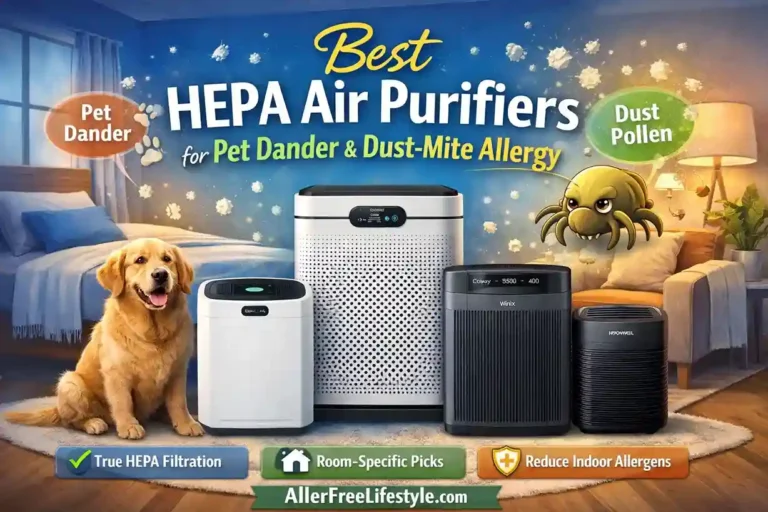
Indoor air often contains invisible allergens like pet dander and dust-mite debris that can trigger discomfort, especially in homes with pets, carpets, and upholstered furniture. For individuals sensitive to common allergens, such as pollen fragments and mold spores, these particles can stay airborne for hours and circulate throughout living spaces. While medications are important for allergy management, reducing indoor allergen exposure is an effective non-drug solution that can improve daily comfort. A True HEPA air purifier is one of the best tools for removing allergens from indoor air and improving overall air quality.
Do HEPA air purifiers help with pet dander and dust-mite allergies?
Yes, True HEPA air purifiers are effective in reducing pet dander and dust-mite allergens in indoor air. These purifiers use HEPA filters to trap particles as small as 0.3 microns, including pet hair, dust-mite debris, and mold spores. Regular use of a HEPA air purifier can improve indoor air quality and reduce allergy symptoms such as nasal congestion, sneezing, and itchy eyes, particularly in areas like bedrooms and living rooms where allergens tend to accumulate.
Why Pet Dander & Dust-Mite Allergens Are Difficult to Control
Pet Dander
- Microscopic skin proteins shed by animals
- Lightweight particles that remain suspended in air
- Easily settle into carpets, furniture, and bedding
Dust-Mite Allergens
- Originate from mite waste particles (not the mites themselves)
- Become airborne when bedding or carpets are disturbed
- Tend to peak during nighttime and early morning hours
Opening windows may introduce outdoor allergens, and fans typically recirculate particles rather than removing them. In contrast, HEPA filtration physically captures allergens, lowering their concentration in indoor air (Bousquet et al., 2020).
Do HEPA Air Purifiers Help With Indoor Allergy Symptoms?
Yes. When used correctly, True HEPA air purifiers reduce airborne allergen load and support better indoor comfort.
Clinical and guideline-based evidence shows that HEPA filtration can:
- Reduce airborne pet dander and dust-mite allergen particles
- Lower continuous allergen recirculation indoors
- Support improved nighttime comfort and sleep quality
These devices do not cure allergies, but they help reduce daily exposure, which supports symptom stability when used consistently—especially in bedrooms (Reisman et al., 1990; Klimek et al., 2024).
What “True HEPA” Actually Means
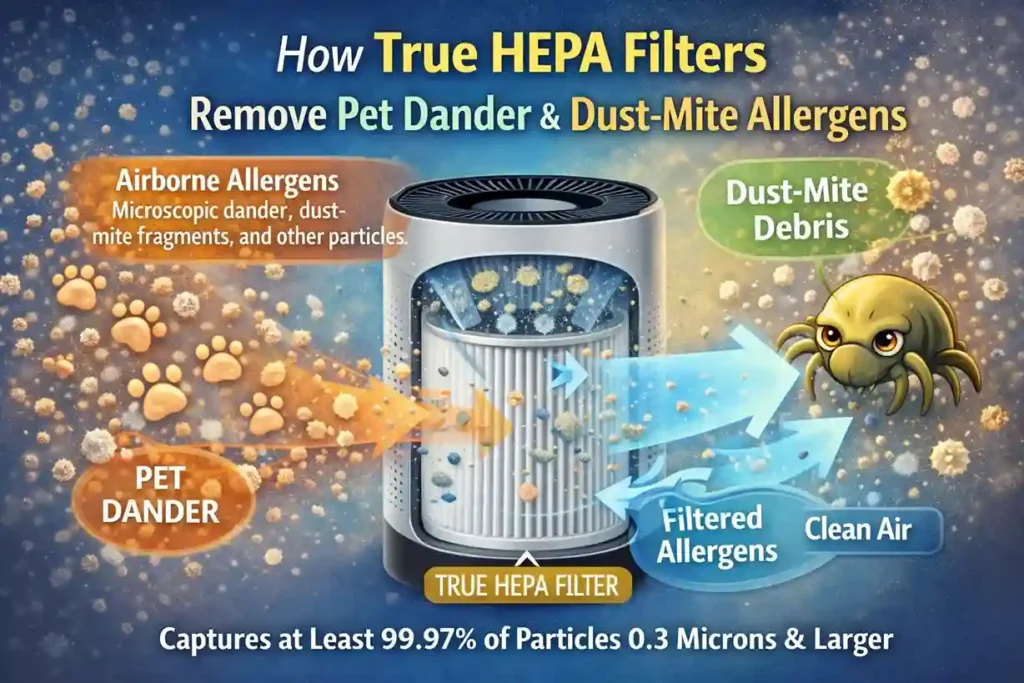
A True HEPA filter is manufactured to capture at least 99.97% of particles measuring 0.3 microns or larger. This particle range includes:
- Pet dander
- Dust-mite debris
- Pollen fragments
- Mold spores
Marketing terms such as “HEPA-like,” “HEPA-style,” or “99% filtration” are not regulated and do not guarantee medical-grade filtration performance.
Buyer Checklist: Features That Matter Most
1️⃣ True HEPA Filtration (Essential)
Required for meaningful allergen removal (Reisman et al., 1990).
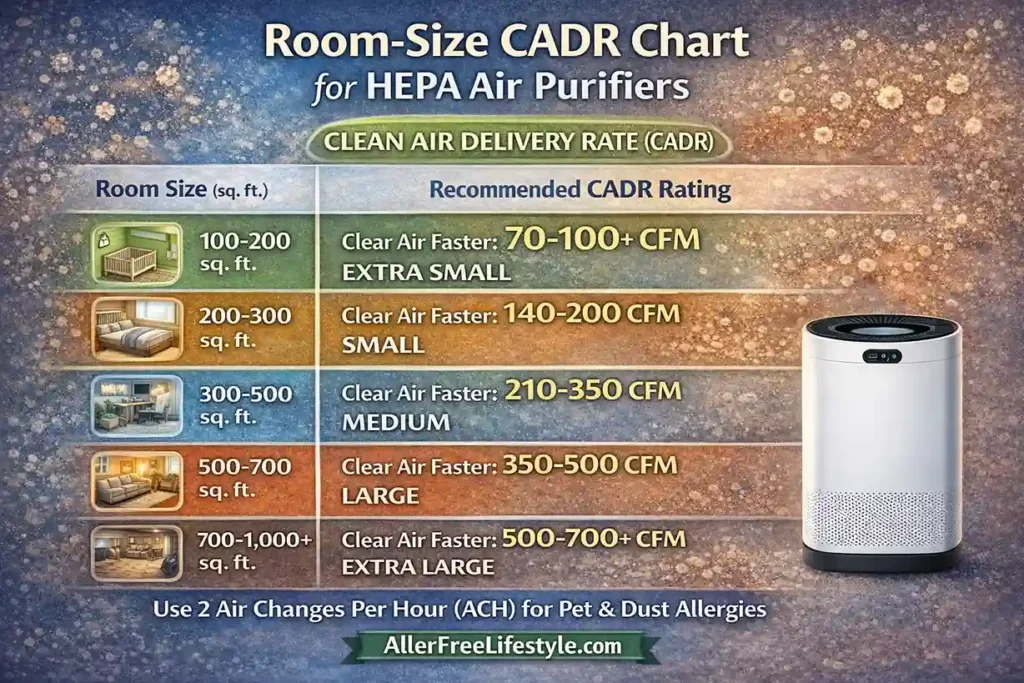
2️⃣ CADR (Clean Air Delivery Rate)
CADR should match the actual room size to ensure sufficient air turnover.
3️⃣ Sealed Filtration Design
Prevents air from bypassing the filter.
4️⃣ Low Operating Noise
Important for bedrooms and nighttime use, where continuous operation is needed.
5️⃣ No Ozone Emission
Avoid ionizers and ozone-producing devices, which may irritate airways (Klimek et al., 2024).
Room-Wise HEPA Air Purifier Buying Guide
✅ Best HEPA Air Purifier for Bedrooms
Best for:
Nighttime congestion, morning sneezing, dust-mite exposure
Why bedrooms matter
- 6–8 hours of continuous exposure during sleep
- Bedding releases allergen particles with movement
- Symptoms often feel worse after waking
What to look for
- True HEPA filtration
- Quiet sleep or night mode
- Room-matched CADR
- Minimal indicator lighting
👉 Recommended type:
Medium-size, low-noise HEPA purifier designed for bedrooms.
✅ Best HEPA Air Purifier for Living Rooms (Pet Dander Control)
Best for:
Homes with cats or dogs, shared family areas
Living rooms typically require:
- Higher CADR
- Strong airflow
- Pre-filters to capture pet hair
👉 Recommended type:
High-CADR HEPA purifier for medium-to-large rooms
✅ Best HEPA Air Purifier for Small Rooms & Apartments
Best for:
Renters, students, offices, compact bedrooms
Key features:
- Compact design
- Energy-efficient operation
- Quiet performance
👉 Recommended type:
Small-room True HEPA purifier
✅ Best HEPA Air Purifier for Homes With Multiple Pets
Best for:
Heavy shedding and higher allergen load
Look for:
- Large filter surface area
- Washable or replaceable pre-filters
- Designed for continuous operation
👉 Recommended type:
Pet-focused HEPA purifier for larger spaces
✅ Best Budget HEPA Air Purifier
Best for:
First-time buyers or limited budgets
✔ Certified True HEPA
✔ Simple controls
✔ Reliable long-term performance
⚠ Avoid unverified ultra-cheap devices.
HEPA Air Purifier vs HEPA Vacuum (Quick Comparison)
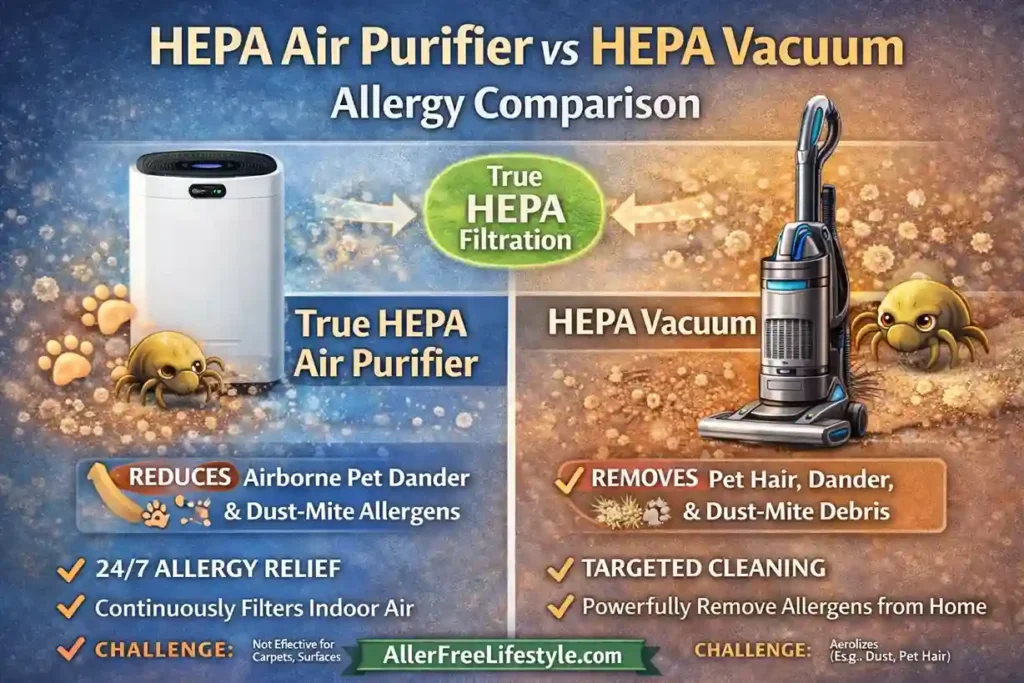
Function | HEPA Purifier | HEPA Vacuum |
Reduces airborne allergens | ✅ | ❌ |
Removes settled dust & mites | ❌ | ✅ |
Improves nighttime comfort | ✅ | ❌ |
Picks up pet hair | ❌ | ✅ |
👉 Best results come from using both together
Where to Place an Air Purifier
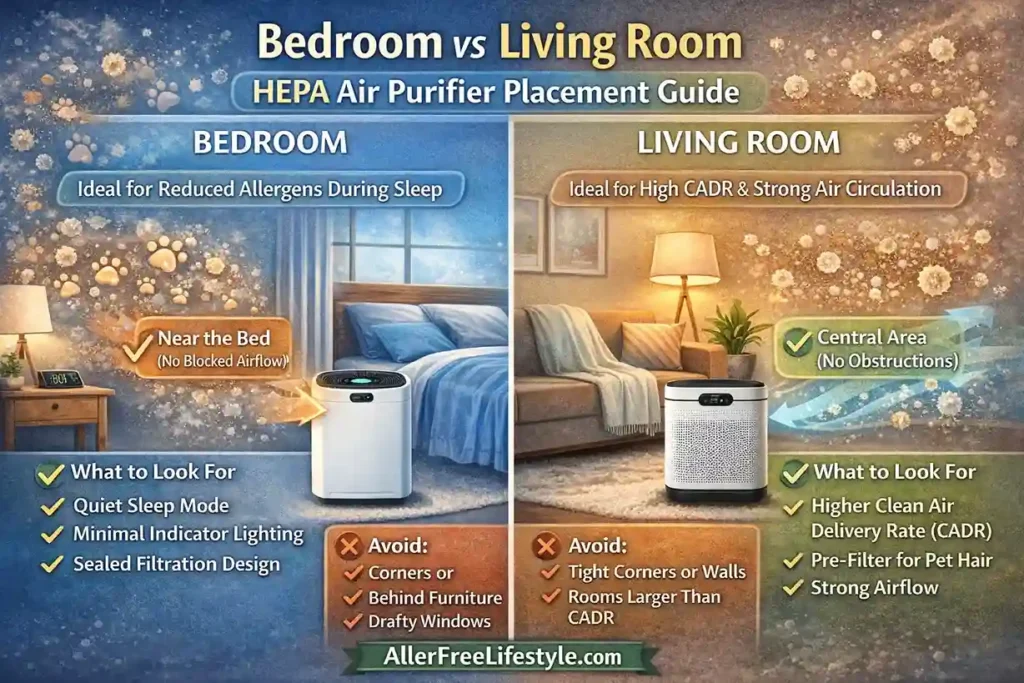
- Bedroom: Near the bed with unobstructed airflow
- Living room: Central area where air circulates
- Avoid corners, walls, and blocked intakes
- Keep doors and windows closed during operation
How Long Should You Run a HEPA Air Purifier?
Area | Recommended Use |
Bedroom | Overnight |
Living room | 8–12 hours daily |
Pet areas | Continuous |
Air purifiers work gradually by processing total air volume rather than delivering instant results (Klimek et al., 2024).
Filter Replacement & Ongoing Costs
- HEPA filter lifespan: 6–12 months
- Pre-filter: clean monthly
- Electricity use: low to moderate
💡 Always check replacement filter cost before purchasing a unit.
Common Myths About Air Purifiers
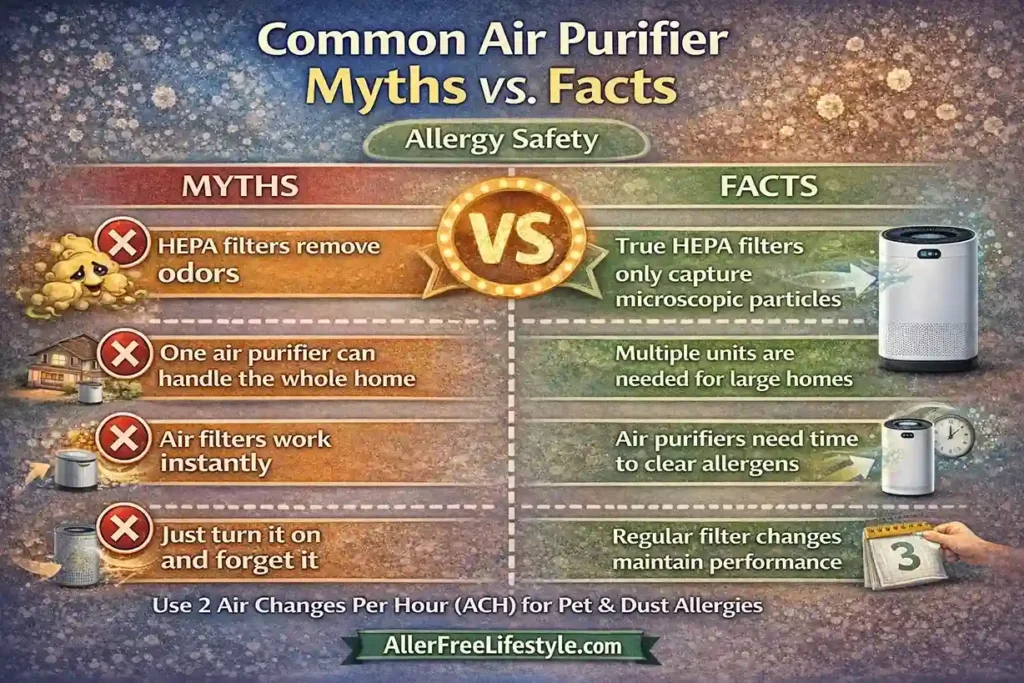
❌ Opening windows alone solves indoor allergies
❌ Houseplants effectively clean indoor air
❌ Ionizers are safer alternatives
❌ One purifier cleans an entire home
Reality: Room-specific HEPA filtration is the most practical approach (Bousquet et al., 2020).
Who Benefits Most From HEPA Air Purifiers?
- People sensitive to pet dander
- Dust-mite allergy sufferers
- Homes with indoor pets
- Individuals with nighttime congestion
- Families in urban or polluted environments
Key Takeaways
- True HEPA filters remove airborne allergens
- Bedroom placement offers the most noticeable comfort
- CADR must match room size
- Avoid ozone-producing devices
- Best results combine air cleaning and regular household cleaning
Medical Disclaimer
This content is for educational purposes only and does not replace professional medical advice, diagnosis, or treatment. HEPA air purifiers may help reduce airborne allergens but do not cure allergies or asthma. Always consult a qualified healthcare professional for medical guidance.
Frequently Asked Questions (FAQs)
1. Do HEPA air purifiers help indoor allergies?
Yes. They reduce airborne allergen concentration
2. Can they remove pet dander?
Yes. Airborne pet dander particles are easily captured by HEPA filters.
3. How many units are needed?
Ideally one per major living space.
4. How soon can changes be noticed?
Some people notice improvement within days; others may need 2–3 weeks of consistent use.
References
Bousquet, J., Klimek, L., Togias, A., Zuberbier, T., Agache, I., Ansotegui, I. J., … Wallace, D. V. (2020).
Next-generation allergic rhinitis and its impact on asthma (ARIA). Journal of Allergy and Clinical Immunology, 145(3), 895–909.
Reisman, R. E., Mauriello, P. M., Davis, G. B., Georgitis, J. W., & DeMasi, J. M. (1990).
A double-blind study of HEPA filtration in allergic rhinitis. Journal of Allergy and Clinical Immunology, 85(6), 1050–1057.
Klimek, L., Bousquet, J., Pfaar, O., Bachert, C., Hellings, P. W., & Agache, I. (2024).
Current management of allergic rhinitis. Journal of Allergy and Clinical Immunology: In Practice, 12(2), 215–229.