

How to Control Dust Mite Allergy in the Bedroom Naturally
Written by: Dr.Muhammad Ihsan Ullah, PhD
Medically reviewed by: Dr. Muhammad Mudassar Hassan Bhatti, MD
Last updated on May 31,2026
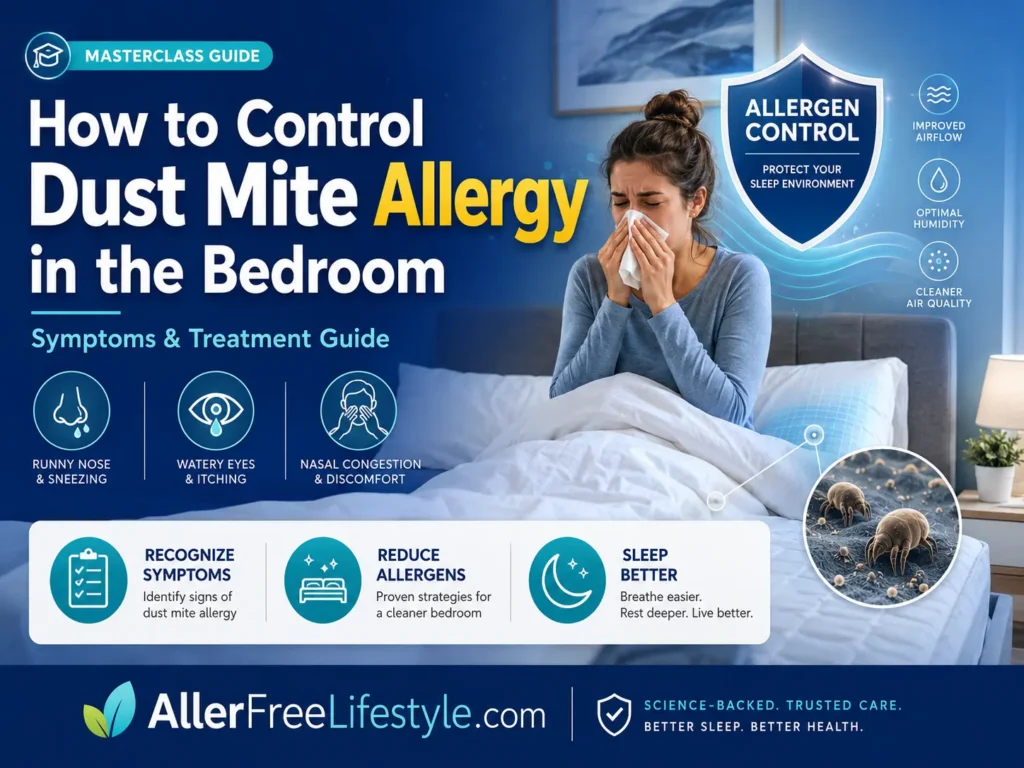
Dust mite allergy can make your bedroom feel like the place where symptoms start instead of where your body rests. If you wake up with sneezing, a blocked nose, itchy eyes, coughing, or poor sleep, you may be reacting to dust mite allergens hidden in your mattress, pillows, bedding, carpets, curtains, or soft furnishings. This guide explains how to control dust mite allergy in the bedroom, recognize common dust mite allergy symptoms, choose safe dust mite allergy treatment options, reduce dust mites in bed, and build a practical bedroom control plan that lowers allergen exposure while you sleep.
What Is the Fastest Way to Control Dust Mite Allergy in the Bedroom?
The fastest practical way to control dust mite allergy in the bedroom is to reduce allergen exposure where your face and airways spend the most time: the bed.
Start with these steps:
- Use dust-mite-proof covers on your mattress and pillows.
- Wash sheets, pillowcases, and bedding weekly.
- Keep bedroom humidity below 50%.
- Remove or reduce carpets, heavy curtains, and fabric clutter.
- Vacuum with a HEPA-filter vacuum.
- Damp dust instead of dry dusting.
- Keep pets and soft toys away from the sleeping area.
Dust mite allergy management works best when environmental control is combined with appropriate medical treatment. Research on dust mite avoidance consistently focuses on allergen reservoirs such as mattresses, pillows, bedding, carpets, and indoor humidity because these are major sources of ongoing exposure (Portnoy et al., 2013)..
How Do You Control Dust Mite Allergy in the Bedroom?
To control dust mite allergy in the bedroom, use dust-mite-proof covers on your mattress and pillows, wash bedding weekly in hot water when fabric allows, keep bedroom humidity below 50%, remove carpets or heavy curtains if possible, vacuum with a HEPA filter, damp dust surfaces, reduce soft toys and fabric clutter, and keep pets off the bed. These steps lower dust mite allergen exposure while you sleep and may reduce sneezing, blocked nose, itchy eyes, coughing, and nighttime allergy symptoms.
What Are the Most Common Dust Mite Allergy Symptoms?
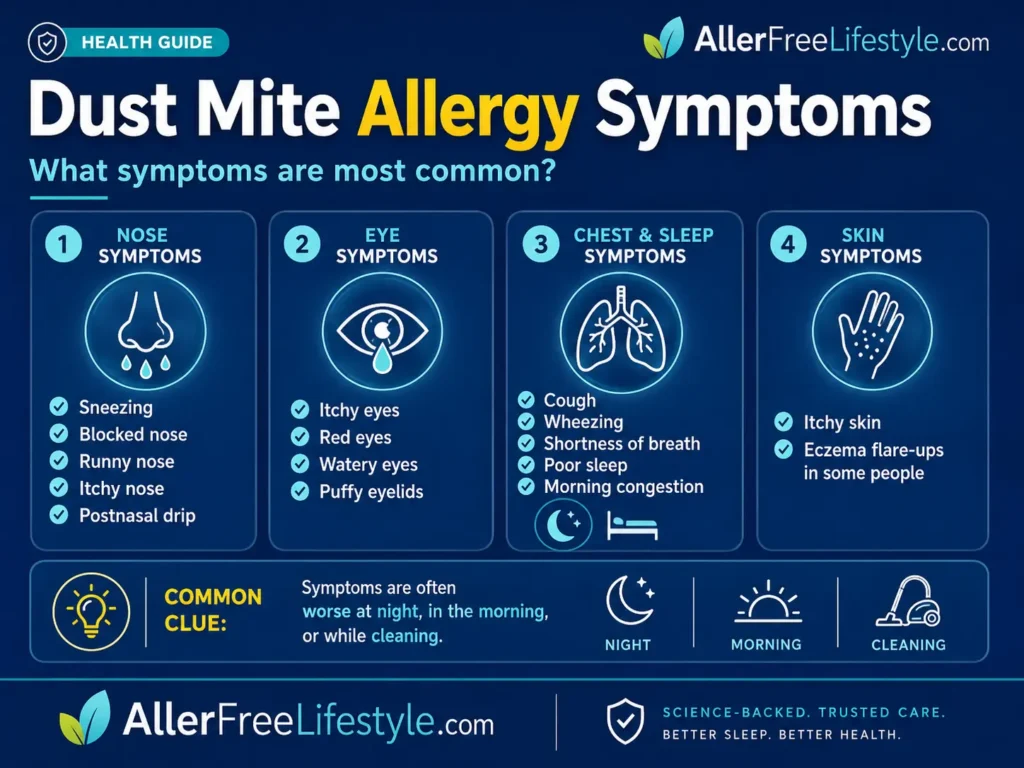
Dust mite allergy symptoms often look like year-round nasal and eye allergy symptoms.
Common symptoms include:
- Sneezing
- Blocked nose
- Runny nose
- Itchy nose
- Postnasal drip
- Itchy eyes
- Red or watery eyes
- Cough
- Throat clearing
- Wheezing
- Chest tightness
- Poor sleep
- Morning congestion
- Eczema flare-ups in some people
The symptom pattern is important. Dust mite allergy is often worse indoors, especially in the bedroom, at night, early in the morning, or during cleaning.
Can Dust Mite Allergy Cause a Blocked Nose or Runny Nose?
Yes. A blocked nose and runny nose are among the most common dust mite allergy symptoms.
You may notice:
- A stuffy nose when lying down
- A runny nose in the morning
- Sneezing after waking
- Postnasal drip
- Mouth breathing at night
- Snoring or restless sleep
A blocked nose can affect sleep quality and daytime energy. If nasal congestion continues for weeks or months, it may need more than an occasional antihistamine.
Can Dust Mite Allergy Cause Itchy, Red, or Watery Eyes?
Yes. Dust mite allergy may cause eye symptoms, especially when allergens from pillows, bedding, or bedroom dust come close to the face.
Eye symptoms may include:
- Itchy eyes
- Red eyes
- Watery eyes
- Puffy eyelids
- Burning or gritty feeling
- Symptoms after lying in bed
Eye symptoms are common when dust mite allergy occurs with allergic conjunctivitis. If eye symptoms are severe, painful, one-sided, associated with vision changes, or linked with discharge, medical review is important.
Can Dust Mite Allergy Cause Coughing, Wheezing, or Asthma Symptoms?
Yes. Dust mite allergy can worsen cough and asthma symptoms in sensitized people.
Watch for:
- Coughing at night
- Coughing after lying down
- Wheezing
- Chest tightness
- Shortness of breath
- Waking from sleep due to cough
- Symptoms during cleaning or after changing bedding
Dust mite allergy is clinically important because it can affect both the upper airway and lower airway. Studies on house dust mite immunotherapy have evaluated benefits in allergic rhinitis and asthma control, especially when symptoms are linked to confirmed dust mite sensitization (Jutel et al., 2024).
If you have wheezing, chest tightness, or shortness of breath, do not treat it as “just allergy.” These symptoms may indicate asthma and should be assessed by a healthcare professional.
Can Dust Mite Allergy Make Eczema or Itchy Skin Worse?
Dust mite allergy may worsen eczema or itchy skin in some people, especially those with atopic dermatitis.
Possible skin-related symptoms include:
- Itchy skin
- Eczema flare-ups
- Irritation after lying in bed
- Worsening itch at night
- Skin discomfort around dusty fabrics
However, dust mites do not bite. If you see bite marks, blood spots, or insects in the bed, consider other causes such as bed bugs, fleas, scabies, irritant dermatitis, or contact allergy.
Why Are Dust Mite Allergy Symptoms Worse at Night or in the Morning?
Dust mite allergy symptoms are often worse at night or in the morning because your bed can hold a high amount of dust mite allergen.
Your mattress, pillow, blanket, duvet, and bedsheets can collect:
- Dust mite particles
- Dust mite droppings
- Dead mite fragments
- Human skin flakes
- Pet dander
- Indoor dust
- Textile fibers
When you lie down, breathe close to the pillow, or move in bed, allergens may reach your nose, eyes, throat, and lungs.
This is why many people say:
- “I wake up sneezing every morning.”
- “My nose blocks only at night.”
- “My eyes itch when I lie in bed.”
- “My cough gets worse in the bedroom.”
If this sounds familiar, your bedroom should be the first place to control.
Is Dust Allergy the Same as Dust Mite Allergy?
Not exactly.
“Dust allergy” is a general phrase. Dust can contain many triggers, including:
- Dust mite allergens
- Pet dander
- Mold spores
- Pollen
- Cockroach particles
- Textile fibers
- Indoor irritants
“Dust mite allergy” is more specific. It means your immune system reacts to proteins from house dust mites.
This difference matters because the right treatment depends on the real trigger. If symptoms continue despite bedroom control, allergy testing can help confirm whether dust mites, pets, mold, pollen, or another allergen is involved.
How Do I Know If My Bedroom Is Triggering Dust Mite Allergy?
Your bedroom may be triggering dust mite allergy if symptoms are worse:
- While lying in bed
- At night
- In the morning
- After changing sheets
- During cleaning
- In humid weather
- In a room with carpet
- Around old pillows or mattresses
- Around soft toys, curtains, cushions, or fabric furniture
You should suspect bedroom dust mite exposure if your symptoms improve when you sleep away from home or in a cleaner, less humid environment.
How Is Dust Mite Allergy Diagnosed?
Dust mite allergy is diagnosed through a combination of symptom history, exposure pattern, and allergy testing.
A clinician may ask:
- Are your symptoms year-round?
- Are they worse in bed or in the morning?
- Do you have asthma, eczema, or eye symptoms?
- Do you have carpets, curtains, pets, or old bedding?
- Does cleaning make symptoms worse?
- Do medicines help?
Testing may include a skin prick test or a specific IgE blood test.
Do I Need a Skin Prick Test for Dust Mite Allergy?
A skin prick test can help confirm whether you are sensitized to dust mite allergens.
During the test, a small amount of allergen extract is placed on the skin. If your immune system reacts, a small itchy bump may appear.
This test is usually performed by trained healthcare professionals.
Can a Blood Test Confirm Dust Mite Allergy?
Yes. A specific IgE blood test can help detect sensitization to dust mite allergens.
A blood test may be useful when:
- Skin testing is not suitable
- Skin disease makes testing difficult
- Certain medicines interfere with skin testing
- There is a need for additional confirmation
- A clinician is considering immunotherapy
Testing is especially important before dust mite immunotherapy because treatment should be based on confirmed allergy, not guessing.
When Should I See an Allergist for Dust Mite Allergy?
See an allergist or qualified clinician if you have:
- Persistent blocked nose
- Symptoms most days of the week
- Poor sleep due to allergy symptoms
- Wheezing or chest tightness
- Cough at night
- Symptoms despite over-the-counter medicines
- Recurrent sinus problems
- Uncontrolled eczema
- Need for long-term treatment
- Interest in allergy immunotherapy
If symptoms are affecting your sleep, breathing, school, work, or quality of life, professional evaluation is worth it.
What Is the Best Treatment for Dust Mite Allergy?
The best dust mite allergy treatment depends on symptom severity.
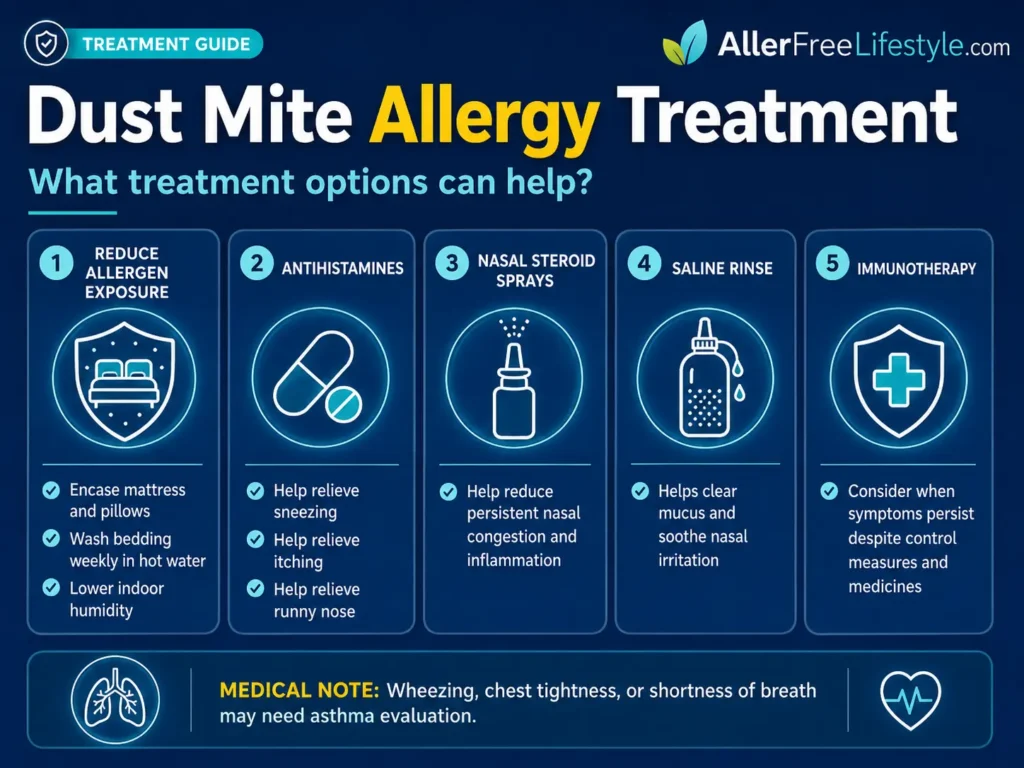
Most people need a combination of:
- Bedroom allergen control
- Antihistamines for sneezing, itching, and runny nose
- Nasal corticosteroid sprays for persistent nasal inflammation
- Saline nasal rinse for mucus and irritation
- Asthma treatment if wheezing is present
- Dust mite immunotherapy for selected patients with confirmed allergy
Allergen immunotherapy is the only treatment approach designed to modify the allergic response over time rather than only relieving symptoms. Recent studies of house dust mite sublingual immunotherapy tablets show benefit in allergic rhinitis, rhinoconjunctivitis, and selected asthma-related outcomes when used in appropriate patients (Schuster et al., 2025)..
Should I Reduce Dust Mite Exposure Before Taking Medicine?
Yes. Reducing exposure is the foundation of dust mite allergy control.
Medicines can calm symptoms, but they do not remove allergens from your bed, pillow, carpet, or bedroom air.
Start with:
- Mattress encasement
- Pillow encasement
- Weekly bedding washing
- Humidity control
- Carpet reduction
- HEPA vacuuming
- Damp dusting
This makes treatment more effective because your body is exposed to fewer triggers every night.
Which Antihistamines Help Dust Mite Allergy Symptoms?
Antihistamines may help with:
- Sneezing
- Itchy nose
- Runny nose
- Itchy eyes
- Watery eyes
They are often useful for mild to moderate symptoms.
Common non-sedating or less-sedating options may include cetirizine, loratadine, fexofenadine, or similar medicines, depending on your country and medical history.
Important points:
- Some antihistamines cause drowsiness.
- Older antihistamines may affect alertness.
- Antihistamines may not fully control nasal blockage.
- Persistent congestion often needs nasal anti-inflammatory treatment.
Ask a healthcare professional if you are pregnant, breastfeeding, elderly, treating a child, have glaucoma, prostate problems, heart disease, liver disease, kidney disease, or take other medicines.
Are Nasal Steroid Sprays Good for Dust Mite Allergy?
Yes. Nasal corticosteroid sprays are often very useful for persistent nasal symptoms.
They may help reduce:
- Nasal congestion
- Sneezing
- Runny nose
- Itchy nose
- Postnasal drip
- Nasal inflammation
They work best when used correctly and consistently.
For better technique:
- Blow your nose gently first.
- Aim the spray slightly outward, away from the nasal septum.
- Do not sniff too hard after spraying.
- Use as directed on the label or by your clinician.
Modern allergic rhinitis guidance continues to support intranasal treatments, including intranasal corticosteroids, as important options for nasal allergy control (Sousa-Pinto et al., 2025)..
Can Saline Nasal Rinse Help Dust Mite Allergy?
Yes. Saline spray or rinse can help remove mucus and allergens from the nose.
It may help with:
- Nasal dryness
- Thick mucus
- Postnasal drip
- Irritation after dust exposure
- Mild congestion
Use sterile, distilled, or previously boiled and cooled water for nasal irrigation devices. Clean the device properly after each use.
Saline is not a cure, but it can support your treatment plan.
Are Decongestants Safe for Dust Mite Allergy?
Decongestants may temporarily reduce nasal blockage, but they should be used carefully.
Nasal decongestant sprays can cause rebound congestion if used too long.
Oral decongestants may not be suitable for people with:
- High blood pressure
- Heart disease
- Thyroid disease
- Glaucoma
- Prostate problems
- Pregnancy
- Certain medication interactions
Use them only according to label directions or medical advice.
When Is Montelukast Used for Dust Mite Allergy?
Montelukast is a leukotriene receptor antagonist. It may be considered in selected patients, especially when allergic rhinitis and asthma overlap.
It is not the first choice for every patient.
Because montelukast has important safety warnings in some countries, it should be used only after a clinician weighs the benefits and risks.
What Should I Do If Dust Mites Trigger Asthma Symptoms?
If dust mites trigger wheezing, chest tightness, shortness of breath, or night cough, you need proper asthma assessment.
Asthma-related treatment may include:
- Reliever inhaler
- Controller inhaler
- Inhaled corticosteroid
- Combination inhaler
- Asthma action plan
- Trigger reduction
- Specialist care if uncontrolled
Do not rely only on cleaning if you have breathing symptoms. Bedroom control is helpful, but asthma needs medical management.
Is Dust Mite Immunotherapy Worth It?
Dust mite immunotherapy may be worth considering if:
- Dust mite allergy is confirmed by testing
- Symptoms are persistent
- Symptoms continue despite bedroom control and medicines
- Allergic rhinitis affects sleep, work, school, or quality of life
- Asthma symptoms are linked with dust mite allergy and clinically stable
- A specialist recommends it
Immunotherapy can be given as allergy shots or sublingual tablets, depending on availability, age, approval status, and clinical suitability.
Real-world and clinical trial data support the role of house dust mite immunotherapy in selected patients with allergic rhinitis and asthma-related disease control, but it must be prescribed and monitored appropriately (Tempels-Pavlica et al., 2024)..
How Can I Control Dust Mites in My Bedroom?
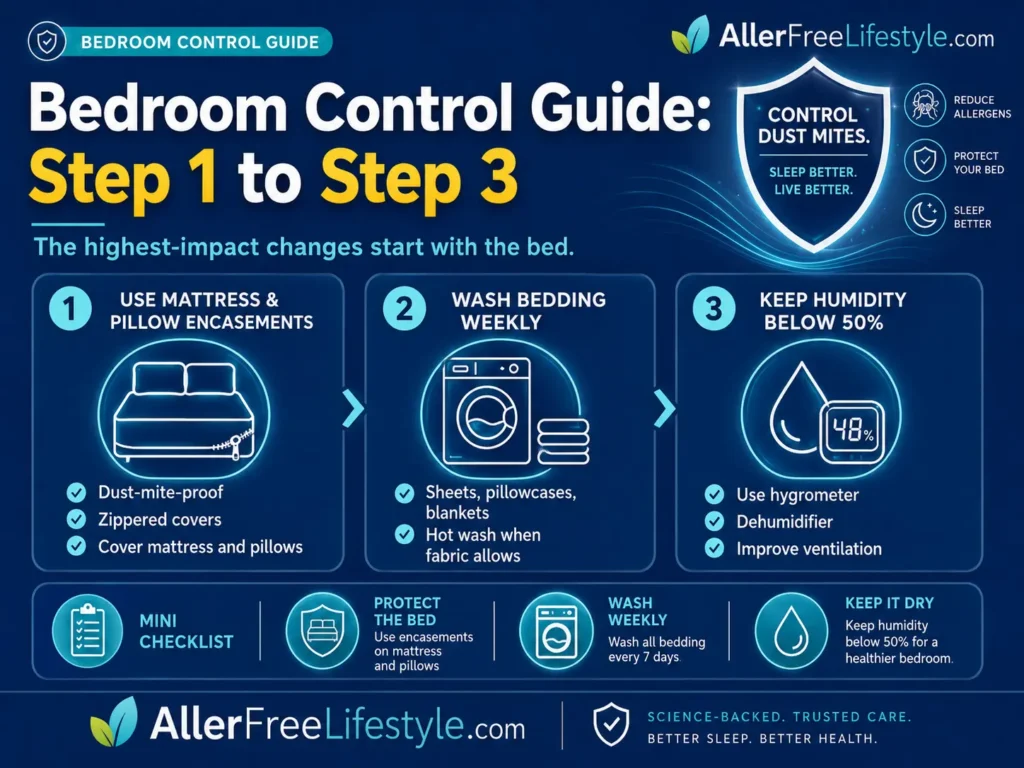
Bedroom control is the most important part of dust mite allergy management because the bed is often the highest-exposure area.
The goal is not to make the room sterile.
The goal is to reduce allergen exposure while you sleep.
Why Is the Bedroom the Most Important Place to Control Dust Mites?
You spend many hours in the bedroom every night.
Dust mite allergens can collect in:
- Mattress
- Pillows
- Sheets
- Blankets
- Duvets
- Comforters
- Carpets
- Rugs
- Curtains
- Upholstered chairs
- Fabric headboards
- Soft toys
- Clothes piles
- Clutter under the bed
If you only clean the living room but ignore your bed, symptoms may continue.
Do Dust Mite Mattress Covers Really Work?
Dust-mite-proof mattress covers can reduce exposure to allergens trapped in the mattress.
Choose a cover that is:
- Fully zippered
- Designed as a complete encasement
- Tightly woven
- Washable
- Properly fitted
- Labeled for dust mite or allergen barrier use
A regular mattress protector is not always enough. You need an encasement that covers the whole mattress.
Should I Use Dust Mite Pillow Covers?
Yes. Pillow covers are very important.
Your face is close to the pillow for several hours each night. If you wake with sneezing, itchy eyes, blocked nose, or coughing, your pillow may be part of the exposure.
Use:
- Dust-mite-proof pillow encasement
- Washable pillowcase over the encasement
- Washable pillows when possible
- Regular replacement of old pillows
Do not protect the mattress and ignore the pillow.
How Often Should I Wash Bedding for Dust Mite Allergy?
Wash bedding weekly.
This includes:
- Sheets
- Pillowcases
- Duvet covers
- Blankets
- Washable mattress protectors
- Washable pillow protectors
Weekly washing helps remove dust mite allergens, skin flakes, and indoor dust.
What Temperature Kills Dust Mites in Bedding?
Hot washing or hot drying is commonly recommended when fabric allows.
Many recommendations use temperatures around:
- 130°F / 54°C
- 60°C
Always check fabric care labels.
If bedding cannot be washed hot:
- Use a hot dryer cycle if suitable
- Wash regularly even at lower temperatures to remove allergens
- Choose washable bedding in the future
- Use allergen-proof covers
- Avoid bulky bedding that cannot be cleaned
Freezing can kill mites in some items, but it does not remove the allergen. Washing or cleaning is still needed when possible.
What Humidity Level Is Best for Dust Mite Allergy?
Keep bedroom relative humidity below 50%.
Dust mites survive and multiply better in humid environments.
To control humidity:
- Use a hygrometer
- Use a dehumidifier if needed
- Use air conditioning where appropriate
- Improve ventilation
- Fix leaks or damp walls
- Avoid drying clothes in the bedroom
- Reduce condensation
A hygrometer is useful because you cannot reliably guess humidity by how the room feels.
Should I Remove Carpet From the Bedroom?
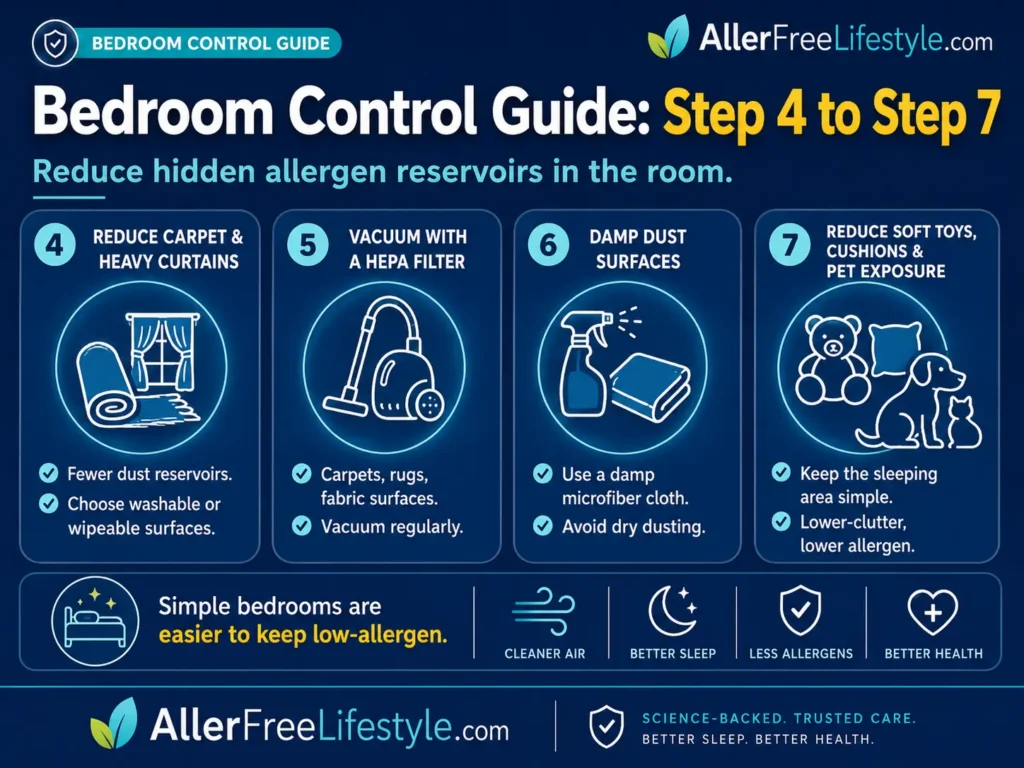
If possible, yes.
Carpet traps dust mite allergen, pet dander, pollen, mold particles, and skin flakes.
Better options include:
- Hard flooring
- Washable rugs
- Smooth surfaces that can be damp mopped
If carpet cannot be removed:
- Vacuum with a HEPA-filter vacuum
- Vacuum slowly and regularly
- Keep clutter off the floor
- Avoid thick rugs near the bed
- Consider wearing a mask while cleaning
- Keep the allergic person out of the room during cleaning if symptoms flare
Are Curtains and Upholstered Furniture Bad for Dust Mite Allergy?
Heavy curtains and upholstered furniture can collect dust and allergens.
Better bedroom choices include:
- Washable curtains
- Roller blinds
- Smooth blinds that can be wiped
- Minimal fabric furniture
- Washable covers
- Less fabric clutter
If you keep curtains, wash or clean them regularly.
Is a HEPA Vacuum Good for Dust Mite Allergy?
A HEPA vacuum can help reduce settled dust and allergens.
It is especially useful for:
- Carpets
- Rugs
- Upholstered furniture
- Fabric headboards
- Mattress surfaces if uncovered
- Areas under the bed
However, vacuuming alone is not enough. It should be combined with mattress covers, pillow covers, weekly bedding washing, and humidity control.
Should I Damp Dust Instead of Dry Dusting?
Yes. Damp dusting is better than dry dusting.
Dry dusting throws allergens into the air.
Use:
- Damp microfiber cloth
- Damp mop
- Washable cleaning cloths
- Wet wiping for hard surfaces
Avoid:
- Feather dusters
- Dry sweeping
- Shaking bedding indoors
- Beating rugs inside
The aim is to remove dust, not spread it.
What Should I Do About Soft Toys, Cushions, and Extra Blankets?
Soft items collect dust.
Reduce:
- Decorative pillows
- Extra cushions
- Fabric baskets
- Stuffed animals
- Extra blankets
- Open clothing piles
- Clutter under the bed
For children:
- Keep only a few favorite washable soft toys
- Wash them regularly
- Keep them away from the pillow area
- Avoid storing many toys on the bed
A simpler bedroom is easier to keep low-allergen.
Should Pets Stay Out of the Bedroom If I Have Dust Mite Allergy?
Yes, it is usually better to keep pets out of the bedroom.
Pets are not dust mites, but they can add:
- Dander
- Hair
- Skin flakes
- Outdoor pollen
- Dust from fur
Pet skin flakes may also contribute to the indoor dust environment.
Best practice:
- No pets on the bed
- Ideally no pets in the bedroom
- Wash pet bedding separately
- Vacuum pet areas regularly
Does Airing the Bed Help Reduce Dust Mites?
Airing the bed may help reduce trapped warmth and moisture.
Helpful habits include:
- Letting bedding breathe after waking
- Keeping the room ventilated
- Avoiding damp bedding
- Keeping humidity below 50%
- Not trapping moisture under heavy bedding all day
Airing the bed is not enough by itself, but it can support humidity control.
What Works Best for Dust Mite Allergy Bedroom Control?
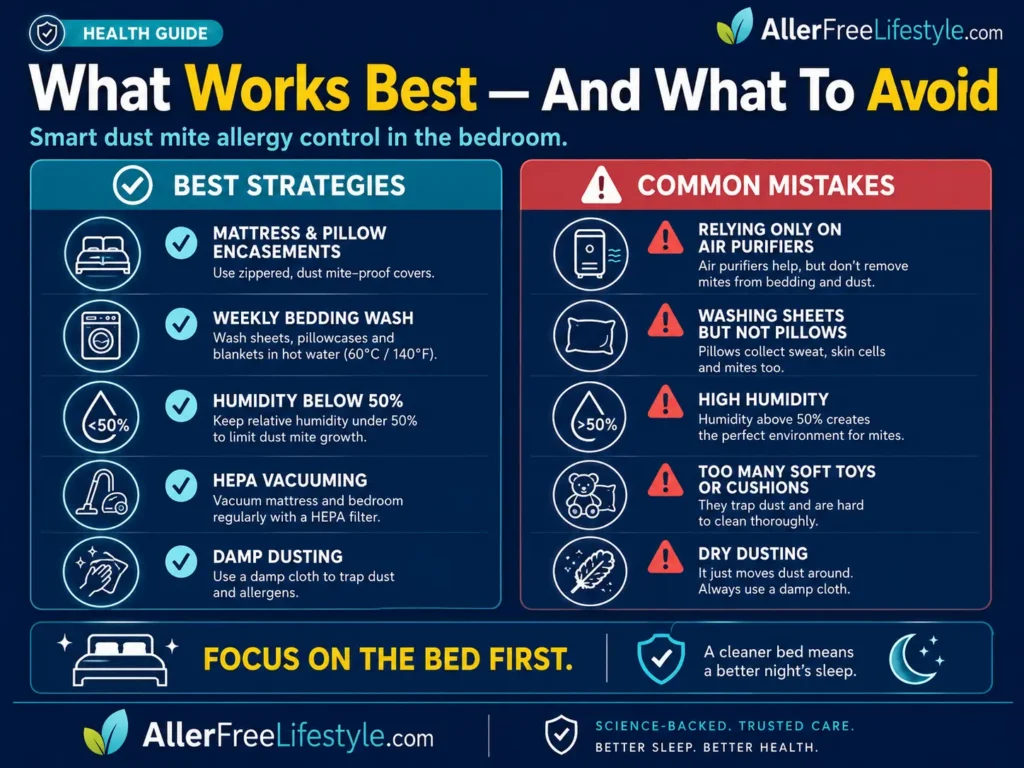
The most useful steps are the ones that target major allergen reservoirs.
Bedroom Control Step | Priority | Why It Helps |
Mattress encasement | High | Blocks allergen exposure from the mattress |
Pillow encasement | High | Reduces allergen close to nose and eyes |
Weekly bedding washing | High | Removes allergens and skin flakes |
Humidity below 50% | High | Makes the room less favorable for mites |
Carpet reduction | High | Removes a major dust reservoir |
HEPA vacuuming | Medium | Reduces settled dust |
Damp dusting | Medium | Removes dust without spreading it |
Soft toy reduction | Medium | Lowers fabric dust reservoirs |
Air purifier | Low to medium | May reduce airborne particles but does not clean bedding |
Sprays or scented products | Low | May irritate symptoms and are not a core solution |
Do Air Purifiers Help With Dust Mite Allergy?
Air purifiers may help reduce some airborne particles, but they do not remove dust mites from mattresses, pillows, carpets, or bedding.
An air purifier should not replace:
- Mattress encasement
- Pillow encasement
- Weekly bedding washing
- Humidity control
- Carpet reduction
- HEPA vacuuming
Air purifiers may be useful as an add-on, especially if the room also contains pet dander, pollen, smoke, or other airborne irritants.
What Bedroom Mistakes Make Dust Mite Allergy Worse?
Many people try to control dust mites but miss the most important details.
Avoid these common mistakes.
Is Washing Sheets Enough to Control Dust Mites?
No. Washing sheets is important, but it is not enough.
You also need to think about:
- Pillows
- Mattress
- Duvet
- Blankets
- Carpet
- Curtains
- Humidity
- Soft toys
- Upholstered furniture
If your mattress and pillow remain unprotected, symptoms may continue.
Can High Humidity Make Dust Mite Allergy Worse?
Yes. High humidity makes the bedroom more favorable for dust mites.
Use a hygrometer and aim for relative humidity below 50%.
If humidity remains high:
- Use a dehumidifier
- Improve ventilation
- Fix dampness
- Avoid drying clothes indoors
- Use air conditioning where suitable
Can Old Pillows and Mattresses Trigger Dust Mite Allergy?
Yes. Old pillows and mattresses can hold dust mite allergens, skin flakes, and indoor dust.
If replacement is not possible, use high-quality allergen-proof encasements.
Replace pillows if they are old, damaged, musty, or difficult to clean.
Is Dry Dusting Bad for Dust Mite Allergy?
Yes. Dry dusting can push allergens into the air.
Use damp dusting instead.
This is especially important in bedrooms with shelves, bedside tables, fans, window ledges, and fabric furniture.
Can Air Purifiers Alone Control Dust Mite Allergy?
No. Air purifiers alone cannot control dust mite allergy because the main allergen reservoirs are often in bedding, mattresses, pillows, carpets, and fabric surfaces.
Use air purifiers only as an additional tool.
What Should I Buy First for Dust Mite Allergy Bedroom Control?
If you are starting from zero, prioritize purchases in this order:
- Dust-mite-proof mattress encasement
- Dust-mite-proof pillow encasements
- Hygrometer
- Washable bedding
- Dehumidifier if humidity is above 50%
- HEPA-filter vacuum if carpet or rugs are present
- Washable curtains or wipeable blinds
Do not spend money first on sprays, perfumes, or decorative products. Start with the bed, humidity, and dust reservoirs.
How Can I Control Dust Mite Allergy in a Child’s Bedroom?
Children may show dust mite allergy differently from adults.
Parents may notice:
- Morning sneezing
- Mouth breathing
- Snoring
- Restless sleep
- Dark circles under the eyes
- Nose rubbing
- Night cough
- Wheezing
- Eczema flare-ups
- Poor concentration due to poor sleep
For a child’s bedroom:
- Use mattress and pillow encasements
- Wash bedding weekly
- Keep soft toys limited and washable
- Keep toys off the pillow area
- Reduce carpets and curtains
- Keep humidity below 50%
- Watch for asthma symptoms
Recent pediatric trial data support the role of house dust mite sublingual immunotherapy tablets in children with allergic rhinitis or rhinoconjunctivitis, with or without asthma, when used in medically appropriate patients (Schuster et al., 2025)..
If a child has wheezing, chest tightness, breathing difficulty, or night cough, seek medical advice.
Can Dust Mite Allergy Trigger Asthma at Night?
Yes. Dust mite allergy can trigger asthma symptoms at night.
Possible signs include:
- Night cough
- Wheezing
- Chest tightness
- Shortness of breath
- Waking up breathless
- Cough after lying down
- Symptoms during cleaning
Nighttime asthma symptoms should never be ignored. They may mean asthma is not well controlled.
Bedroom control can reduce triggers, but asthma usually needs a medical plan.
Can You Completely Get Rid of Dust Mites?
Usually, no.
You cannot completely remove all dust mites from a normal home.
But you can reduce exposure enough to make symptoms better.
The goal is not perfection.
The goal is lower allergen exposure while you sleep.
Focus on:
- Mattress encasement
- Pillow encasement
- Weekly washing
- Humidity below 50%
- Carpet reduction
- HEPA vacuuming
- Damp dusting
- Less fabric clutter
When Should I Get Medical Help for Dust Mite Allergy?
Get medical help if you have:
- Wheezing
- Shortness of breath
- Chest tightness
- Night cough
- Severe sleep disturbance
- Persistent blocked nose
- Symptoms despite bedroom control
- Symptoms despite medicines
- Recurrent sinus infections
- Poorly controlled eczema
- Child with chronic cough or poor sleep
Seek urgent care for severe breathing difficulty, blue lips, severe asthma attack symptoms, or signs of anaphylaxis.
7-Day Bedroom Reset: How Can I Reduce Dust Mites Step by Step?
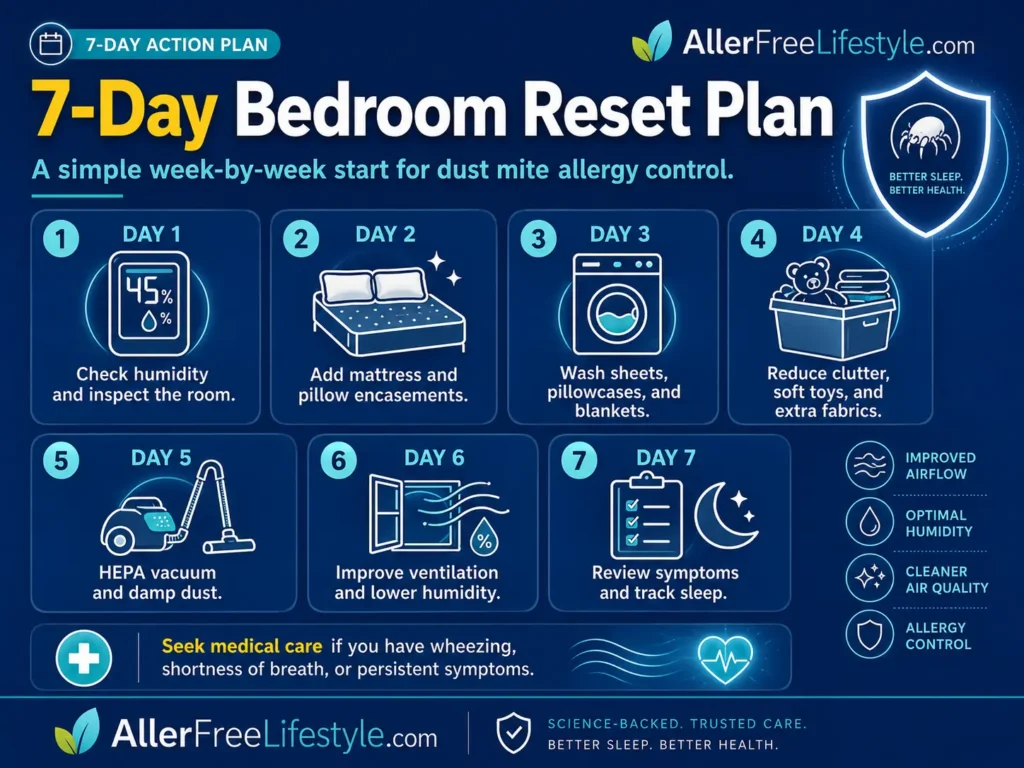
Day 1: Check the Bedroom
Look at:
- Mattress age
- Pillow condition
- Carpet
- Curtains
- Soft toys
- Humidity
- Clutter
- Pet access
Use a hygrometer to measure humidity.
Day 2: Protect the Bed
Add:
- Mattress encasement
- Pillow encasements
- Box spring encasement if needed
Remove unnecessary cushions and decorative pillows.
Day 3: Wash Bedding
Wash:
- Sheets
- Pillowcases
- Duvet covers
- Blankets
- Washable protectors
Use hot water or hot drying when fabric allows.
Day 4: Reduce Fabric Clutter
Remove or reduce:
- Extra blankets
- Soft toys
- Fabric baskets
- Heavy curtains
- Clothes piles
- Clutter under the bed
Day 5: Clean Correctly
Use:
- Damp dusting
- Damp mopping
- HEPA vacuuming
- Cleaning under the bed
- Mask if cleaning triggers symptoms
Avoid dry dusting.
Day 6: Control Humidity
Aim for relative humidity below 50%.
Use:
- Dehumidifier
- Air conditioning
- Ventilation
- Leak repair
- Reduced indoor drying
Day 7: Track Symptoms
Write down:
- Morning sneezing
- Blocked nose
- Eye itching
- Cough
- Wheezing
- Sleep quality
- Medicine use
If symptoms remain troublesome, consider medical review and allergy testing.
Why Is My Nose Blocked Only at Night?
Morning sneezing may happen because dust mite allergens build up in pillows, mattresses, blankets, and bedroom dust.
Try:
- Pillow encasement
- Mattress encasement
- Weekly bedding washing
- Humidity below 50%
- Removing carpet near the bed
- Damp dusting bedside surfaces
If symptoms continue, testing may help confirm the trigger.
Why Is My Nose Blocked Only at Night?
Your nose may block at night because lying down increases contact with bedding allergens. Dust mite particles from pillows, mattresses, and blankets may irritate the nose while you sleep.
Night congestion can also be affected by:
- Dry air
- Humidity
- Mold
- Pet dander
- Reflux
- Sinus disease
- Non-allergic rhinitis
If the problem is persistent, see a clinician.
Can Dust Mites Live in Pillows and Mattresses?
Yes. Pillows and mattresses can collect dust mite allergens because they hold skin flakes, warmth, and moisture.
That is why mattress and pillow encasements are among the most important bedroom control steps.
Do Dust Mites Bite?
No. Dust mites do not bite.
They cause symptoms through allergens from their body fragments and droppings.
If you have bite marks, consider other causes such as bed bugs, fleas, mosquitoes, scabies, or skin irritation.
How Long Does It Take to Reduce Dust Mite Allergy Symptoms?
Some people notice improvement within days or weeks after strong bedroom control, especially if bedding and pillow exposure were major triggers.
However, improvement may take longer if:
- The mattress is old
- Carpet remains in the bedroom
- Humidity stays high
- Asthma is uncontrolled
- Other allergens are involved
- Nasal inflammation is chronic
A consistent plan works better than occasional deep cleaning.
What Is the Best Bedding for Dust Mite Allergy?
The best bedding is:
- Washable
- Low-clutter
- Easy to dry
- Covered with allergen-proof encasements
- Washed weekly
- Not overly thick or difficult to clean
Avoid bedding that cannot be washed or dried properly.
Can Dust Mite Allergy Cause Sinus Problems?
Dust mite allergy can contribute to chronic nasal inflammation, congestion, and mucus drainage, which may worsen sinus pressure or recurrent sinus symptoms in some people.
However, not every sinus problem is allergy. Persistent facial pain, fever, thick colored discharge, or recurrent infections need medical evaluation.
Can Dust Mite Allergy Cause Poor Sleep?
Yes. Dust mite allergy can disturb sleep through:
- Nasal blockage
- Sneezing
- Cough
- Postnasal drip
- Itchy eyes
- Asthma symptoms
- Mouth breathing
- Snoring
Poor sleep can affect mood, energy, concentration, and daily performance.
Is Dust Mite Allergy Worse in Humid Weather?
Yes, dust mite problems can be worse in humid conditions because dust mites survive better when humidity is high.
Keep bedroom humidity below 50% when possible.
Can Dust Mite Allergy Be Cured?
Dust mite allergy is usually managed rather than instantly cured.
However, many people can significantly reduce symptoms through:
- Bedroom allergen control
- Correct medication use
- Allergy testing
- Immunotherapy in selected cases
House dust mite immunotherapy may reduce symptoms and medication need in appropriately selected patients, and some newer studies continue to support its role in allergic rhinitis and asthma-related disease management (Roberts et al., 2025)..
Key Takeaway: What Is the Best Bedroom Plan for Dust Mite Allergy?
The best bedroom plan for dust mite allergy is simple but consistent.
Protect the bed.
Wash bedding weekly.
Keep humidity below 50%.
Remove dust reservoirs.
Clean without spreading dust.
Treat nasal and asthma symptoms properly.
Consider allergy testing if symptoms persist.
Dust mite allergy is not only a cleaning issue. It is an exposure issue, an inflammation issue, and sometimes an asthma issue. When bedroom control and medical treatment work together, many people can breathe better, sleep better, and wake with fewer allergy symptoms.
Medical Disclaimer
This article is for educational purposes only and is not a substitute for professional medical advice, diagnosis, or treatment. Always consult a qualified healthcare provider if you have persistent allergy symptoms, asthma, breathing difficulty, or before starting any new treatment or medication.
Frequently Asked Questions (FAQs)
1. How do I control dust mite allergy in the bedroom?
Use dust-mite-proof covers on your mattress and pillows, wash bedding weekly, keep humidity below 50%, reduce carpets and heavy curtains, vacuum with a HEPA filter, and damp dust surfaces regularly.
2. Why are my dust mite allergy symptoms worse at night?
Symptoms are often worse at night because dust mite allergens collect in mattresses, pillows, blankets, carpets, and soft furnishings. When you lie in bed, these allergens stay close to your nose, eyes, and airways.
3. What are the common symptoms of dust mite allergy?
Common symptoms include sneezing, blocked nose, runny nose, itchy or watery eyes, postnasal drip, coughing, wheezing, poor sleep, and morning congestion.
4. What is the best treatment for dust mite allergy?
The best treatment usually combines bedroom allergen control with medicines such as antihistamines, nasal steroid sprays, saline rinses, and asthma treatment if needed. Some people may benefit from allergy immunotherapy.
5. Can I completely get rid of dust mites?
Usually, no. You may not completely remove dust mites from your home, but you can greatly reduce exposure by protecting bedding, washing sheets weekly, lowering humidity, and removing dust reservoirs from the bedroom.
References
- Portnoy, J., Miller, J. D., Williams, P. B., Chew, G. L., Miller, J. D., Zaitoun, F., Phipatanakul, W., Kennedy, K., Barnes, C., Grimes, C., & Larenas-Linnemann, D. (2013). Environmental assessment and exposure control of dust mites: A practice parameter. Annals of Allergy, Asthma & Immunology, 111(6), 465–507. https://doi.org/10.1016/j.anai.2013.09.018
- Jutel, M., Klimek, L., Richter, H., Vogelberg, C., Brehler, R., & Hamelmann, E. (2024). House dust mite SCIT reduces asthma risk and significantly improves long-term rhinitis and asthma control: A real-world evidence study. Allergy, 79(4), 1045–1055. https://doi.org/10.1111/all.16052
- Tempels-Pavlica, Ž., Kappen, J. H., de Weger, W. W., Larenas-Linnemann, D., & van der Valk, J. P. M. (2024). House dust mite sublingual allergen immunotherapy tablet is safe and well-tolerated in Dutch clinical practice. Frontiers in Allergy, 5, 1355324. https://doi.org/10.3389/falgy.2024.1355324
- Schuster, A., Caimmi, D., Nolte, H., Novakova, S., Mikler, J., Foss-Skiftesvik, M. H., Østerdal, A. S., Emeryk, A., Gagnon, R., & Pfaar, O. (2025). Efficacy and safety of SQ house dust mite sublingual immunotherapy-tablet in children with allergic rhinitis/rhinoconjunctivitis with or without asthma: A randomised, double-blind, placebo-controlled, phase III trial. The Lancet Regional Health – Europe, 48, 101136. https://doi.org/10.1016/j.lanepe.2024.101136
- Sousa-Pinto, B., Bousquet, J., Agache, I., Anto, J. M., Berger, U., Canonica, G. W., Casale, T. B., Chivato, T., Del Giacco, S., Demoly, P., & others. (2025). Allergic Rhinitis and Its Impact on Asthma: ARIA–EAACI guidelines 2024–2025 revision. Allergy. https://doi.org/10.1111/all.70131
- Roberts, G., Just, J., Caimmi, D., Nolte, H., Novakova, S., Foss-Skiftesvik, M. H., Østerdal, A. S., Emeryk, A., & Pfaar, O. (2025). SQ house dust mite sublingual immunotherapy tablet in children with allergic asthma: A randomised phase III trial. Allergy, 80(12), 3401–3411. https://doi.org/10.1111/all.70073