

Claritin vs Zyrtec vs Allegra: Which Works Best?
Written by: Dr. Muhammad Ihsan Ullah, PhD (Pharmacology)
Medically reviewed by: Dr. Asma Fareed Khan, PhD (Clinical Pharmacy)
ENT review support: Dr. Ali Raza Dogar, MBBS, D-LO
Last reviewed: September 16, 2026
This article was reviewed for antihistamine safety, drowsiness guidance, drug interactions, dosage-label accuracy, and allergic rhinitis advice. The review helps ensure the content is medically responsible, evidence-based, and easy to understand.
Quick Answer: Claritin vs Zyrtec vs Allegra
Zyrtec is often the strongest choice for itching, hives, and more intense allergy symptoms, but it may cause more drowsiness. Allegra is usually the best option for daytime use because it is least likely to make you sleepy. Claritin is a gentler daily option for mild to moderate allergies (Linton et al., 2023; Wise et al., 2023).
Choose Zyrtec if you need stronger relief.
Choose Allegra if you need the least drowsiness.
Choose Claritin if your symptoms are mild and you want steady daily relief.
Many people compare Claritin, Zyrtec, and Allegra because all three are popular over-the-counter allergy medicines. They can help with sneezing, runny nose, itchy eyes, and hives, but they are not exactly the same.
The main difference is usually strength vs. drowsiness. Zyrtec may feel stronger for itching and hives, Allegra is usually the least drowsy, and Claritin is often a gentle daily option for mild allergies (Linton et al., 2023; Wise et al., 2023).

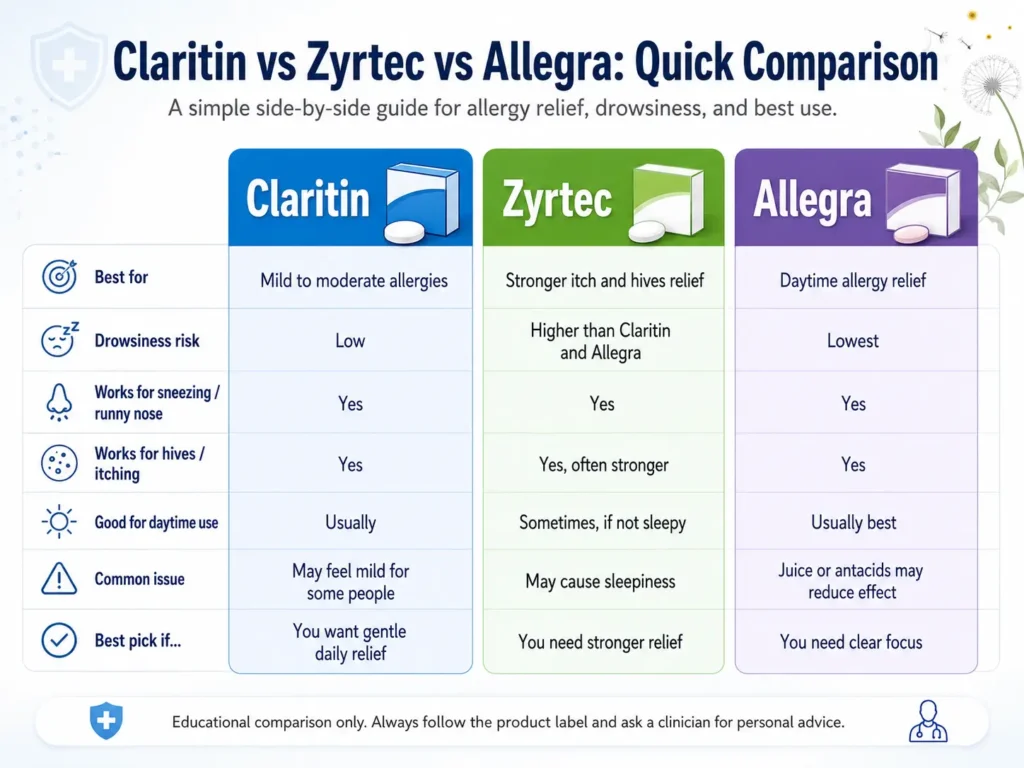
Claritin vs Zyrtec vs Allegra: Quick Comparison
Feature | Claritin | Zyrtec | Allegra |
Generic name | Loratadine | Cetirizine | Fexofenadine |
Best for | Mild to moderate allergies | Stronger itch and hives relief | Daytime allergy relief |
Drowsiness risk | Low | Higher than Claritin and Allegra | Lowest |
Works for sneezing/runny nose | Yes. | Yes. | Yes. |
Works for hives/itching | Yes. | Yes, often stronger. | Yes. |
Good for daytime use | Usually | Sometimes, if not sleepy | Usually best |
Common issue | May feel mild for some people | May cause sleepiness | Juice/antacids may reduce the effect. |
Best pick if… | You want gentle daily relief. | You need stronger relief. | You need clear focus. |
This comparison is based on common clinical use, labeling warnings, and allergic rhinitis treatment guidance (DailyMed, n.d.-a; DailyMed, n.d.-b; DailyMed, n.d.-c; Linton et al., 2023; Wise et al., 2023).
Claritin vs Zyrtec: Which Is Better?
Zyrtec is usually stronger than Claritin for itching, hives, and more intense allergy symptoms. However, Zyrtec is more likely to cause drowsiness. Claritin is usually better for mild daily allergies when you want a lower chance of sleepiness (DailyMed, n.d.-b; Linton et al., 2023).
Need | Better choice |
Stronger allergy relief | Zyrtec |
Less drowsiness | Claritin |
Hives and itching | Zyrtec |
Mild daily allergies | Claritin |
Faster relief | Zyrtec |
Daytime use | Claritin, if Zyrtec makes you sleepy |
This comparison is based on antihistamine treatment evidence and labeling warnings (DailyMed, n.d.-b; Linton et al., 2023).
Allegra vs Claritin: Which Is Better?
Allegra may be better than Claritin if you need allergy relief during the day with the lowest chance of drowsiness. Claritin may be better if your symptoms are mild to moderate and you want a simple once-daily allergy medicine.
The main difference is that Allegra contains fexofenadine, while Claritin contains loratadine. Both are second-generation antihistamines, but Allegra is often preferred for daytime focus, while Claritin is often used as a gentle daily option.
Choose Allegra if:
– You want the least drowsiness.
– You need daytime allergy relief.
– You drive, study, or work long hours.
– Claritin feels too mild for you.
Choose Claritin if:
– Your symptoms are mild.
– You want steady daily relief.
– You prefer a low-sedating option.
– You do not want to worry about fruit juice reducing absorption.
If your main symptom is nasal congestion, neither Allegra nor Claritin may be enough on its own. A nasal spray or nasal-first treatment plan may work better for blocked nose symptoms.
Allegra vs Zyrtec: Which Is Better?
Zyrtec may be better if your main symptoms are itching, hives, or stronger allergy flare-ups. Allegra may be better if you need daytime relief without feeling sleepy.
Zyrtec can feel stronger for some people, but it also has a higher chance of drowsiness. Allegra is usually less sedating, so it is often a better choice for work, school, driving, and daytime use.
Choose Zyrtec if itching or hives are your main problem. Choose Allegra if staying alert is more important.
Loratadine vs Fexofenadine vs Cetirizine: Generic Names Explained
Claritin, Zyrtec, and Allegra are brand names. Their generic names are different:
– Claritin = loratadine
– Zyrtec = cetirizine
– Allegra = fexofenadine
Loratadine is usually a gentle, low-sedating option. Cetirizine may feel stronger for itching and hives but can cause more drowsiness. Fexofenadine is usually the least drowsy and is often preferred for daytime use.
Which Allergy Medicine Is Best for You?
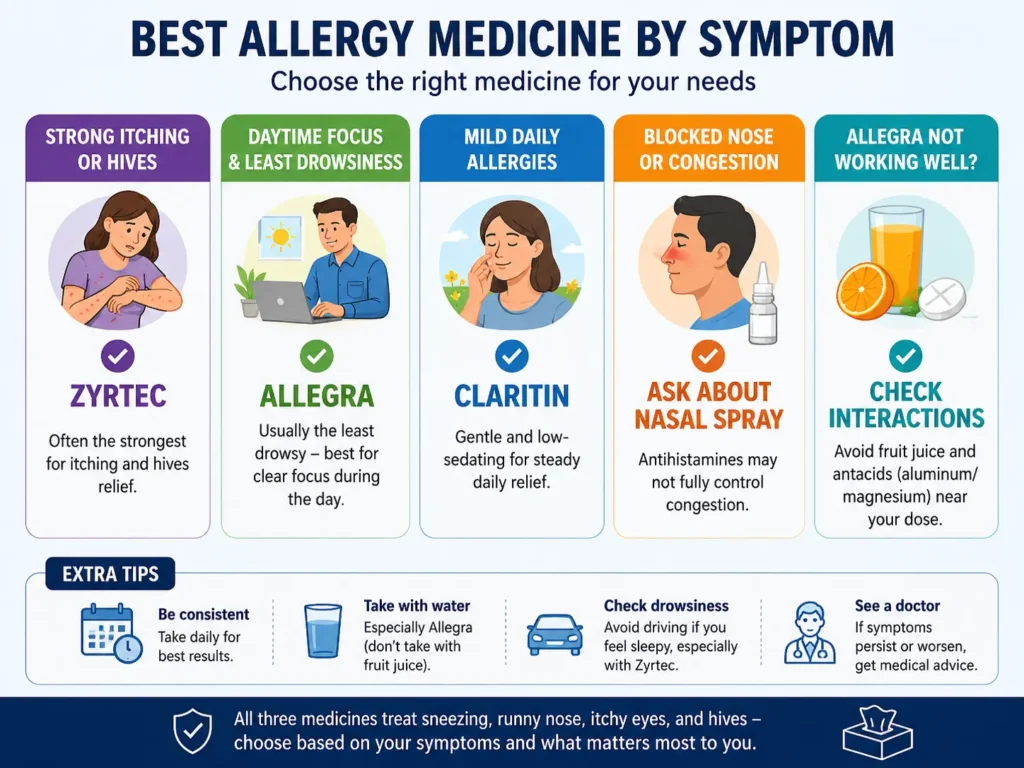
Your main need | Best option | Why |
Strongest symptom relief | Zyrtec | Often stronger for itching and hives |
Least drowsiness | Allegra | Usually best for daytime focus |
Mild daily allergies | Claritin | Gentle and low-sedating for many people |
Driving or studying | Allegra | Lower chance of brain fog |
Hives and intense itching | Zyrtec | Often preferred for itch control |
Allergy symptoms with blocked nose | Ask about nasal spray | Antihistamines may not fully control congestion. |
Note: This situation-based guidance is based on antihistamine treatment evidence and allergic rhinitis guidance (Linton et al., 2023; Wise et al., 2023).
Does Zyrtec Make You Sleepy?
Yes, Zyrtec can make some people sleepy. Cetirizine is a second-generation antihistamine, but it can still cause drowsiness in sensitive people. If you are taking it for the first time, avoid driving or operating machinery until you know how your body reacts (DailyMed, n.d.-b; Yang et al., 2026).
Which Works Fastest: Claritin, Zyrtec, or Allegra?
Medicine | Typical onset | Practical note |
Zyrtec | Often around 1 hour | May feel faster for itching/hives |
Allegra | Can work quickly if absorbed well | Take with water, not juice |
Claritin | May feel slower for some people | Often better for steady mild symptoms |
Note: Onset and perceived speed can vary by person, product form, and symptom type (Linton et al., 2023).
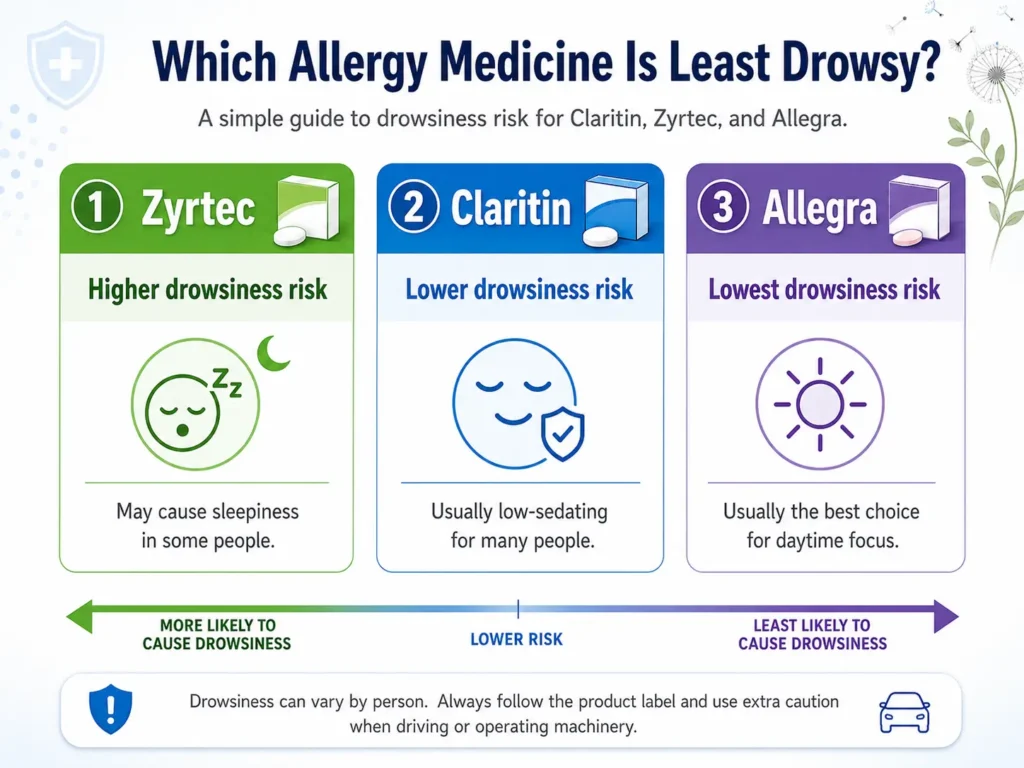
Which Is the Least Drowsy: Claritin, Zyrtec, or Allegra?
Allegra is usually the least drowsy option among the three. Claritin is also low-sedating for many people. Zyrtec may work well, but it has a higher chance of causing sleepiness compared with Claritin and Allegra (DailyMed, n.d.-b; Linton et al., 2023).
What Are Claritin, Zyrtec, and Allegra Used For?
Claritin, Zyrtec, and Allegra are commonly used for allergic rhinitis symptoms such as sneezing, runny nose, itching, and watery eyes. They may also help with itching and hives (Rosenfield et al., 2024; Wise et al., 2023).
They are commonly used for:
• Year-round allergies
• Sneezing
• Runny nose
• Itchy or watery eyes
• Itching
• Hives
How Claritin, Zyrtec, and Allegra Work
What histamine does
When your body reacts to triggers (pollen, dust mites, pet dander), it can release histamine. Histamine attaches to H1 receptors in your:
- nose (sneezing, runny nose, itch)
- eyes (itchy/watery eyes)
- skin (itch, hives)
How antihistamines block allergy symptoms
Claritin, Zyrtec, and Allegra act at H1 receptors, reducing the “histamine signal” and calming symptoms like:
- sneezing
- runny nose
- itchy eyes
- skin itching
- hives
These medicines work mainly by acting on H1 histamine receptors, which help reduce common allergy symptoms (Linton et al., 2023).
Why drowsiness differs
Drowsiness depends partly on how much of the medicine affects the central nervous system. Allegra is usually less sedating, Claritin is usually low-sedating, and Zyrtec is more likely to cause sleepiness in some people (Linton et al., 2023; Yang et al., 2026).
Why Allegra May Not Work Well: Juice and Antacid Interactions
Problem | What happens | Better choice |
Taking Allegra with fruit juice | May reduce absorption | Take with water. |
Taking Allegra near antacids | May reduce effect | Separate from aluminum/magnesium antacids |
Expecting it to fix congestion | May disappoint | Consider nasal treatment advice. |
Irregular use during allergy season | Relief may feel weak. | Use consistently as directed. |
Note: Allegra absorption can be reduced by fruit juice and certain antacids (DailyMed, n.d.-c).
Side Effects of Claritin, Zyrtec, and Allegra
Side effect | Claritin | Zyrtec | Allegra |
Drowsiness | Low risk | Higher risk | Lowest risk |
Headache | Possible | Possible | Possible |
Dry mouth | Possible | Possible | Possible |
Dizziness | Possible | Possible | Less common |
Fatigue | Possible | More likely | Possible |
Note: Side effects can vary by person and product form. Always follow the label (DailyMed, n.d.-a; DailyMed, n.d.-b; DailyMed, n.d.-c).
When to get medical help
Face, lip, tongue, or throat swelling
Trouble breathing
Severe rash
Fainting
Severe confusion
These symptoms can signal a serious reaction and should be treated as safety warnings (DailyMed, n.d.-a; DailyMed, n.d.-b; DailyMed, n.d.-c).
Claritin, Zyrtec, and Allegra Dosage by Age
Doses vary by country, product form, and brand. Always follow the exact product label or ask a clinician, especially for children, older adults, pregnancy, breastfeeding, kidney disease, or liver disease.
Medicine | Common adult direction | Children | Caution |
Claritin | Often once daily | Depends on age/product | Ask a doctor with liver/kidney disease. |
Zyrtec | Often once daily | Depends on age/product | May cause drowsiness |
Allegra | Once or twice daily, depending on the product | Depends on age/product | Avoid juice and certain antacids. |
Note: Dosage depends on age, product form, and health conditions. Always follow the exact product label (DailyMed, n.d.-a; DailyMed, n.d.-b; DailyMed, n.d.-c).
Best Choice by Situation
Situation | Best option | Why |
You need to drive or study. | Allegra | Least likely to cause drowsiness |
You have strong itching or hives. | Zyrtec | Often stronger for itch relief |
You have mild seasonal allergies. | Claritin | Gentle daily option |
You felt sleepy on Zyrtec. | Allegra or Claritin | Usually less sedating |
You take antacids often. | Claritin or Zyrtec may be simpler. | Allegra can interact with aluminum/magnesium antacids. |
Your main issue is congestion. | Ask about nasal sprays | Antihistamines may not be enough. |
Note: These situation-based choices are based on common antihistamine use, drowsiness risk, Allegra interaction warnings, and nasal congestion treatment guidance (DailyMed, n.d.-b; DailyMed, n.d.-c; Linton et al., 2023; Torres et al., 2024).
Pregnancy, Breastfeeding, Older Adults, and Health Conditions
Pregnancy
Claritin and Zyrtec are often listed as common options during pregnancy when an oral antihistamine is needed, but pregnant patients should confirm with their OB provider before use (ACOG, n.d.; Rosenfield et al., 2024; Specialist Pharmacy Service, 2025).
Breastfeeding
Many lactation references consider loratadine, cetirizine, and fexofenadine compatible in usual doses, but the baby should be monitored for unusual sleepiness, poor feeding, or irritability (National Library of Medicine, 2025a, 2025b; National Library of Medicine, 2026; Specialist Pharmacy Service, 2026).
Older adults
In older adults, the biggest issues are
- medication interactions
- kidney function changes
- sensitivity to sedation
Second-generation antihistamines are usually preferred over first-generation antihistamines because they are less sedating and have a lower anticholinergic burden (Linton et al., 2023).
Kidney or liver disease
OTC labels commonly advise clinician guidance if you have kidney disease (especially for fexofenadine) or liver/kidney disease (often for loratadine) (DailyMed, n.d.-a; DailyMed, n.d.-c).
Can You Take Claritin, Zyrtec, and Allegra Together?
No, you should not usually take Claritin, Zyrtec, and Allegra together unless a clinician tells you to. They are all H1 antihistamines, so stacking them may increase side effects without giving better routine allergy control (Linton et al., 2023).
Avoid alcohol and sedatives with Zyrtec
Cetirizine labeling warns that alcohol, sedatives, and tranquilizers may increase drowsiness (DailyMed, n.d.-b).
Do not take Allegra with fruit juice
Avoid orange, grapefruit, and apple juice near your Allegra dose. Take Allegra with water unless your clinician says otherwise (DailyMed, n.d.-c).
Be careful with “-D” versions
Don’t assume “D” (pseudoephedrine) is just a stronger antihistamine. It adds a stimulant-like decongestant that can cause:
- insomnia
- jitters/anxiety
- increased heart rate
- increased blood pressure
Use caution or avoid if you have hypertension, heart disease, glaucoma, prostate enlargement, or significant insomnia. Pregnant patients should be especially careful with pseudoephedrine and should ask an OB provider before using “-D” allergy products (ACOG, n.d.).
Claritin-D vs Allegra-D vs Zyrtec-D: What’s the Difference?
Claritin-D, Allegra-D, and Zyrtec-D are not just stronger versions of Claritin, Allegra, and Zyrtec. The “D” usually means the product contains pseudoephedrine, a decongestant used for nasal blockage.
Regular Claritin, Zyrtec, and Allegra mainly help sneezing, itching, runny nose, and watery eyes. The “D” versions may help more with congestion, but they can also cause side effects such as trouble sleeping, nervousness, faster heartbeat, or increased blood pressure.
People with high blood pressure, heart disease, glaucoma, prostate problems, anxiety, insomnia, pregnancy, or certain medication use should ask a clinician before using “D” allergy products.
How to Use Allergy Medicine So It Works Better
- Match the medicine to your main symptom
Itching/hives → Zyrtec
Daytime focus → Allegra
Mild symptoms → Claritin - Use it consistently during allergy season
Random dosing often gives weaker results. - Check common mistakes
Allegra with juice, Zyrtec causing sleepiness, or congestion needing a different treatment plan.
Why Your Nose May Still Feel Blocked
Claritin, Zyrtec, and Allegra can help sneezing, itching, and runny nose, but nasal congestion may need a different approach. If a blocked nose is your main symptom, ask a clinician whether a nasal spray or nasal-first allergy plan is better for you (Torres et al., 2024; Wise et al., 2023).
When to See a Doctor
See a clinician urgently if you have:
- breathing difficulty/wheezing
- facial swelling or throat tightness
- severe or spreading rash
- fainting or severe confusion
See a clinician soon (non-urgent) if:
- Symptoms persist despite correct use
- You suspect asthma (cough/wheeze with allergies)
- You have frequent sinus infections or severe facial pain
- Hives are unusual (painful, bruising, or blistering) or persistent
Final Verdict: Claritin vs Zyrtec vs Allegra
Zyrtec is often the best choice when you need stronger relief, especially for itching and hives, but it may cause drowsiness. Allegra is usually the best daytime choice because it is least sedating. Claritin is a good gentle option for mild to moderate allergies. If congestion is your main problem, an oral antihistamine may not be enough, and you may need a nasal-focused treatment plan (Linton et al., 2023; Torres et al., 2024; Wise et al., 2023).
Medical Disclaimer
This article is for educational purposes only and does not replace medical advice. Always follow your product label. Talk with a licensed clinician for infants, pregnancy, breastfeeding, kidney or liver disease, chronic illness, or if you take other medications.
Frequently Asked Questions
Which is better, Claritin, Zyrtec, or Allegra?
The best choice depends on your main allergy problem. Zyrtec is often stronger for itching and hives, Allegra is usually the least drowsy option for daytime use, and Claritin is a gentle daily choice for mild to moderate allergy symptoms.
Is Zyrtec stronger than Claritin?
Zyrtec may feel stronger than Claritin for many people, especially for hives, itching, and more intense allergy symptoms. However, Zyrtec is also more likely to cause drowsiness, so Claritin may be better if you want a lower chance of sleepiness.
Is Allegra better than Zyrtec?
Allegra may be better than Zyrtec if you need allergy relief without feeling sleepy during the day. Zyrtec may be better if your main problem is strong itching or hives. The better option depends on whether you care more about strength or low drowsiness.
Which allergy medicine is least drowsy?
Allegra is usually the least drowsy option among Claritin, Zyrtec, and Allegra. Claritin is also low-sedating for many people. Zyrtec can work well, but it has a higher chance of making some people sleepy.
Is Allegra better than Claritin?
Allegra may be better than Claritin if you want daytime allergy relief with the lowest chance of drowsiness. Claritin may be better for mild daily allergies when you want a gentle, simple option.
What is the difference between Allegra and Claritin?
Allegra contains fexofenadine, while Claritin contains loratadine. Both are second-generation antihistamines, but Allegra is usually less drowsy, while Claritin is often a gentle daily option for mild to moderate allergies.
Is Claritin or Allegra better for congestion?
Neither Claritin nor Allegra is usually the best option if nasal congestion is your main symptom. Oral antihistamines may help sneezing and runny nose, but a nasal spray or nasal-first plan may work better for blocked nose.
Is Allegra the same as Zyrtec?
No. Allegra contains fexofenadine, while Zyrtec contains cetirizine. Zyrtec may feel stronger for itching and hives, but Allegra is usually less likely to cause drowsiness.
Which is better: Claritin, Zyrtec, or Allegra for daytime use?
Allegra is usually the best daytime option because it is least likely to cause drowsiness. Claritin is also low-sedating for many people. Zyrtec may work well but can make some people sleepy.
Which works faster, Claritin, Zyrtec, or Allegra?
Zyrtec often works quickly for many people and may start helping within about an hour. Allegra can also work well when taken correctly with water. Claritin may feel milder or slower for some users, but it can still help with daily allergy symptoms.
Which is better for hives, Zyrtec or Allegra?
Zyrtec is often preferred for hives and intense itching because it may provide stronger symptom relief. Allegra can also help hives, but it may be a better choice when avoiding drowsiness is more important.
Which is better for daytime use, Claritin or Allegra?
Allegra is usually the better daytime option if your main goal is to avoid drowsiness. Claritin is also a good low-sedating option for mild to moderate allergies, but Allegra is often preferred for driving, studying, work, or long shifts.
Does Zyrtec make you sleepy?
Yes, Zyrtec can make some people sleepy. It is a second-generation antihistamine, but drowsiness can still happen. If you are taking Zyrtec for the first time, avoid driving or operating machinery until you know how it affects you (DailyMed, n.d.-b; Yang et al., 2026).
Can I take Claritin and Zyrtec together?
You should not usually take Claritin and Zyrtec together unless a clinician tells you to. They are both antihistamines, so combining them may increase side effects without giving better routine allergy control (Linton et al., 2023).
Can I take Allegra with orange juice?
No, it is better to take Allegra with water. Orange juice, apple juice, and grapefruit juice may reduce how well Allegra is absorbed, which can make it less effective (DailyMed, n.d.-c).
Which allergy medicine is best for a blocked nose?
Claritin, Zyrtec, and Allegra can help sneezing, itching, runny nose, and watery eyes, but they may not fully relieve nasal congestion. If a blocked nose is your main symptom, ask a clinician whether a nasal spray or nasal-first allergy plan is better (Torres et al., 2024; Wise et al., 2023).
Which is safest during pregnancy, Claritin, Zyrtec, or Allegra?
Claritin and Zyrtec are commonly listed as options during pregnancy when an oral antihistamine is needed. However, pregnant patients should always confirm with their OB provider before using any allergy medicine (ACOG, n.d.; Specialist Pharmacy Service, 2025).
Which is better for allergies at night?
Zyrtec may be useful at night if it makes you sleepy and you need stronger relief for itching or hives. However, you should not use antihistamines only as sleep medicine unless a clinician recommends it.
Can children take Claritin, Zyrtec, or Allegra?
Some forms of Claritin, Zyrtec, and Allegra are available for children, but the dose depends on the child’s age, weight, product form, and label instructions. Always follow the exact product label or ask a pediatrician before giving allergy medicine to a child (DailyMed, n.d.-a; DailyMed, n.d.-b; DailyMed, n.d.-c).
References
American College of Obstetricians and Gynecologists. (2025). What medicine can I take for allergies while I’m pregnant? ACOG. https://www.acog.org/womens-health/experts-and-stories/ask-acog/what-medicine-can-i-take-for-allergies-while-im-pregnant
DailyMed. (n.d.-a). Loratadine tablet: Drug label. U.S. National Library of Medicine. https://dailymed.nlm.nih.gov/dailymed/lookup.cfm? setid=196da80c-3dbb-40c7-ac93-8a57d6acb1c3
DailyMed. (n.d.-b). Cetirizine hydrochloride tablet: Drug label. U.S. National Library of Medicine. https://dailymed.nlm.nih.gov/dailymed/drugInfo.cfm?setid=abaf61ad-17bd-4dcf-aff1-6687c4cb1b9f
DailyMed. (n.d.-c). Fexofenadine hydrochloride tablet: Drug label. U.S. National Library of Medicine. https://dailymed.nlm.nih.gov/dailymed/drugInfo.cfm?setid=9738127d-7308-454c-94c8-3229d507370f
Linton, S., Hossenbaccus, L., & Ellis, A. K. (2023). Evidence-based use of antihistamines for treatment of allergic conditions. Annals of Allergy, Asthma & Immunology, 131(4), 412–420. https://doi.org/10.1016/j.anai.2023.07.019
National Library of Medicine. (2025a). Cetirizine. In Drugs and Lactation Database (LactMed®). National Center for Biotechnology Information. https://www.ncbi.nlm.nih.gov/books/NBK501509/
National Library of Medicine. (2025b). Fexofenadine. In Drugs and Lactation Database (LactMed®). National Center for Biotechnology Information. https://www.ncbi.nlm.nih.gov/books/NBK500677/
National Library of Medicine. (2026). Loratadine. In Drugs and Lactation Database (LactMed®). National Center for Biotechnology Information. https://www.ncbi.nlm.nih.gov/books/NBK501009/
Rosenfield, L., Keith, P. K., Quirt, J., Small, P., & Ellis, A. K. (2024). Allergic rhinitis. Allergy, Asthma & Clinical Immunology, 20(Suppl 3), Article 74. https://doi.org/10.1186/s13223-024-00923-6
Specialist Pharmacy Service. (2025). Hay fever or allergic rhinitis: Treatment during pregnancy. NHS Specialist Pharmacy Service. https://www.sps.nhs.uk/articles/hayfever-or-allergic-rhinitis-treatment-during-pregnancy/
Specialist Pharmacy Service. (2026). Using antihistamines during breastfeeding. NHS Specialist Pharmacy Service. https://www.sps.nhs.uk/articles/using-antihistamines-during-breastfeeding/
Torres, M. I., Gil-Mata, S., Bognanni, A., Ferreira-da-Silva, R., Yepes-Nuñez, J. J., Lourenço-Silva, N., Cardoso-Fernandes, A., Ferreira, A., Ferreira-Cardoso, H., Portela, D., Teles, J., Kvedariene, V., Torres, M. J., Klimek, L., Pfaar, O., Brussino, L., Zuberbier, T., Fonseca, J. A., Schünemann, H. J., … Palamarchuk, Y. (2024). Intranasal versus oral treatments for allergic rhinitis: A systematic review with meta-analysis. The Journal of Allergy and Clinical Immunology: In Practice, 12(12), 3404–3418. https://doi.org/10.1016/j.jaip.2024.09.001
Wise, S. K., Damask, C., Roland, L. T., Ebert, C., Levy, J. M., Lin, S. Y., Luong, A. U., Orlandi, R. R., Smith, T. L., & others. (2023). International consensus statement on allergy and rhinology: Allergic rhinitis—2023. International Forum of Allergy & Rhinology, 13(4), 293–859. https://doi.org/10.1002/alr.23090
Yang, T., Wu, X., Yi, X., Xiang, C., Yang, Y., Yang, C., Zheng, X., Han, Y., & Wang, Y. (2026). Gender and age variations in neuropsychiatric adverse events of cetirizine and levocetirizine: A disproportionality analysis of ICSRs from FAERS and EudraVigilance data. Frontiers in Pharmacology, 16, Article 1737359. https://doi.org/10.3389/fphar.2025.1737359