

Antihistamine Rebound Effect: What Happens When You Suddenly Stop Daily Allergy Pills?
Written by: Dr. Muhammad Ihsan Ullah, PhD
Medically reviewed by: Dr. Asma Fareed Khan, PhD—Clinical Pharmacy
Last updated on September 18, 2026
Daily allergy pills such as cetirizine (Zyrtec) and levocetirizine (Xyzal) provide effective relief for millions of people dealing with allergic rhinitis, hives, and other histamine-related conditions. However, some long-term users notice an unexpected problem after stopping these medicines: intense itching that seems different from their usual allergy symptoms.

This has raised an important question among patients: what happens when you stop taking antihistamines every day?
Recent safety information has highlighted rare cases of severe itching after stopping long-term cetirizine or levocetirizine use, making it important to understand the difference between an antihistamine discontinuation reaction and the natural return of allergy symptoms (1).
Quick Answer
The antihistamine rebound effect is a possible reaction that occurs after stopping long-term daily antihistamine use, especially with cetirizine (Zyrtec) and levocetirizine (Xyzal). Some individuals may experience severe itching within days of discontinuation, while others may simply notice their original allergy symptoms returning. This reaction is considered a medication discontinuation effect rather than addiction.
What Is the Antihistamine Rebound Effect After Long-Term Daily Use?
The antihistamine rebound effect describes the possible appearance of symptoms after stopping regular antihistamine therapy. The most recognized example involves severe itching, medically known as pruritus, after discontinuing certain second-generation antihistamines.
Antihistamines work by blocking histamine H1 receptors. Histamine is a chemical messenger involved in allergic responses, including itching, sneezing, nasal congestion, and skin reactions.
Common H1 antihistamines include:
- Cetirizine (Zyrtec)
- Levocetirizine (Xyzal)
- Loratadine (Claritin)
- Fexofenadine (Allegra)
The reaction does not occur in everyone who stops antihistamines. Current evidence suggests that it is uncommon and mainly reported after prolonged daily use of cetirizine or levocetizine (1).
Can Stopping Zyrtec Suddenly Cause Severe Itching?
Some people report severe itching after stopping Zyrtec (cetirizine), particularly after taking it daily for months or years.
The U.S. Food and Drug Administration (FDA) have identified cases where patients developed significant pruritus after discontinuing cetirizine or levocetirizine. In reported cases, individuals often did not experience itching before starting these medications (1).
The itching may involve:
- The entire body
- Multiple areas of the skin
- Skin without visible changes or rash
The exact biological explanation is still being investigated, but researchers believe that changes in histamine signaling after prolonged H1 receptor blockade may contribute to this response (2).
Why Does Itching Occur After Stopping Cetirizine or Levocetirizine?
The precise mechanism behind antihistamine withdrawal itching is not completely understood.
A possible explanation involves the way the body adapts to long-term receptor blocking.
During daily antihistamine use:
- Histamine H1 receptors are continuously blocked.
- Allergy-related signaling is reduced.
- The body maintains a new balance of histamine activity.
After sudden discontinuation:
- Histamine signaling resumes without medication blocking.
- Some individuals may temporarily experience increased sensitivity.
- Severe itching may develop.
This process is different from addiction because antihistamines do not create a reward-based dependency. The concern is a possible physiological adjustment after stopping long-term treatment.
How Long Does Antihistamine Withdrawal Itching Last?
The duration of antihistamine withdrawal itching varies from person to person.
Reported cases indicate that symptoms often begin within a few days after stopping long-term cetirizine or levocetirizine use (1).
Factors that may influence the duration include:
- Length of antihistamine use
- Individual sensitivity
- Underlying allergic conditions
- Overall skin health
Some individuals improve over time, while others may require medical guidance if itching is severe or persistent.
Is This Antihistamine Withdrawal or Are Allergy Symptoms Returning?
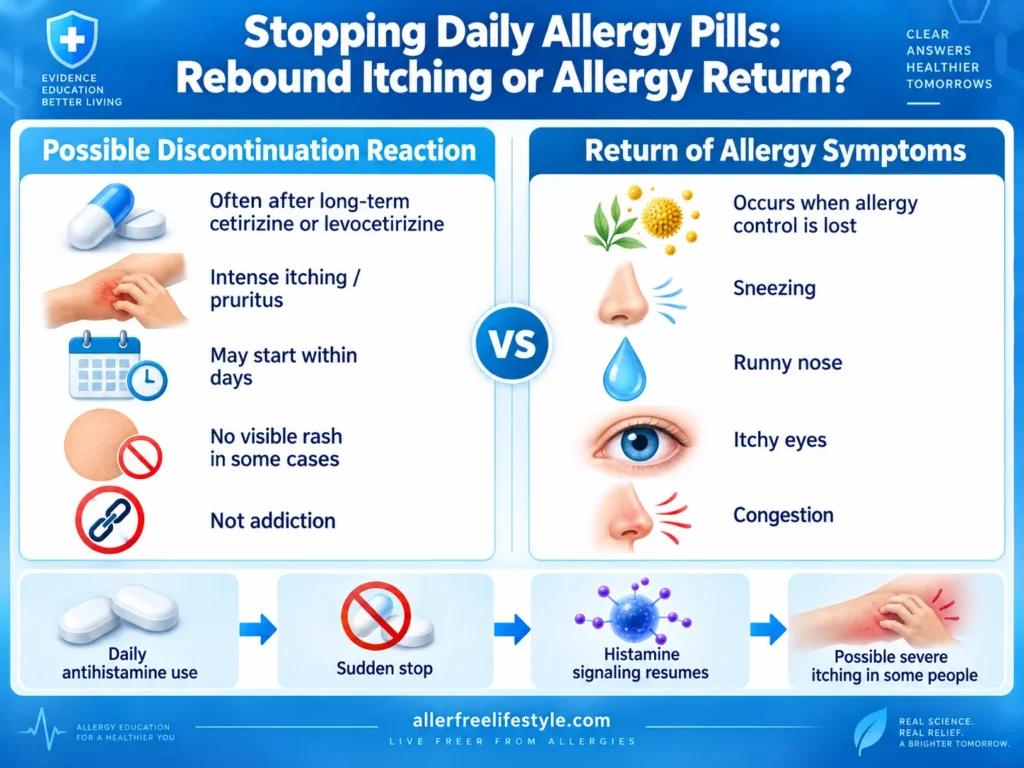
Stopping an allergy medication can create confusion because symptoms may appear similar. However, the underlying reasons are different.
Feature | Antihistamine discontinuation reaction | Return of allergy symptoms |
Main cause | Stopping long-term antihistamine use | Loss of allergy symptom control |
Commonly reported with | Cetirizine and levocetirizine | Any allergy medication |
Typical symptoms | Intense itching or pruritus | Sneezing, runny nose, itchy eyes, congestion |
Timing | Often within days after stopping | Depends on allergen exposure |
Mechanism | Possible temporary change in histamine response | Original allergic inflammation returns. |
Related to addiction? | No | No |
Understanding this difference helps patients avoid assuming every symptom after stopping medication is a withdrawal reaction.
What Happens When You Stop Taking Antihistamines Every Day?
The effect of stopping daily antihistamines depends on the individual and the reason the medication was being used.
Possible outcomes include:
Allergy symptoms may return
If antihistamines were controlling seasonal allergies or chronic allergic symptoms, the original condition may become noticeable again.
A discontinuation reaction may occur
A small number of long-term users of cetirizine or levocetirizine may experience severe itching after stopping treatment (1).
The body readjusts to normal histamine activity
Without medication blocking H1 receptors, normal histamine signaling resumes
For people considering stopping daily antihistamines, discussing medication changes with a healthcare professional may help determine the most appropriate approach.
Is Cetirizine Withdrawal the Same as Antihistamine Dependence?
No. Cetirizine withdrawal is not considered addiction or dependence.
Addiction involves compulsive drug-seeking behavior and reward pathway changes. Antihistamine discontinuation reactions involve a possible physiological response after stopping a medication used regularly.
A person who experiences itching after stopping cetirizine is not “addicted” to the medicine. Instead, the body may be temporarily responding to the absence of long-term histamine receptor blockade.
Medical Disclaimer
This article is intended for educational purposes only and does not replace professional medical advice, diagnosis, or treatment. Consult a qualified healthcare professional before changing long-term medication use, especially if severe itching or unexpected symptoms occur after stopping antihistamines.
Frequently Asked Questions
1. What is the antihistamine rebound effect?
It is a possible discontinuation reaction that may occur after stopping long-term daily antihistamine use, especially involving cetirizine or levocetirizine.
2. Why am I itchy after stopping Zyrtec?
Some people develop intense itching after stopping long-term Zyrtec use. This appears to be a rare discontinuation reaction rather than an allergic response or addiction.
3. How long does antihistamine withdrawal itching last?
The duration differs between individuals. Symptoms may begin within days after stopping the medication and may resolve differently depending on personal factors.
4. Can stopping antihistamines suddenly cause problems?
Most people do not experience major issues, but some long-term users may develop significant itching after stopping certain antihistamines.
5. Is antihistamine withdrawal the same as allergies coming back?
No. Withdrawal-related itching is different from the return of typical allergy symptoms such as sneezing, congestion, or itchy eyes.
References
- U.S. Food and Drug Administration (FDA). Cetirizine or Levocetirizine: Drug Safety Communication — FDA Warns About Risk of Severe Itching After Discontinuation of Long-Term Use of Allergy Medicines. 2025.
Available from: https://www.fda.gov/safety/medical-product-safety-information/cetirizine-or-levocetirizine-drug-safety-communication-fda-warns-about-risk-severe-itching-after
DOI: Not assigned. - Chung AH, La Grenade L, Harinstein LM. Pruritus after discontinuation of cetirizine. Therapeutic Advances in Drug Safety. 2019;10:2042098619859996.
DOI: 10.1177/2042098619859996 - Simons, FER, Simons, KJ. Histamine and H1-antihistamines: Celebrating a century of progress. Journal of Allergy and Clinical Immunology. 2011;128(6):1139–1150.e4.
DOI: 10.1016/j.jaci.2011.09.005