

Claritin vs Zyrtec vs Allegra: Which Allergy Medicine Works Best?
Written by: Dr.Muhammad Ihsan Ullah, PhD
Medically reviewed by: Dr. Muhammad Muzamil Khan & Dr. Asma Fareed Khan
Last updated on February 21,2026

If you’re here, you’re probably not asking “What are allergies?”
You’re asking real-life questions like:
- Which works best: Claritin vs Zyrtec vs Allegra?
- Which is least drowsy for daytime, driving, school, or work?
- Which works fastest—and which lasts the longest?
- What’s safest for infants, kids, pregnancy, breastfeeding, and older adults?
- What should I NOT mix with these meds (alcohol, other antihistamines, fruit juice, antacids, sleep meds, “-D” products)?
- How do they work (class + mechanism of action) in simple terms?
The quick guide
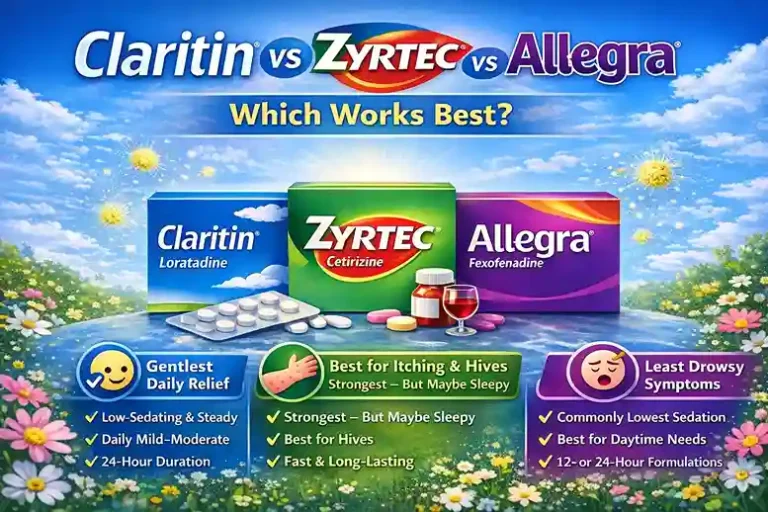
Choose Zyrtec (cetirizine) if…
- you want strong symptom relief
- you have hives or intense itch
- you can tolerate possible sleepiness
Zyrtec is often experienced as “strongest,” especially for itching/hives, but can be more sedating than the others (Linton, S., et al. 2023).
Choose Allegra (fexofenadine) if…
- you need the least drowsyoption
- you drive long hours, operate machinery, work shifts, study, or need clear focus
- you’ve felt sleepy on other antihistamines
Allegra is widely described as among the least sedating second-generation antihistamines (Linton, S., et al. 2023).
Choose Claritin (loratadine) if…
- symptoms are mild to moderate
- you want a gentle dailyoption
- you prefer something that’s usually low-sedating and steady
Second-generation antihistamines like loratadine are commonly recommended for allergic rhinitis (Wise, S. K., et al. 2023).
Comparison table
Feature | Claritin (loratadine) | Zyrtec (cetirizine) | Allegra (fexofenadine) |
Drug class | 2nd-gen H1 antihistamine | 2nd-gen H1 antihistamine | 2nd-gen H1 antihistamine |
“Best for” | mild–moderate allergies | stronger relief, often best for itch/hives | least drowsy daytime use |
Drowsiness | low | higher vs others | lowest |
Works for hives? | yes | yes (often strongest) | yes |
Works for itchy eyes? | yes | yes | yes |
“Big interaction” | organ disease = dosing caution | alcohol/sedatives may worsen drowsiness | fruit juice + antacids reduce absorption |
Pregnancy (typical guidance) | commonly considered an option | commonly considered an option | often acceptable; sometimes less preferred |
Breastfeeding | generally compatible | generally compatible | generally compatible |
Pregnancy guidance commonly lists cetirizine and loratadine among acceptable options when needed (American College of Obstetricians and Gynecologists 2024), (Rosenfield, L., et al. 2024).
Classification
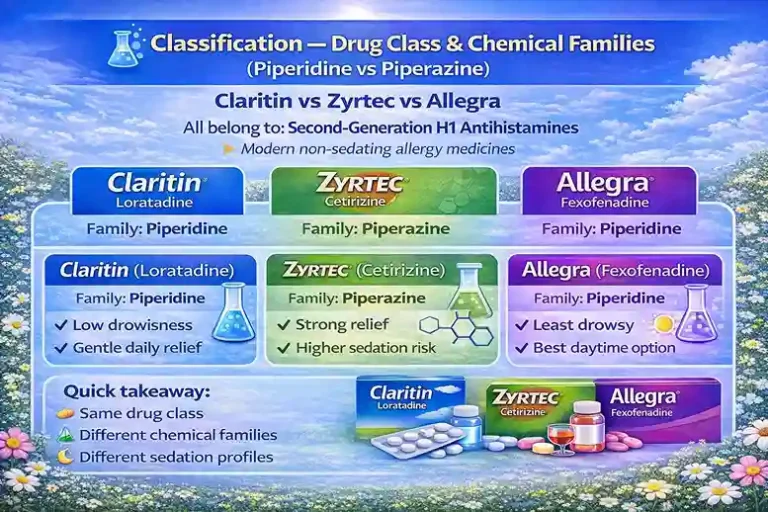
All three are second-generation H1 antihistamines. Many modern references describe them as H1 inverse agonists (more on that in Mechanism of Action) (Linton, S., et al. 2023).
Claritin (loratadine)
- Therapeutic class:Second-generation H1 antihistamine
- Chemical family:Piperidine derivative
- Notable:liver metabolism; has an active metabolite
Zyrtec (cetirizine)
- Therapeutic class:Second-generation H1 antihistamine
- Chemical family:Piperazine derivative
- Notable:can cause more drowsiness in some people vs other second-gen options
Allegra (fexofenadine)
- Therapeutic class:Second-generation H1 antihistamine
- Chemical family:Piperidine derivative
- Notable:very low brain penetration → typically least sedating
Mechanism of action
What histamine does
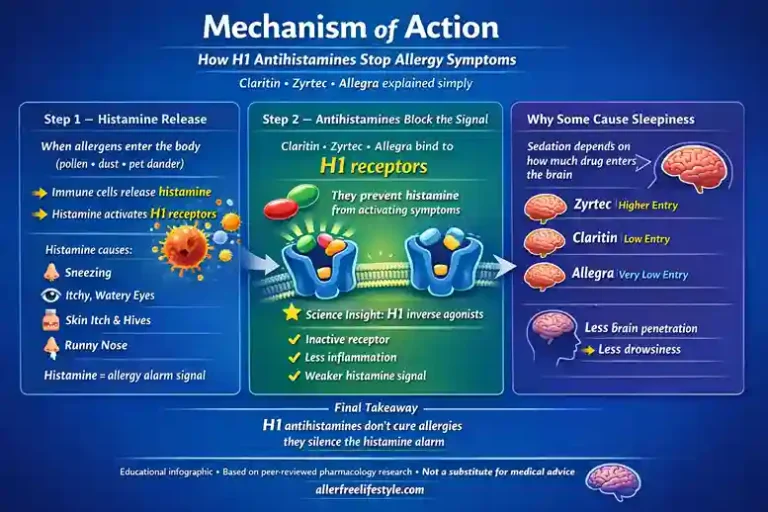
When your body reacts to triggers (pollen, dust mites, pet dander), it can release histamine. Histamine attaches to H1 receptors in your:
- nose (sneezing, runny nose, itch)
- eyes (itchy/watery eyes)
- skin (itch, hives)
What these medications do
Claritin, Zyrtec, and Allegra act at H1 receptors, reducing the “histamine signal” and calming symptoms like:
- sneezing
- runny nose
- itchy eyes
- skin itching
- hives
Many modern pharmacology sources describe newer antihistamines as inverse agonists—they stabilize the H1 receptor in its inactive form, reducing baseline receptor activity and the response to histamine (Linton, S., et al. 2023).
Why drowsiness differs
Drowsiness depends largely on how much of the medication reaches the brain (CNS penetration).
- Cetirizine (Zyrtec): slightly more CNS penetration in some people → higher chance of sleepiness
- Loratadine (Claritin): low CNS penetration → usually low sedation
- Fexofenadine (Allegra): very low CNS penetration → typically least sedating
That’s why “least drowsy allergy medicine” searches often point to Allegra (Linton, S., et al. 2023).
What they treat (pharmacological uses)
All three are used for:
1) Allergic rhinitis (seasonal or year-round)
- sneezing
- runny nose
- itching
- watery eyes
Second-generation antihistamines are widely used in allergic rhinitis management (Wise, S. K., et al. 2023).
2) Urticaria (hives)
- itchy welts
- recurring hives
Second-generation H1 antihistamines are core symptom-control options for hives (Linton, S., et al. 2023).
3) Allergy symptom prevention (during known exposure)
For example: known pet exposure or high-pollen days.
Which one works best for different symptoms?
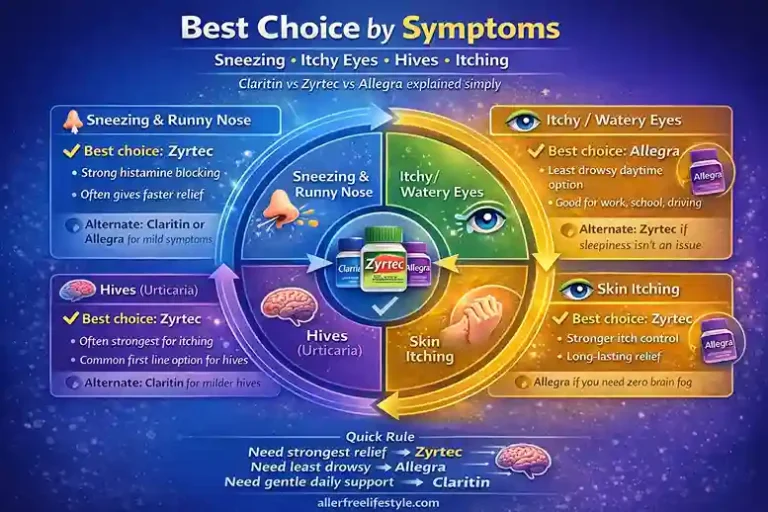
Best for overall symptom relief
Many patients report Zyrtec gives the strongest overall relief—especially when itch or hives are the dominant symptom (Linton, S., et al. 2023).
Best for hives and itch
Zyrtec is commonly used for hives because it can be strong for itch control—but sedation varies widely by person.
Best for daytime performance (work, driving, studying)
Allegra is often the best match when your biggest fear is feeling “foggy” or sleepy.
Best for “gentle daily support”
Claritin is a common choice for mild symptoms or people who want a steady, usually low-sedating option.
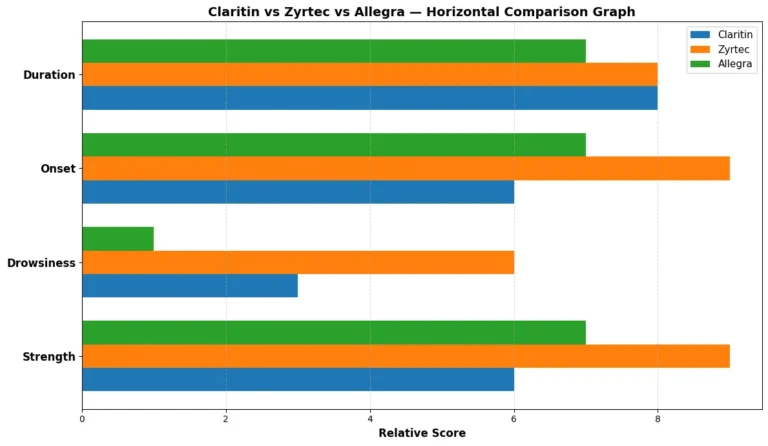
Onset and duration (fastest vs longest)
People often ask: “Which works fastest?” and “Which lasts longest?”
Onset (how quickly you may feel it)
- Many people feel Zyrtecwithin about an hour
- Allegracan feel fast too—but only if absorbed properly
- Claritincan feel milder or slower for some people
Duration (how long it lasts)
Most common “once daily” versions of these medicines are intended to provide 24-hour coverage, though some Allegra products are dosed twice daily depending on formulation.
Key point: If your medication “doesn’t work,” it’s often not because it’s a bad drug—it’s because of absorption blockers, wrong timing, or the wrong symptom target (e.g., congestion).
The reason Allegra “doesn’t work”: absorption blockers
Two huge “clinic pearls”:
1) Allegra + fruit juice = less absorption
Fexofenadine labeling warns against taking it with fruit juice because it can reduce absorption and effectiveness (DailyMed 2024c).
Simple rule: take Allegra with water. Keep juice away by several hours.
2) Allegra + aluminum/magnesium antacids = less absorption
Fexofenadine labeling also warns about taking it with aluminum/magnesium antacids (DailyMed 2024c).
Professional drug information describes reduced exposure when taken close together (Drugs.com 2025).
Simple rule: separate by about 2 hours.
Drowsiness, sleep, driving, and “brain fog”
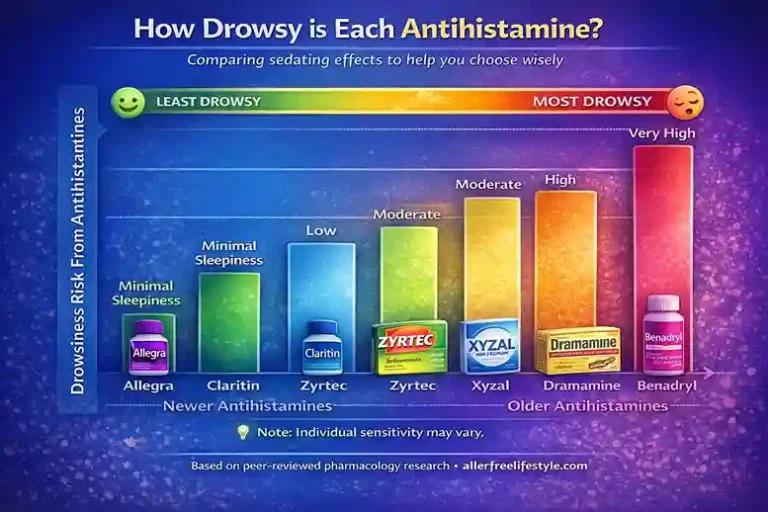
This is where most people decide between Zyrtec and Allegra.
Typical sedation trend
Zyrtec > Claritin > Allegra (more to less likely to cause drowsiness in typical use).
A safe “first dose” rule
If you haven’t used a medication recently:
- take the first dose at home
- wait several hours before driving/operating machinery
- if you feel sleepy, switch to a less sedating option
Sleep: can these help you sleep?
Some people intentionally take Zyrtec at night if it makes them drowsy. That can be practical—but you should never rely on antihistamines as sleep medication, and you should avoid combining them with other sedatives unless a clinician advises it.
Side effects (adverse effects)
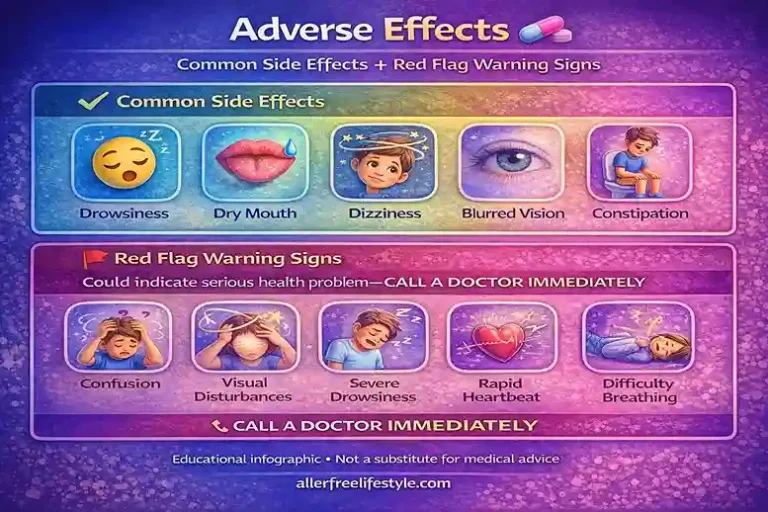
Common side effects (most people)
- mild sleepiness (more common with Zyrtec)
- dry mouth
- headache
- dizziness
- fatigue
“Stop and seek help” warning signs
Seek urgent care if you get:
- swelling of lips/face/tongue
- breathing difficulty
- severe rash, blistering, or widespread hives with systemic symptoms
- fainting or severe confusion
OTC labeling instructs users to stop and seek medical advice for allergic reactions and certain severe symptoms (DailyMed 2024c).
Dosing by life stage (infants, kids, adults, older adults)
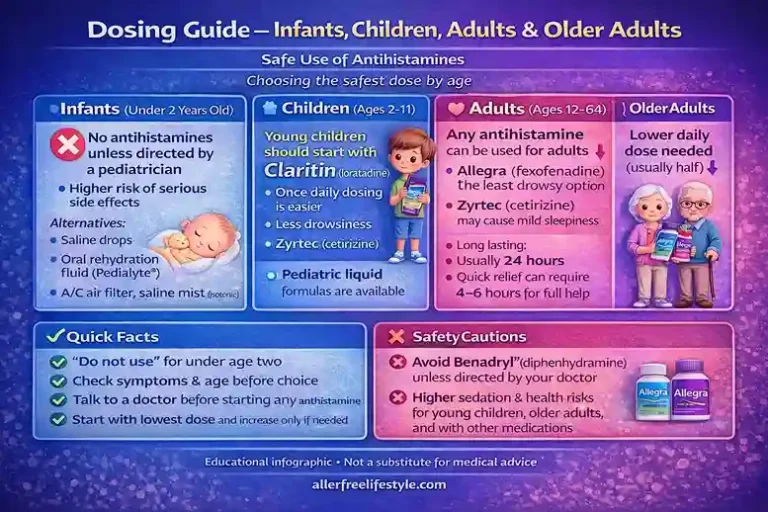
Important: Doses vary by country, product form, and brand/generic. Always follow your exact label. The goal here is to help you understand the usual labeling patterns and how clinicians think about dosing safely.
Claritin (loratadine):
- Children 2 to under 6 years:often 5 mg once daily (liquid/tablet depends on product)
- Age 6+ and adults:often 10 mg once daily
- Under 2 years:clinician guidance
- Liver/kidney disease:may need a different dose; label often advises “ask a doctor” (DailyMed 2024a).
Zyrtec (cetirizine):
- Infants 6 to 23 months:some labels include 2.5 mg once daily (and sometimes adjustments depending on age) (DailyMed 2024b).
- Children:dose varies by age and formulation
- Adults:commonly 10 mg once daily
- Kidney disease:may require adjustment
- Older adults:some products recommend lower maximum dose—check your label (DailyMed 2024b).
Allegra (fexofenadine):
- Adults/children 12+: commonly 60 mg twice daily or 180 mg once daily (depending on product)
- Children under 12:depends on formulation/strength
- Kidney disease:label commonly advises clinician guidance for dosing (DailyMed 2024c).
Special populations

A) Pregnancy: what’s typically preferred
A common question is: “Which is safest during pregnancy?”
Guidance and reviews often note:
- cetirizine (Zyrtec)and loratadine (Claritin) may be considered when an oral antihistamine is needed during pregnancy (American College of Obstetricians and Gynecologists 2024).
- Specialist pharmacy guidance lists cetirizine and loratadine as preferred optionsduring pregnancy (Specialist Pharmacy Service 2025).
Practical pregnancy tip: Use the lowest effective dose, avoid unnecessary “-D” decongestants unless your clinician recommends them, and confirm your plan with your OB provider.
B) Breastfeeding: compatibility + what to monitor
Lactation references generally consider loratadine, cetirizine, and fexofenadine compatible in usual doses, with monitoring (National Library of Medicine 2025a), (National Library of Medicine 2025b), (National Library of Medicine 2025c).
Specialist pharmacy guidance also lists cetirizine and loratadine as preferred in breastfeeding for full-term healthy infants (Specialist Pharmacy Service 2025).
What to monitor in the baby:
- unusual sleepiness
- poor feeding
- irritability
- slow weight gain
Big breastfeeding caution: “-D” products (pseudoephedrine) may reduce milk supply in some people, especially early postpartum. Lactation references highlight this concern (National Library of Medicine 2025a),(National Library of Medicine 2025b), (National Library of Medicine 2025c).
C) Older adults
In older adults, the biggest issues are:
- medication interactions
- kidney function changes
- sensitivity to sedation
Second-generation antihistamines are usually preferred over first-generation due to lower sedation and anticholinergic burden (Linton, S., et al. 2023).
D) Kidney or liver disease
OTC labels commonly advise clinician guidance if you have kidney disease (especially for fexofenadine) or liver/kidney disease (often for loratadine) (DailyMed 2024a).
“Don’t mix with…”
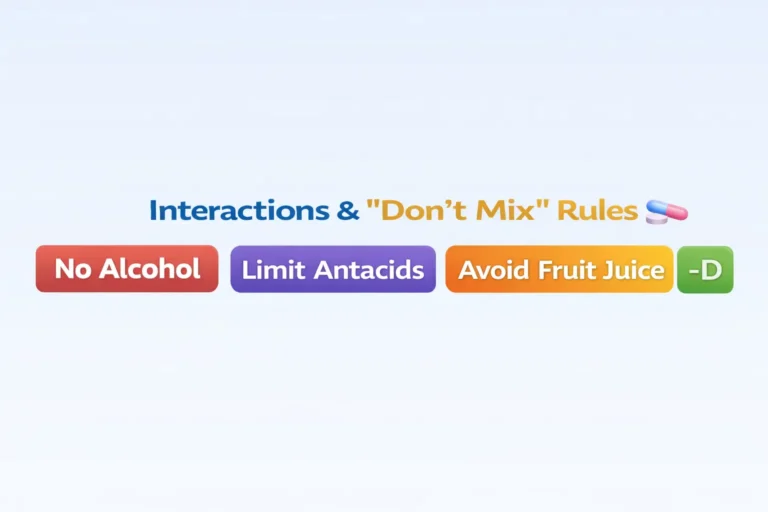
1) Don’t stack antihistamines (Claritin + Zyrtec + Allegra)
They’re the same class (H1 antihistamines). Taking more than one usually increases side effects without proven added benefit. If one doesn’t work, switch rather than combining.
2) Alcohol and sedatives
Alcohol and sedatives can worsen drowsiness and impairment—especially if you’re already sleepy on Zyrtec.
3) Allegra rules
- No fruit juice(orange, grapefruit, apple) near your Allegra dose (DailyMed 2024c).
- Separate aluminum/magnesium antacidsby about 2 hours (Drugs.com 2025).
4) “-D” products (pseudoephedrine)
Don’t assume “D” is just a stronger antihistamine. It adds a stimulant-like decongestant that can cause:
- insomnia
- jitters/anxiety
- increased heart rate
- increased blood pressure
Use caution or avoid if you have hypertension, heart disease, glaucoma, prostate enlargement, or significant insomnia.
When to use each
Pick Zyrtec if you want…
- strongest relief
- best chance at controlling itch and hives
- and you can handle possible sleepiness
Best time to take it:
If it makes you sleepy, take it in the evening.
Pick Allegra if you want…
- the least drowsy option
- the best daytime productivity
- fewer “brain fog” complaints
Best time to take it:
Morning (with water), and avoid juice and antacids around the dose.
Pick Claritin if you want…
- a gentle daily option
- lower sedation for many people
- steady relief for mild-to-moderate symptoms
Best time to take it:
Morning or evening—choose what fits your symptoms.
How to use these medicines well (so they actually work)
Step 1: Match the medicine to your main symptom
- Itch/hives dominant → Zyrtec often strongest
- Need clear daytime focus → Allegra
- Mild daily symptoms → Claritin
Step 2: Use it consistently during the season
If your allergies last weeks, “random dosing” often disappoints. Consistent daily use during exposure is typically more effective.
Step 3: Fix the common mistakes
If symptoms persist:
- check Allegra absorption blockers (juice/antacids)
- check sedation issues (Zyrtec timing or switch)
- check if your dominant symptom is congestion
“But my nose is still blocked” (congestion reality check)
Oral antihistamines are great for sneezing/itch/runny nose, but congestion can be stubborn.
Evidence comparing intranasal vs oral therapies suggests intranasal treatments can be more effective than oral treatments for overall symptom control and quality-of-life in many cases (Torres, M. I., et al. 2024).
ARIA work continues to refine recommendations using systematic reviews and GRADE methods (Vieira, R. J., et al. 2024).
Patient-friendly takeaway:
If congestion is your No.1 symptom, ask your clinician about a nasal-first plan instead of “more antihistamine.”
When to seek medical evaluation (don’t keep self-treating)
See a clinician urgently if you have:
- breathing difficulty/wheezing
- facial swelling or throat tightness
- severe or spreading rash
- fainting or severe confusion
See a clinician soon (non-urgent) if:
- symptoms persist despite correct use
- you suspect asthma (cough/wheeze with allergies)
- you have frequent sinus infections or severe facial pain
- hives are unusual (painful, bruising, blistering) or persistent
Medical disclaimer
This article is for educational purposes only and does not replace medical advice. Always follow your product label. Talk with a licensed clinician for infants, pregnancy, breastfeeding, kidney/liver disease, chronic illness, or if you take other medications.
Frequently Asked Questions(FAQs)
1) Which is stronger—Zyrtec, Claritin, or Allegra?
Zyrtec is often experienced as the strongest, especially for itching and hives, but it can cause more drowsiness.
2) Which is least drowsy for daytime and driving?
Allegra is usually the least sedating choice.
3) Can I take Claritin and Zyrtec together?
No. Don’t stack antihistamines. Switch instead.
4) Why can’t I take Allegra with orange juice?
Fruit juice can reduce Allegra absorption, making it less effective.
5) Which is safest during pregnancy?
Claritin and Zyrtec are commonly considered options during pregnancy when medication is needed—confirm with your OB provider.
References
- Wise, S. K., et al. (2023). International consensus statement on allergy and rhinology: Allergic rhinitis 2023. International Forum of Allergy & Rhinology.
- Linton, S., et al. (2023). Evidence-based use of antihistamines for treatment. Annals of Allergy, Asthma & Immunology.
- Rosenfield, L., et al. (2024). Allergic rhinitis. Allergy, Asthma & Clinical Immunology, 20, 923.
- Bousquet, J., et al. (2020). Next-generation Allergic Rhinitis and Its Impact on Asthma (ARIA) guidelines. Journal of Allergy and Clinical Immunology.
- Vieira, R. J., et al. (2024). Protocol for systematic reviews informing the 2024 revision of ARIA guidelines. BMJ Open(PMCID: PMC11270335).
- Torres, M. I., et al. (2024). Intranasal versus oral treatments for allergic rhinitis: Evidence synthesis. The Lancet Respiratory Medicine.
- American College of Obstetricians and Gynecologists. (2024). What medicine can I take for allergies while I’m pregnant? ACOG Patient Guidance.
- Specialist Pharmacy Service. (2025). Hay fever or allergic rhinitis: Treatment during pregnancy. UK NHS Specialist Pharmacy Service.
- Specialist Pharmacy Service. (2025). Using antihistamines during breastfeeding. UK NHS Specialist Pharmacy Service.
- National Library of Medicine. (2025a). Loratadine. In Drugs and Lactation Database (LactMed®).
- National Library of Medicine. (2025b). Cetirizine. In Drugs and Lactation Database (LactMed®).
- National Library of Medicine. (2025c). Fexofenadine. In Drugs and Lactation Database (LactMed®).
- (2024a). Loratadine (OTC) labeling. U.S. National Library of Medicine.
- (2024b). Cetirizine hydrochloride (OTC) labeling. U.S. National Library of Medicine.
- (2024c). Fexofenadine hydrochloride (OTC) labeling. U.S. National Library of Medicine.
- com. (2025). Fexofenadine: Prescribing information. Drug Information Resource.