

Home Environment Optimization for Allergy-Free Living
Written by: Dr.Muhammad Ihsan Ullah, PhD
Medically reviewed by: Dr. Muhammad S.Anil, MD
Last updated on February 20,2026
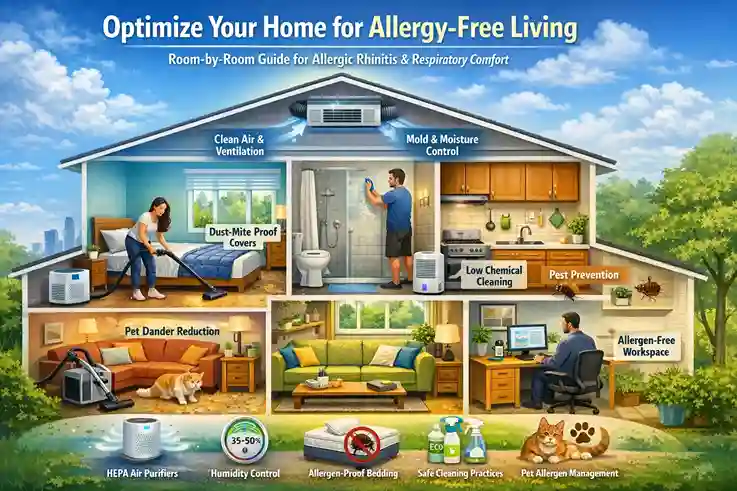
For people living with allergic rhinitis (hay fever), the home environment is the single most important controllable factor influencing daily symptoms. Even with good medications, continuous exposure to dust mites, pet dander, mold spores, indoor allergens, and irritants can keep nasal inflammation active.
Research consistently shows that environmental control especially inside the home reduces allergen load, lowers nasal inflammation, improves sleep, and decreases flare frequency (Bousquet et al., 2020; Dykewicz et al., 2020).
This room-by-room guide explains how to optimize your home for allergy-free living, using practical, evidence-based strategies that support medical care when needed.
Why Home Environment Matters in Allergic Rhinitis
Allergic rhinitis is driven by repeated allergen exposure, not just outdoor pollen. Many people experience perennial (year-round) symptoms due to indoor triggers.
Common indoor contributors include:
- Dust mites (bedding, carpets)
- Pet dander (fur, saliva proteins)
- Mold (bathrooms, kitchens, basements)
- Indoor air pollution
- Cleaning chemicals and fragrances
Reducing exposure at the source is one of the most effective long-term strategies for symptom control.
Core Principles of an Allergy-Friendly Home
An optimized home environment focuses on:
- Clean air
- Controlled humidity
- Minimal dust reservoirs
- Proper ventilation
- Low chemical exposure
Each room plays a different role.
Bedroom: The Most Important Room
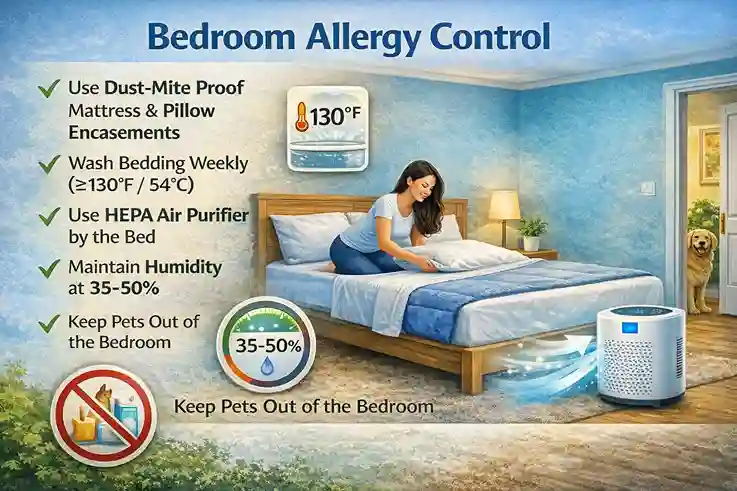
You spend 6–8 hours daily in the bedroom making it the highest-impact area for allergy control.
Key Bedroom Strategies
✔ Dust-mite-proof mattress & pillow encasements
✔ Wash bedding weekly in hot water (≥130°F / 54°C)
✔ Remove heavy curtains and carpets if possible
✔ Keep pets completely out of the bedroom
✔ Use a HEPA air purifier near the bed
✔ Maintain humidity at 35–50%
📌 Why this works:
Dust mites thrive in warm, humid bedding. Reducing exposure significantly improves nasal symptoms and sleep quality (Platts-Mills et al., 2015).
Living Room: Managing Shared Air & Surfaces

Living rooms accumulate allergens from people, pets, furniture, and outdoor air.
Best Practices
- Vacuum carpets and upholstery 1–2 times weekly using a HEPA vacuum
- Dust surfaces with damp microfiber cloths
- Avoid decorative clutter that traps dust
- Use washable rugs instead of wall-to-wall carpeting
- Keep windows closed during high-pollen days
- Avoid scented candles, incense, and air fresheners
Kitchen: Mold & Cockroach Control Zone
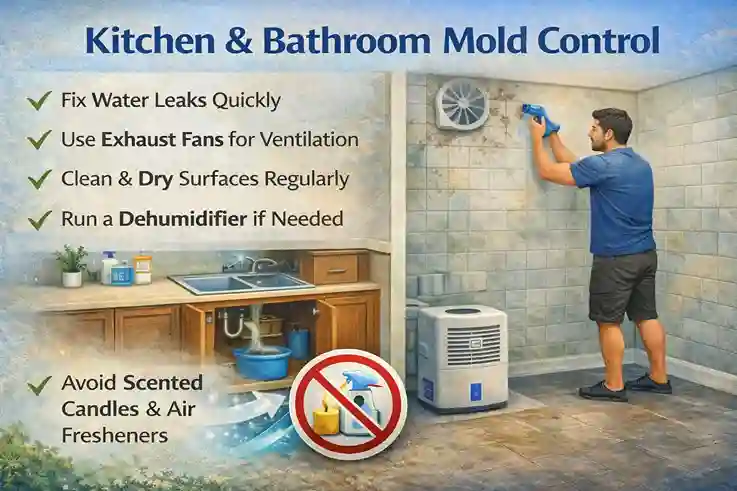
Kitchens can contribute to allergic symptoms through moisture, food debris, and pests.
Optimization Tips
✔ Fix water leaks promptly
✔ Clean sinks, drains, and cabinets regularly
✔ Store food in sealed containers
✔ Take trash out daily
✔ Avoid harsh chemical sprays—use low-odor cleaners
✔ Use exhaust fans during cooking
Cockroach allergens are a significant trigger in urban environments and are linked to worse allergy outcomes (Rosenstreich et al., 1997).
Bathroom: Moisture & Mold Prevention
Bathrooms are ideal environments for mold growth.
Key Actions
- Use exhaust fans during showers
- Keep surfaces dry
- Clean grout and tiles regularly
- Use mold-resistant shower curtains
- Avoid storing damp towels inside rooms
- Use a dehumidifier if ventilation is poor
Mold spores worsen nasal congestion and sinus pressure in sensitive individuals.
Home Office & Study Areas
People with allergic rhinitis often experience concentration problems due to congestion.
Improve Air & Comfort
- Keep desk surfaces minimal
- Clean electronics regularly
- Use an air purifier if room is enclosed
- Avoid perfumes and strong cleaning products
- Maintain ergonomic posture to support breathing
Laundry & Clothing: Hidden Allergen Source
Clothing can carry pollen indoors.
Smart Laundry Habits
✔ Change clothes after outdoor exposure
✔ Wash outdoor clothes promptly
✔ Avoid drying clothes outdoors during pollen season
✔ Store clean clothes in closed wardrobes
Whole-Home Air Quality Control
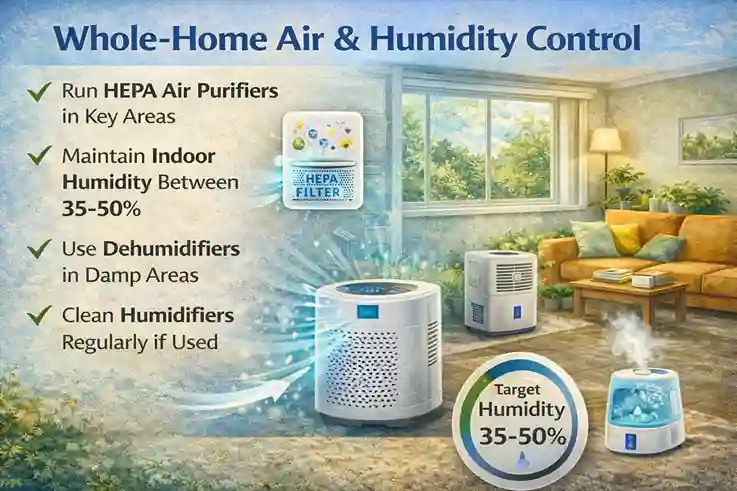
HEPA Air Purifiers
HEPA filters remove:
- Pollen
- Dust mites
- Pet dander
- Mold spores
- Fine particulate matter
Clinical studies show measurable symptom improvement in allergic rhinitis with consistent HEPA use (Reisman et al., 1990).
Indoor Humidity Control
Target range: 35–50%
- High humidity → mold & dust mites
- Low humidity → nasal dryness & irritation
Use:
- Dehumidifiers in damp areas
- Humidifiers in dry climates (clean regularly)
Cleaning Products: Less Is Better
Many “clean” smells irritate allergic airways.
Choose:
✔ Low-odor or fragrance-free cleaners
✔ Simple soap-based products
✔ Vinegar-based solutions (where safe)
Avoid:
❌ Aerosol sprays
❌ Bleach overuse
❌ Strong disinfectant fumes
Pets & Allergic Rhinitis: Realistic Management
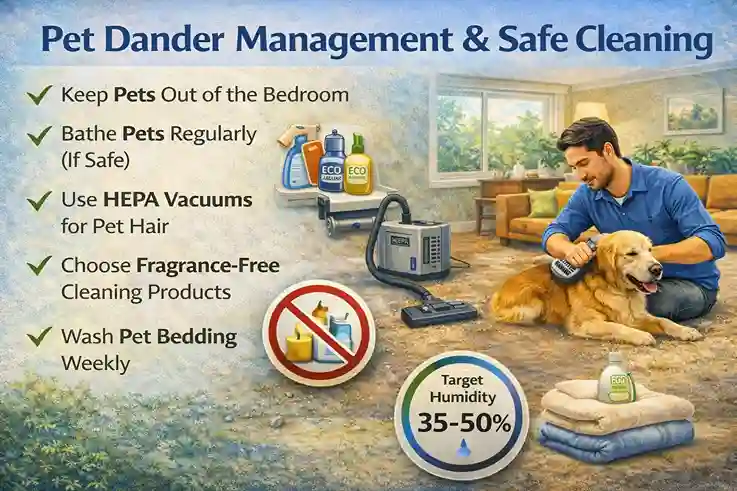
Pets are emotionally important—but allergenic.
Evidence-Based Compromises
- Keep pets out of bedroom
- Bathe pets regularly (if safe)
- Use HEPA vacuum cleaners
- Wash pet bedding weekly
“No truly hypoallergenic pets exist.”
What Home Optimization Can and Cannot Do
✔ Can:
- Reduce allergen load
- Lower symptom frequency
- Improve sleep & breathing
- Reduce medication reliance (supportive)
❌ Cannot:
- Cure allergic rhinitis
- Replace prescribed treatments
- Eliminate all allergens completely
When Environmental Control Is Not Enough
Seek medical advice if:
- Symptoms persist despite optimization
- Asthma symptoms appear
- Frequent sinus infections occur
- Nighttime breathing remains poor
Environmental control works best alongside medical care.
Medical Review Disclaimer
This article is for informational and educational purposes only and does not constitute medical advice. The content is written by a qualified healthcare professional and medically reviewed for accuracy. However, it should not be used as a substitute for professional medical diagnosis, treatment, or advice. Always consult a licensed healthcare provider regarding any medical condition or health concern.
Frequently Asked Questions (FAQs)
5. Which room matters most for allergy control?
The bedroom—because of prolonged exposure.
4. Do air purifiers really help allergic rhinitis?
Yes. HEPA filters significantly reduce airborne allergens.
3. Is frequent cleaning enough without air purifiers?
Cleaning helps, but air purifiers reduce airborne particles that cleaning cannot.
4. Should I remove carpets completely?
If possible, yes—especially in bedrooms.
References
Bousquet, J., Klimek, L., Togias, A., Zuberbier, T., Agache, I., Ansotegui, I. J., … Wallace, D. V. (2020). Next-generation allergic rhinitis and its impact on asthma (ARIA). Journal of Allergy and Clinical Immunology, 145(3), 895–909. https://doi.org/10.1016/j.jaci.2019.12.898
Dykewicz, M. S., Wallace, D. V., Baroody, F., Bernstein, J., Craig, T., Finegold, I., … Portnoy, J. (2020). Rhinitis 2020: A practice parameter update. Journal of Allergy and Clinical Immunology, 146(4), 721–767.
Platts-Mills, T. A. E., et al. (2015). Dust mite allergens and asthma. Journal of Allergy and Clinical Immunology, 136(1), 38–48.
Reisman, R. E., Mauriello, P. M., Davis, G. B., Georgitis, J. W., & DeMasi, J. M. (1990). Effectiveness of HEPA air cleaners in allergic rhinitis. Journal of Allergy and Clinical Immunology, 85(6), 1050–1057.
Rosenstreich, D. L., et al. (1997). The role of cockroach allergy in asthma morbidity. New England Journal of Medicine, 336(19), 1356–1363