

When Is Pollen Season? Tree, Grass & Ragweed Allergy Calendar (2026)
Written by: Dr.Muhammad Ihsan Ullah, PhD
Medically reviewed by: Dr. Jamal ud Din Khan, FCPS
Last updated on August 25, 2026
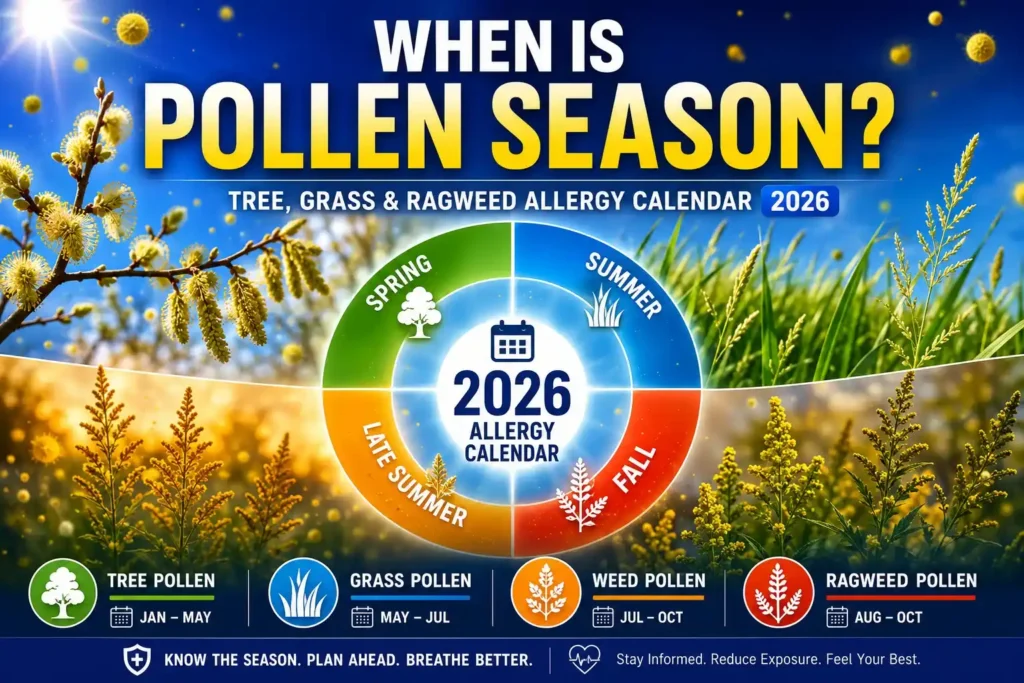
Pollen season is no longer a short, predictable spring event. In many regions of USA, it now starts earlier, lasts longer, and shows higher airborne pollen concentrations than in previous decades. Climate change, urban air pollution, and shifts in plant biology have all contributed to this extended allergy burden (Zhang & Steiner, 2022).
For people sensitive to tree pollen, grass pollen, weed pollen, or ragweed pollen, understanding when each season begins and peaks is essential for planning outdoor activity and reducing exposure.
This 2026 pollen allergy season calendar explains when pollen season starts and ends, when tree pollen season starts, when grass pollen is highest, and when ragweed season becomes worst.
When does pollen season start and end?
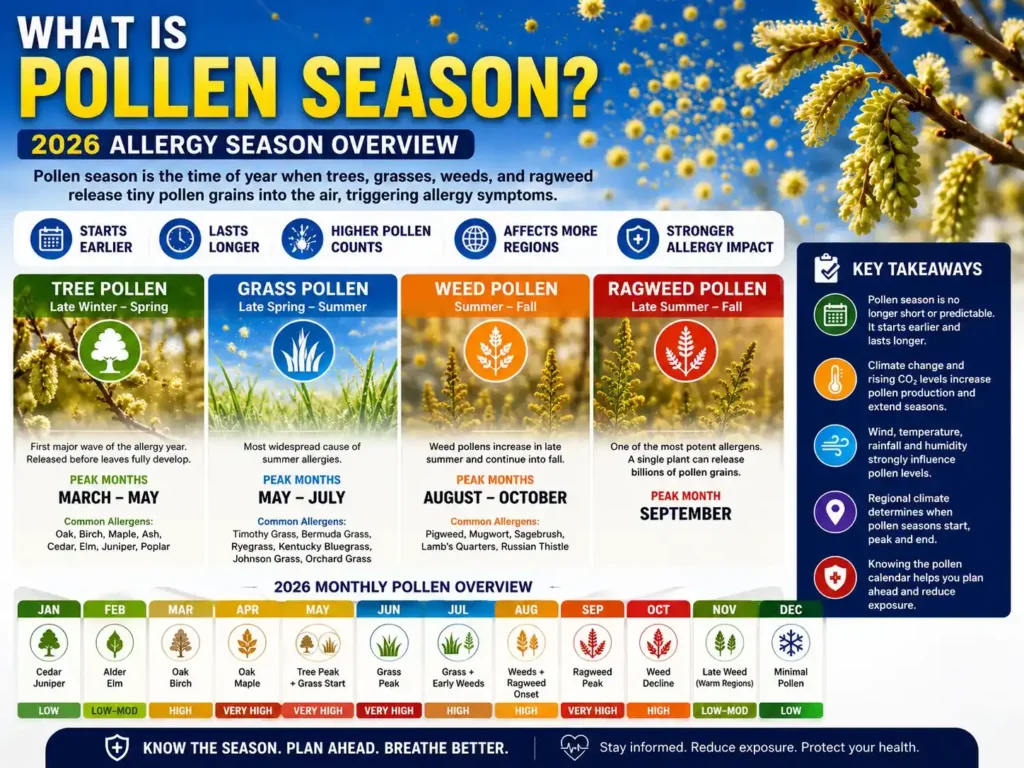
Pollen season does not follow a single fixed timeline. It changes based on climate, region, altitude, and plant species.
In general:
- Tree pollen season begins in late winter or early spring
- Grass pollen season peaks in late spring and summer
- Weed and ragweed pollen season dominates late summer and fall
Warmer climates often experience earlier starts and longer durations, while colder regions have shorter but more intense peaks (D’Amato et al., 2020).
When Will Pollen Season End in 2026?
Pollen season in 2026 will not end on the same date everywhere. In many temperate regions, the main pollen season usually begins to slow down in October, once ragweed and weed pollen decline. In warmer climates, pollen may continue into November, especially if the first frost comes late.
A general 2026 pollen season ending pattern looks like this:
- Tree pollen usually declines by late spring or early summer.
- Grass pollen often drops by mid to late summer.
- Weed pollen may continue into October.
- Ragweed pollen usually ends in October or after the first hard frost.
- Warm regions may have lingering pollen into November.
For many allergy sufferers, the practical answer is: pollen season usually ends after ragweed season finishes. If your symptoms continue after pollen levels drop, indoor allergens such as dust mites, mold, pet dander, or poor air quality may be contributing.
Why are pollen seasons changing?
Modern research confirms that climate change is reshaping pollen patterns worldwide.
Key changes include:
- Earlier spring pollen release
- Longer pollen seasons
- Increased pollen production per plant
- Higher atmospheric pollen concentration
- Expanded ragweed distribution
Rising carbon dioxide levels enhance plant growth and pollen output, particularly in highly allergenic species like ragweed (Zhang & Steiner, 2022).
What months are worst for pollen allergies?
The severity of allergy symptoms depends on pollen type and overlap between seasons.
Typical peak periods:
- Tree pollen → March to May
- Grass pollen → May to July
- Weed pollen → August to October
- Ragweed pollen → September (peak)
September is often the most difficult month for seasonal allergy sufferers due to intense ragweed exposure combined with lingering weed pollen.
Tree pollen season calendar
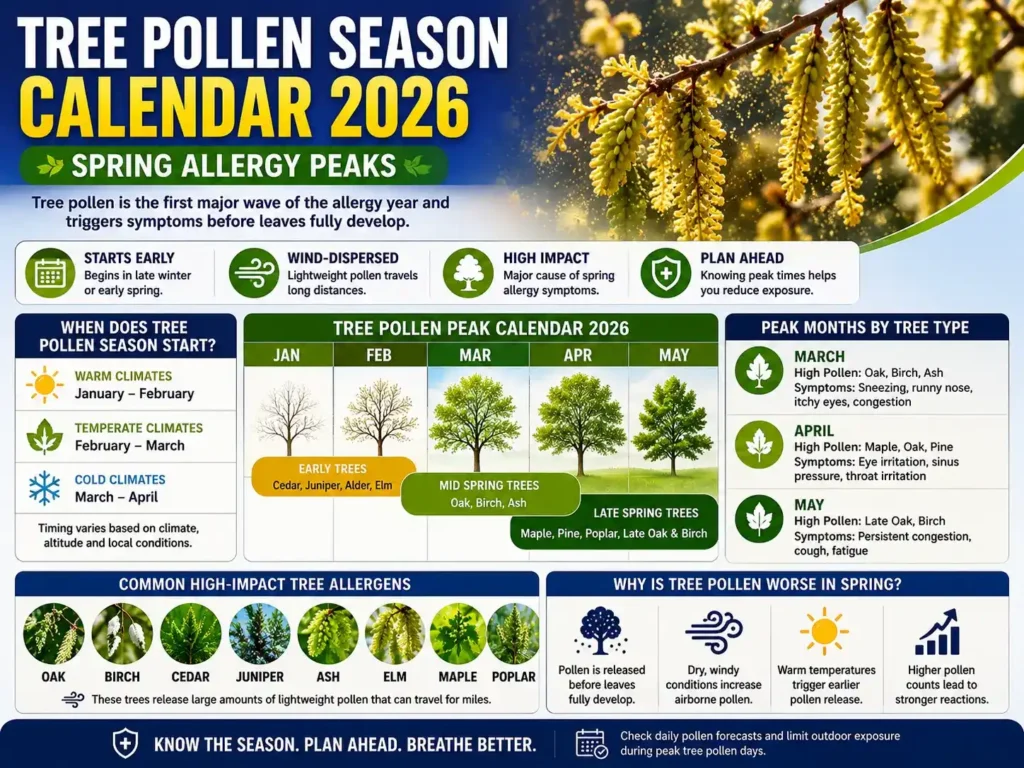
Tree pollen is the first major wave of the allergy year and often begins before leaves fully develop.
When Will Tree Pollen Season End in 2026?
Tree pollen season in 2026 will usually end between late spring and early summer, depending on climate and location. In many temperate areas, tree pollen is strongest from March through May and begins to fade by late May or June.
Tree pollen may end earlier in warmer, drier areas where the spring bloom finishes quickly. In colder climates, tree pollen may start later and continue into early summer. Some regions may also have overlapping tree and grass pollen, which can make symptoms feel like tree pollen is lasting longer than it really is.
If your symptoms continue after tree pollen declines, grass pollen may be taking over. This is common in late spring and early summer when tree pollen season overlaps with grass pollen season.
When does tree pollen season start?
- Warm climates: January–February
- Temperate climates: February–March
- Cold climates: March–April
Early-season trees include cedar, juniper, alder, and elm.
What months is tree pollen highest?
Peak tree pollen periods:
- March: oak, birch, ash
- April: maple, oak, pine
- May: late oak and birch overlap
Oak and birch are among the most clinically important tree allergens.
Which trees cause the strongest allergies?
Common high-impact tree allergens include:
- Oak
- Birch
- Cedar
- Juniper
- Ash
- Elm
- Maple
- Poplar
These trees produce lightweight wind-dispersed pollen that can travel long distances.
Why is tree pollen worse in spring?
Tree pollen is released before full leaf development, allowing it to disperse freely. Dry, windy spring conditions significantly increase airborne concentration.
Grass pollen season calendar
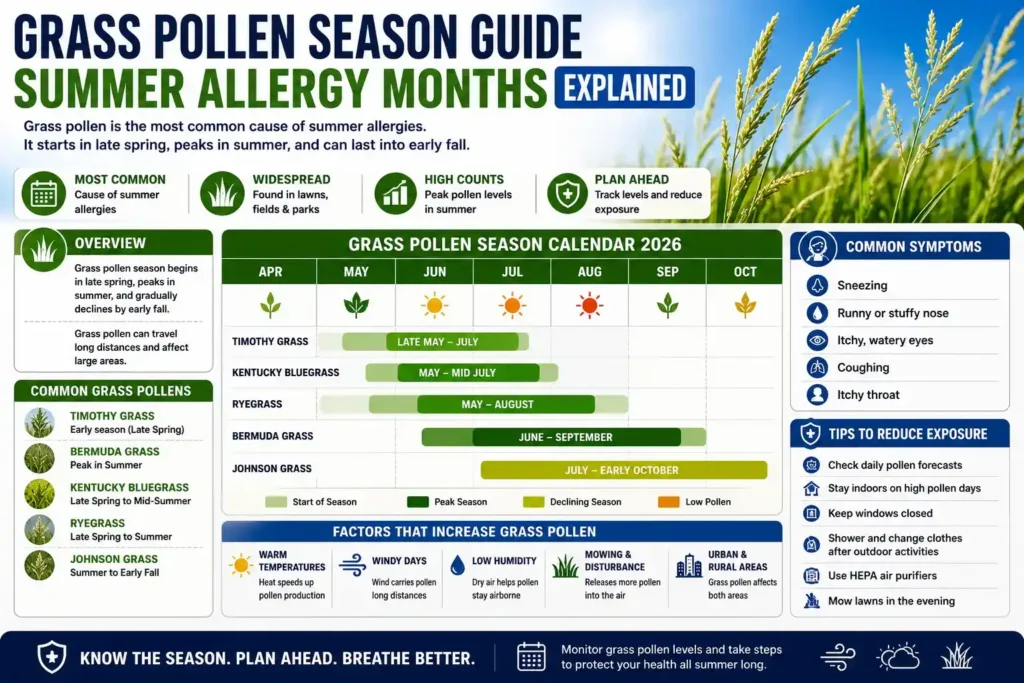
Grass pollen follows tree pollen and dominates late spring and summer.
It is one of the most widespread causes of seasonal allergies globally.
When is grass pollen highest?
Grass pollen peaks:
- Late spring (May)
- Early summer (June–July)
In warmer regions, grass pollen may extend into August.
What months does grass pollen peak?
- May: rising levels
- June: peak intensity
- July: sustained high levels
- August: declining or extended depending on climate
Which grasses cause allergies?
Common allergenic grasses include:
- Timothy grass
- Bermuda grass
- Ryegrass
- Kentucky bluegrass
- Johnson grass
Orchard grass
Why is grass pollen worse in summer?
Hot, dry, and windy conditions enhance pollen dispersal. Lawn mowing can also sharply increase local airborne pollen exposure.
What time of day is grass pollen highest?
Grass pollen is often highest:
- Early morning
- Late afternoon
Outdoor activities during mowing periods can significantly increase exposure.
Weed pollen season calendar
Weed pollen season begins in late summer and continues into fall.
Many individuals underestimate fall allergies, assuming spring is the only allergy season.
When does weed pollen season begin?
- Warm regions: July
- Temperate regions: August
What months is weed pollen worst?
- August: early rise
- September: peak exposure
- October: decline phase
Which weeds cause fall allergies?
Common weed allergens include:
- Ragweed
- Mugwort
- Pigweed
- Sagebrush
- Lamb’s quarters
- Russian thistle
Why do weed allergies worsen in late summer?
Dry air, wind activity, and reduced rainfall increase airborne pollen levels. Overlapping mold spores may also worsen symptoms.
Ragweed pollen season calendar
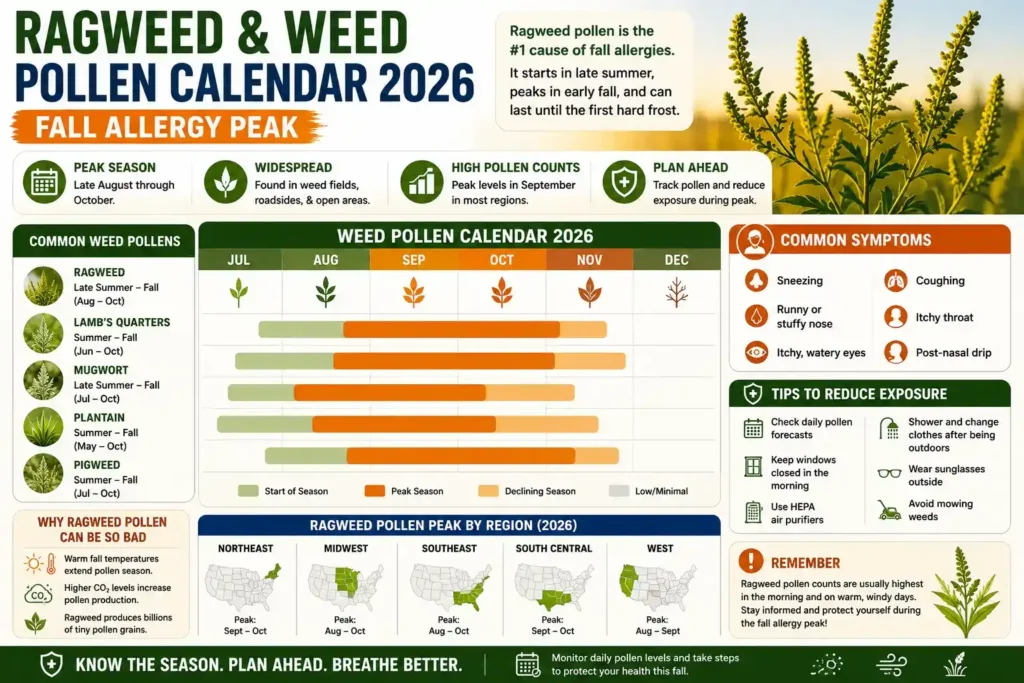
Ragweed and weed pollen calendar 2026 infographic showing fall allergy peak months, weed pollen timeline, symptoms, and ragweed exposure risks
Ragweed is one of the most potent seasonal allergens worldwide.
A single plant can release billions of pollen grains during one season.
When Is Ragweed Season in 2026?
Ragweed season in 2026 will usually begin in August, peak in September, and continue into October or until the first hard frost. In warmer areas, ragweed symptoms may last into November.
September is often the hardest month for ragweed allergy because pollen levels are usually high and exposure can be intense. Ragweed pollen is lightweight, wind-dispersed, and can travel long distances, so symptoms may occur even if there are no ragweed plants directly around your home.
People with ragweed allergy may notice:
- sneezing
- runny nose
- blocked nose
- itchy throat
- itchy or watery eyes
- coughing
- worsening asthma symptoms
If your allergies are worst in late summer or fall, ragweed should be one of the first triggers to consider.
When does ragweed season start and end?
- Starts: August
- Peaks: September
- Ends: October or first frost
In warmer climates, ragweed may persist into November.
What month is ragweed pollen highest?
September is the peak ragweed month in most regions.
Why is ragweed allergy so severe?
Ragweed pollen is:
- Extremely lightweight
- Highly wind-dispersed
- Produced in massive quantities
- Highly allergenic at low exposure levels
Its ability to travel long distances contributes to widespread seasonal outbreaks.
How far can ragweed pollen travel?
Ragweed pollen can travel hundreds of kilometers through atmospheric currents, affecting regions far from its origin.
Why is ragweed season getting longer?
Rising temperatures and delayed frost extend the growing season, allowing longer pollination periods (D’Amato et al., 2020).
Monthly pollen allergy calendar 2026
- January: cedar, juniper
- February: alder, elm
- March: oak, birch
- April: oak, maple
- May: tree peak + grass start
- June: grass peak
- July: grass + early weeds
- August: weeds + ragweed onset
- September: ragweed peak
- October: weed decline
- November: late weed pollen (warm regions)
- December: minimal pollen
Pollen Schedule 2026: Month-by-Month Quick View
Here is a simple 2026 pollen schedule to help understand which pollen type is most likely to trigger symptoms each month.
January: cedar and juniper may affect warmer regions
February: early tree pollen may begin in mild climates
March: tree pollen rises, especially oak, birch, maple, elm, and ash
April: tree pollen often reaches high levels
May: tree pollen may overlap with grass pollen
June: grass pollen is often high
July: grass pollen may continue, with early weed pollen starting in some areas
August: weed pollen and ragweed season begin
September: ragweed pollen usually peaks
October: ragweed and weed pollen decline, especially after frost
November: late weed or ragweed pollen may continue in warmer climates
December: outdoor pollen is usually low, but indoor allergens may still trigger symptoms
This schedule is a general guide. Local pollen timing can change based on weather, rainfall, wind, temperature, altitude, and regional plant growth.
Which pollen types dominate each season?
Spring
Tree pollen dominates.
Summer
Grass pollen dominates.
Fall
Weed and ragweed pollen dominate.
Which regions have the longest pollen seasons?
Warmer regions typically experience:
- Earlier pollen onset
- Longer seasonal duration
- Higher annual pollen load
Colder regions have shorter but sharper seasonal peaks.
Does weather affect pollen levels?
Yes, weather strongly influences pollen concentration.
Wind
Increases airborne pollen transport.
Rain
Temporarily reduces pollen but may increase mold exposure.
Heat
Increases plant growth and pollen production.
Humidity
Humidity may reduce dispersal but increase indoor allergen persistence.
How to Use Daily Pollen Counts During Allergy Season
Daily pollen counts can help you plan outdoor activity and reduce allergy flares. They are especially useful during tree pollen season, grass pollen season, weed pollen season, and ragweed season.
Use pollen counts this way:
- Check the pollen forecast before outdoor activity.
- Identify which pollen type is high, not just the total pollen number.
- Keep windows closed on high-pollen days.
- Avoid outdoor exercise during peak pollen periods if symptoms are severe.
- Shower and change clothes after outdoor exposure.
- Wash hair before bed if pollen symptoms are worse at night or in the morning.
- Use sunglasses or a hat outdoors to reduce pollen contact with the eyes and hair.
- Follow your allergy treatment plan before symptoms become severe.
Pollen counts are not perfect because they can vary by neighborhood, weather, and measuring station. Still, they are useful for spotting patterns and planning better allergy routines.
Why are allergies worse in the morning?
Yes, weather strongly influences pollen concentration.
Wind
Increases airborne pollen transport.
Rain
Temporarily reduces pollen but may increase mold exposure.
Heat
Increases plant growth and pollen production.
Humidity
May reduce dispersal but increase indoor allergen persistence.
Is climate change making pollen seasons worse?
Yes. Multiple studies confirm:
- Longer pollen seasons
- Higher pollen production
- Earlier seasonal onset
- Increased allergen potency
These changes are strongly associated with rising CO₂ levels and global warming (Zhang & Steiner, 2022).
Why do seasonal allergies feel worse today?
Several environmental factors contribute:
- Air pollution exposure
- Longer pollen seasons
- Urban heat islands
- Cross-reactive allergens
- Higher pollen concentrations
Together, these factors increase both exposure and immune sensitivity.
Pollen season comparison (quick guide)
Pollen Type | Start | Peak | End | Severity |
Tree | Jan–Apr | Mar–May | May–Jun | High (spring spike) |
Grass | Apr–Jun | May–Jul | Jul–Aug | Moderate–High |
Weed | Jul–Aug | Aug–Oct | Oct–Nov | Moderate |
Ragweed | Aug | Sep | Oct–Nov | Very High |
Peak allergy severity by month (2026 overview)
Month | Dominant Pollen | Risk Level |
Jan–Feb | Cedar, early trees | Low–Moderate |
Mar–Apr | Tree pollen | Very High |
May–Jun | Tree + grass overlap | High |
Jul | Grass + weeds | Moderate–High |
Aug | Weeds + ragweed start | High |
Sep | Ragweed peak | Very High |
Oct | Ragweed + weeds | High |
Nov–Dec | Minimal pollen | Low |
Key takeaways
- Tree pollen dominates early spring
- Grass pollen dominates late spring and summer
- Weed and ragweed pollen dominate fall
- September is the peak ragweed month
- Climate change is extending pollen seasons
- Weather strongly influences pollen exposure
- Regional climate determines allergy timing
Medical Disclaimer
This article is for educational and informational purposes only and is not intended to replace professional medical advice, diagnosis, or treatment. Always consult a qualified healthcare provider or allergist for personalized guidance regarding allergy symptoms or medical conditions.
Frequently Asked Questions (FAQs)
When does pollen season start and end?
Pollen season usually starts in late winter or early spring with tree pollen, continues through late spring and summer with grass pollen, and often ends in fall after weed and ragweed pollen decline. In many areas, pollen season ends around October or after the first hard frost.
When will pollen season end in 2026?
September is often the worst month for pollen allergies due to peak ragweed exposure, especially in temperate regions.
When does tree pollen season end in 2026?
Tree pollen season usually ends in late spring or early summer. In many areas, tree pollen declines by late May or June, but it can overlap with grass pollen and make symptoms continue.
When is grass pollen highest?
Grass pollen is often highest from May to July, with peak symptoms commonly occurring in late spring and early summer. In warmer regions, grass pollen may continue into August.
When is ragweed season in 2026?
Ragweed season usually starts in August, peaks in September, and ends in October or after the first hard frost. In warmer climates, ragweed pollen may continue into November.
What month is pollen the worst?
September is often one of the worst months for pollen allergies because ragweed usually peaks then. Spring months such as March, April, and May can also be severe for people with tree pollen allergy.
Is pollen worse in the morning or evening?
It depends on the pollen type. Ragweed pollen may be worse in the morning, while tree and grass pollen may be higher later in the day in some regions. Weather, wind, humidity, and local plant patterns can change pollen timing.
Why are allergies worse after rain?
Rain can temporarily wash pollen out of the air, but damp conditions may increase mold spores. Thunderstorms and windy rain can also break pollen particles into smaller pieces, which may worsen symptoms in sensitive people.
How do I know which pollen is causing my allergies?
Look at the season and symptom pattern. Spring symptoms often suggest tree pollen, late spring and summer symptoms suggest grass pollen, and late summer or fall symptoms suggest weed or ragweed pollen. Allergy testing can confirm specific triggers.
Can pollen season last all year?
Outdoor pollen is usually seasonal, but in warm climates some plants may release pollen for longer periods. If symptoms continue year-round, indoor allergens such as dust mites, mold, cockroaches, or pet dander may also be involved.
References
- Zhang, Y., & Steiner, A. L. (2022). Projected climate-driven changes in pollen emission season length and magnitude over the continental United States. Nature Communications, 13, 1234. https://doi.org/10.1038/s41467-022-28764-0
- D’Amato, G., Vitale, C., De Martino, A., et al. (2020). Effects of climate change on allergic diseases: A review of the literature. International Journal of Environmental Research and Public Health, 17(9), 3077. https://doi.org/10.3390/ijerph17093077