

What Temperature Water Kills Dust Mites in Hypoallergenic Pillows?
Written by: Dr.Muhammad Ihsan Ullah, PhD
Medically reviewed by: Dr. Jamal ud Din Khan, FCPS
Last updated on August 22, 2026

Quick answer:
If your hypoallergenic pillow is machine-washable and the care label permits hot water, aim for about 130°F (54.4°C) or hotter. Experimental research found that 55°C (131°F) or above killed all tested house dust mites, while a separate mechanical-laundry study found complete mite killing at 60°C (140°F) (1,2).
The important point is not to choose the hottest setting automatically. “Hypoallergenic” describes an allergy-conscious product, not a universal washing temperature. The pillow’s filling, cover, seams, foam components, and construction determine how much heat it can safely tolerate.
What Temperature Kills Dust Mites in Hypoallergenic Pillows?
For a washable hypoallergenic pillow, temperatures around 55–60°C (131–140°F) have the strongest direct experimental support for killing house dust mites.
A practical household benchmark is approximately 130°F (54.4°C), which is very close to the experimentally demonstrated 55°C threshold. However, the pillow should only be washed this hot when its manufacturer’s care instructions allow it.
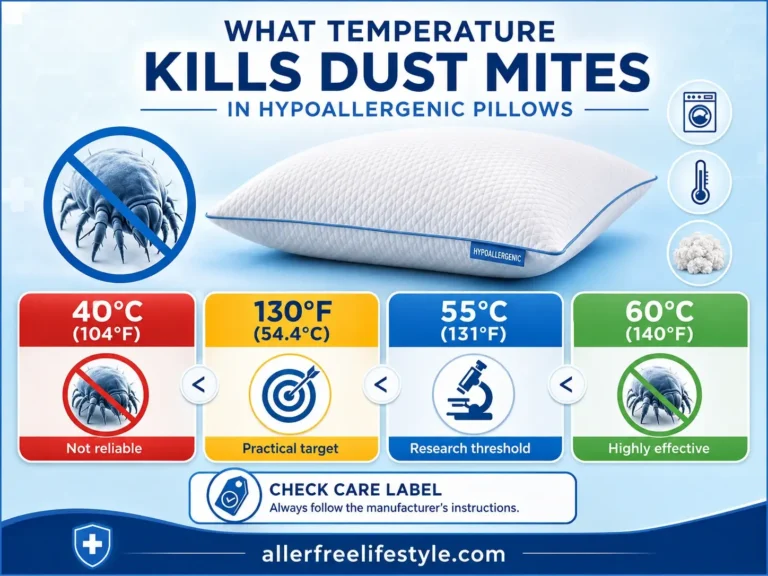
Water Temperature | Fahrenheit | What It Means for Dust Mites | Practical Advice |
40°C | 104°F | Should not be relied upon to kill all mites | Washing may still remove mites and allergenic material |
54.4°C | 130°F | Practical hot-water target close to the experimentally supported threshold | Use only if permitted by the care label |
55°C | 131°F | Experimental research found complete mite mortality at this temperature or higher | Strong evidence-based reference point |
60°C | 140°F | Mechanical-laundry research found complete mite killing | Suitable for pillows specifically designed to tolerate a 60°C wash |
Key takeaway:
For dust-mite control, around 130°F or hotter is a sensible target, with direct experimental evidence strongest from approximately 55°C upward (1).
Is 130°F (54.4°C) Hot Enough to Kill Dust Mites?
About 130°F is a reasonable practical target, but it should not be interpreted as an exact biological cut-off.
The difference between 54.4°C and 55°C is only 0.6°C. In the classic laundering experiment, all tested mites were killed at 55°C or greater (1).
Real-world washing is more complex than simply reading the temperature setting. The actual heat reaching the pillow can be influenced by the washing machine, cycle duration, water volume, load size, and the thickness of the item being washed.
For that reason, it is more accurate to think of approximately 55°C and above as the evidence-supported range, rather than suggesting that one exact degree guarantees the same outcome in every washing machine and every pillow.
Is 60°C (140°F) Better for Killing Dust Mites?
A 60°C wash is highly effective against house dust mites when the material can tolerate it.
In research comparing mechanical washing at 30°C, 40°C, 60°C, and steam-water conditions, all house dust mites were killed during the 60°C cycle. Lower-temperature cycles did not produce the same complete mite mortality (2).
This does not mean 60°C is always preferable to 55°C. Once an effective temperature is reached, fabric safety becomes equally important.
A pillow that is damaged, distorted, or degraded by excessive heat has not benefited from choosing a hotter wash.
Use 60°C when the manufacturer’s care label specifically allows it; otherwise, use the hottest permitted setting rather than exceeding the pillow’s heat tolerance.
Will Washing a Pillow at 40°C Kill Dust Mites?
A 40°C (104°F) wash should not be relied upon to kill all house dust mites.
Research comparing different laundry temperatures found substantially greater mite-killing effects at 60°C than at 30°C or 40°C (2).
However, a cooler wash is not necessarily useless. Mechanical washing can physically remove mites, dust, debris, and allergenic proteins even when the temperature is insufficient to kill every living mite.
This distinction is important because:
- killing mitesrefers to destroying living organisms;
- removing allergensrefers to washing away proteins and mite debris capable of triggering allergic reactions.
The two goals overlap, but they are not identical.
Does Hot-Water Washing Remove Dust Mite Allergens Too?
Yes, washing can reduce dust-mite allergens, but mite death and allergen removal should not be treated as the same process.
The major clinically relevant dust-mite allergens include proteins such as Der p 1 and Der f 1. These allergens can remain in bedding material even after the mite itself has died.
The original laundering study found that even a cold washing cycle could substantially reduce measured mite-allergen concentrations despite failing to remove most live mites. This shows why physical washing and rinsing remain important in addition to heat exposure (1).
Therefore, the goal is not merely to “cook” the mites. A complete laundry process should:
- use a manufacturer-approved temperature;
- wash and rinse the pillow thoroughly;
- use an appropriate laundry detergent;
- dry the pillow completely according to its care instructions.
Can Every Hypoallergenic Pillow Be Washed in Hot Water?
No.
Before washing a hypoallergenic pillow at 130°F, 55°C, or 60°C, check the care label carefully.
Pay particular attention to:
- the maximum permitted wash temperature;
- whether the whole pillow is machine-washable;
- whether only the removable cover can be washed;
- permitted drying temperatures;
- instructions for specialty fillings or foam.
Some synthetic-filled pillows may tolerate machine washing, while certain memory-foam, latex, or specialty-constructed pillows may require different cleaning methods. The manufacturer’s instructions should therefore take priority over a general dust-mite temperature recommendation.
Never increase the washing temperature beyond the approved limit simply because a hotter cycle may kill mites more effectively.
What If My Hypoallergenic Pillow Cannot Be Washed at 130°F?
If the care label does not permit a sufficiently hot wash, do not damage the pillow trying to reach a particular temperature.
Instead:
- wash removable pillow covers at their permitted temperature;
- follow the manufacturer’s recommended cleaning method for the pillow itself;
- use a washable allergen-barrier pillow encasementwhen appropriate;
- keep the pillow completely dry after cleaning;
- consider whether a machine-washable replacement would be more practical if frequent hot laundering is important.
Recent reviews of house-dust-mite avoidance also emphasize that environmental control is best viewed as a combination of exposure-reduction measures rather than a single intervention (3).
The Bottom Line
If you want to kill dust mites in a machine-washable hypoallergenic pillow, the clearest experimental evidence supports temperatures of approximately 55°C (131°F) or higher, with 60°C (140°F) providing highly effective mite killing when the material permits it (1,2).
A household setting around 130°F (54.4°C) is a useful practical reference, but no temperature should override the pillow manufacturer’s care instructions.
The simplest rule is:
Use the hottest evidence-supported temperature that your hypoallergenic pillow is specifically designed to tolerate.
And remember that effective laundering has two jobs: killing live dust mites and physically removing the allergens they leave behind.
Medical Disclaimer
This content is for general educational purposes only and is not a substitute for professional medical advice, diagnosis, or treatment. If you have a diagnosed dust-mite allergy, asthma, or persistent allergy-related symptoms, consult a qualified healthcare professional.
Frequently Asked Questions(FAQs)
1. What temperature water kills dust mites in hypoallergenic pillows?
For machine-washable pillows, around 55°C (131°F) or hotter has strong experimental support for killing dust mites, provided the care label permits it.
2. Is 130°F hot enough to kill dust mites?
Approximately 130°F (54.4°C) is a practical hot-water target and is very close to the experimentally supported 55°C threshold.
3. Does washing a pillow at 60°C kill dust mites?
Yes. 60°C (140°F) is highly effective for killing dust mites when the pillow is designed to tolerate that wash temperature.
4. Will a 40°C wash kill dust mites?
A 40°C wash should not be relied upon to kill all dust mites, although washing can still help remove mites and allergenic material.
5. Can all hypoallergenic pillows be washed in hot water?
No. Always follow the manufacturer’s care label, as different pillow materials and constructions tolerate heat differently.
6. Does washing remove dust mite allergens?
Yes. Washing can physically remove substantial amounts of dust-mite allergen even when the water temperature does not kill every mite.
References
- McDonald LG, Tovey E. The role of water temperature and laundry procedures in reducing house dust mite populations and allergen content of bedding. Journal of Allergy and Clinical Immunology.1992;90:599–608. DOI: 10.1016/0091-6749(92)90132-L.
- Choi SY, Lee IY, Sohn JH, Lee YW, Shin YS, Yong TS, et al. Optimal conditions for the removal of house dust mite, dog dander, and pollen allergens using mechanical laundry. Annals of Allergy, Asthma & Immunology.2008;100(6):583–588. DOI: 10.1016/S1081-1206(10)60060-9.
- van Boven FE, Braunstahl GJ, Arends LR, van Maaren MS, Bramer WM, van Wijk RG, et al. House dust mite allergen avoidance strategies for the treatment of allergic asthma: A hypothesis-generating meta-analysis. World Allergy Organization Journal.2024;17(6):100919. DOI: 10.1016/j.waojou.2024.100919.