

How to Control Dust Mites in High-Humidity Tropical Climates
Written by: Dr. Muhammad Ihsan Ullah, PhD (Pharmacology)
Medically reviewed by: Dr. Jamal ud Din Khan, FCPS (Pulmonology)
Last updated on August 24, 2026

Controlling dust mites is more challenging in tropical climates because warmth and moisture remain high for much of the year. Instead of relying on occasional deep cleaning or a single “mite-killing” product, effective control requires a consistent strategy that reduces indoor moisture, limits mite reservoirs, and removes the allergens left behind in bedding and household dust.
At a Glance: A Smarter Approach for Tropical Homes
In hot, humid environments, dust-mite control works best as an ongoing environmental routine. The goal is not to make a home completely mite-free—which is rarely realistic—but to keep conditions less favorable for mites and reduce the amount of allergenic material accumulating around you.
How Can You Control Dust Mites in a Humid Tropical Home?
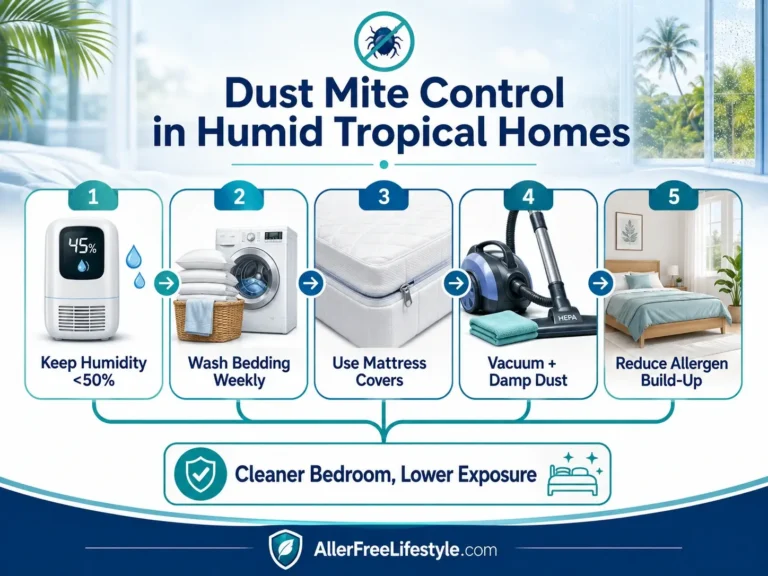
House dust mites thrive particularly well in warm, humid environments. A 2026 review of tropical regions identified persistent warmth and humidity as important factors supporting year-round mite proliferation and highlighted Dermatophagoides pteronyssinus, Dermatophagoides farinae, and Blomia tropicalis as important tropical mite species (1).
For practical house dust mite control in tropical climates, focus first on the bedroom because mattresses, pillows, bedding, rugs, and upholstered furnishings can hold substantial amounts of mite allergen.
A useful control routine combines:
- humidity monitoring and moisture reduction;
- regular bedding care;
- allergen-impermeable mattress and pillow encasements;
- thorough removal of dust from fabrics and surfaces;
- fewer unnecessary dust-holding furnishings.
A 2025 meta-analysis of randomized clinical trials found that house dust mite avoidance measures can reduce household dust and major mite allergen concentrations, supporting a combined exposure-reduction approach rather than dependence on one intervention alone (2).
What Indoor Humidity Helps Keep Dust Mites Under Control?
Relative humidity is one of the most important environmental factors to manage.
House dust mites absorb moisture from their surroundings rather than drinking free water. Tropical conditions are particularly favorable: recent research describes temperatures around 25–30°C and relative humidity around 75–80% as highly supportive of mite growth (1).
For home control, aim to keep indoor relative humidity below about 50% when realistically achievable.
The important word is consistently. Briefly lowering humidity will not instantly eliminate mites already established inside mattresses or furnishings.
Use a digital hygrometer to monitor the bedroom. It gives a far more reliable picture than judging humidity by whether the room feels cool or dry.
Do Dehumidifiers Really Help Control Dust Mites?
A dehumidifier can be useful in a high-humidity tropical home, but only if it actually lowers room humidity enough and keeps it there.
For better performance:
- choose a unit suitable for the room size;
- keep windows and external doors closed while it runs;
- drain or empty collected water regularly;
- check results with a separate hygrometer;
- prioritize bedrooms before less-used areas.
In very humid climates, portable dehumidification may not be sufficient by itself. Its role is to help create a less favorable environment while other measures reduce the existing allergen reservoir.
Can Air Conditioning Reduce Dust Mites in Tropical Homes?
Air conditioning may help when it reduces indoor moisture as well as temperature.
A colder room is not automatically a drier room. If relative humidity remains high, cooling alone may not provide the environmental control you expect.
Monitor bedroom humidity while the air conditioner is operating. If the room remains persistently humid, better ventilation management or additional dehumidification may be needed.
This is especially important in tropical regions, where humid outdoor air can quickly enter when windows and doors remain open.
How Should Bedding Be Washed to Reduce Dust Mites?
Bedding deserves priority because it combines warmth, moisture, skin debris, and prolonged human contact.
A practical routine includes:
- washing sheets and pillowcases approximately once a week;
- using a hot wash around 60°C when the fabric safely allows;
- drying bedding completely before use;
- regularly washing removable blankets and covers;
- avoiding damp laundry or bedding in the bedroom.
Washing is important for another reason: killing mites and removing mite allergens are not the same thing.
Mite bodies and fecal particles contain allergenic proteins. Even after mites die, this material can remain in bedding and dust until it is physically removed.
Research across households in Southeast and East Asia found lower house dust mite allergen levels in homes that had received mattress-care services, with more recent mattress care associated with lower allergen concentrations (3).
Are Dust-Mite Mattress and Pillow Covers Worth Using?
Yes, properly designed allergen-impermeable encasements can help reduce exposure to allergenic material stored inside mattresses and pillows.
Choose fully zippered encasements specifically designed to act as allergen barriers rather than ordinary mattress protectors.
They are especially useful because mattresses cannot be routinely washed like sheets.
However, mattress and pillow covers should complement—not replace—humidity management and regular cleaning. A protected mattress in a persistently humid, dust-filled bedroom is only a partial solution.
Can HEPA Vacuuming Remove Dust Mite Allergens?
Vacuuming helps remove allergen-containing dust from carpets, rugs, upholstered furniture, and other reservoirs.
A vacuum with high-efficiency filtration is preferable because poorly filtered machines may release fine particles back into the room.
For better dust control:
- vacuum slowly and systematically;
- damp-wipe hard surfaces instead of dry dusting;
- reduce wall-to-wall carpeting where practical;
- minimize unnecessary upholstered furniture in bedrooms;
- clean washable curtains, rugs, and soft furnishings regularly.
A HEPA air purifier may capture some particles suspended in the air, but it should not replace source control because much of the dust-mite allergen burden remains settled in bedding and furnishings.
How Can You Prevent Dust Mites From Building Up Again?
In a humid tropical climate, maintenance matters more than occasional intensive cleaning.
Keep the routine simple:
Weekly: wash bedding and clean bedroom surfaces.
Regularly: vacuum mattresses, rugs, carpets, and upholstered furniture where appropriate.
Continuously: monitor indoor humidity and manage excess moisture.
Also be cautious about sprays, powders, essential oils, and products marketed as instant dust-mite solutions. Killing mites without removing allergens or correcting the humid environment leaves much of the underlying problem unchanged.
The most practical long-term formula is simple:
Control moisture + reduce mite reservoirs + remove allergen-containing dust consistently.
That approach is far more realistic for a tropical home than trying to eliminate every dust mite.
Medical Disclaimer
This article is for educational purposes only and is not a substitute for professional medical advice, diagnosis, or treatment. If allergy symptoms persist, worsen, or interfere with breathing, consult a qualified healthcare professional.
Frequently Asked Questions(FAQs)
1. What humidity level helps control dust mites?
Aim for below about 50% relative humidity when achievable. Consistently drier conditions make the indoor environment less favorable for dust mites.
2. Do dehumidifiers help reduce dust mites?
They can help if they maintain sufficiently low indoor humidity. Use a digital hygrometer to confirm whether humidity is actually being reduced.
3. Does air conditioning help control dust mites?
Yes, when it lowers indoor humidity as well as temperature. Simply making a room colder does not guarantee effective mite control.
4. How often should bedding be washed for dust mites?
Wash sheets and pillowcases about once a week, preferably using hot water around 60°C when the fabric permits, then dry them completely.
5. Do dust-mite mattress covers really work?
Allergen-impermeable mattress and pillow encasements can reduce exposure to allergens stored in bedding, particularly when combined with humidity control and regular cleaning.
6. Can a HEPA air purifier remove dust mites?
A HEPA purifier can capture some airborne allergen particles, but it does not remove mites living in mattresses and furnishings. Source control remains more important.
References
- Tahir HM, Nik Kamarudin NAA, Ahamad M, Che Lah EF. A narrative review of house dust mite allergy: species distribution and allergen sensitisation patterns across tropical regions.Frontiers in Allergy. 2026;7:1813656. doi:10.3389/falgy.2026.1813656
- Sobczak M, Kowal K, Pawliczak R. Are There Effective Methods to Reduce Exposure to House Dust Mite Allergens? A Meta-Analysis of Randomized Clinical Trials.International Forum of Allergy & Rhinology. 2025;15(8):792–802. doi:10.1002/alr.23565
- Kim D, Jeon H, Park JY, Othman H, Thi Hien T, Lestari P, Tantrakarnapa K, Lee K. Characteristics of house dust mite allergens in Southeast and East Asia with the effect of hygienic practices.Indoor Environments. 2024;1(2):100010. doi:10.1016/j.indenv.2024.100010