

Best Time of Day to Exercise Indoors During Peak Pollen Season
Written by: Dr. Muhammad Ihsan Ullah, PhD (Pharmacology)
Medically reviewed by: Dr. Jamal ud Din Khan, FCPS (Pulmonology)
Last updated on August 24, 2026
When pollen counts climb, moving a run, cycling session or strength workout indoors can reduce direct exposure. But if you are already exercising inside, should you still plan your workout around morning or evening pollen peaks? The answer depends less on a fixed clock time and more on how well your indoor space is protected from outdoor pollen.
Quick answer:
The best time to exercise indoors during peak pollen season is when your workout space has the lowest pollen exposure. If windows and doors are closed and the air is effectively filtered, morning versus evening becomes less important. Timing matters more when outdoor pollen can easily enter the room.
Does Time of Day Matter If You Exercise Indoors During Pollen Season?
It can, but not in the same way it matters for outdoor exercise.
Pollen levels fluctuate over the day as plants release pollen and wind, temperature, humidity, and atmospheric transport redistribute it. Importantly, modern aerobiology research shows that different pollen types do not share one universal daily peak. A 2026 study analyzing multiple pollen types found distinct intradiurnal patterns that were strongly influenced by meteorological conditions and pollen type (1).
That means advice such as “always exercise at night” or “morning is always worst” is too simplistic.
Once you move indoors, a more useful question is:
How much outdoor pollen is actually reaching the air where I am exercising?
If very little pollen is entering, your preferred workout time may matter more for consistency than the outdoor pollen clock.
Is Morning or Evening Better for Indoor Exercise With Allergies?
Neither is automatically better.
A morning indoor workout may be a sensible choice on a day when your relevant outdoor pollen is elevated in the morning. On another day—or with another pollen type—the pattern may be different.
Rather than choosing morning or evening based on a universal rule, consider:
- your specific pollen allergy;
- the local pollen forecast;
- whether windows have been open;
- how frequently exterior doors are opening;
- weather and wind conditions; and
- whether filtered air is circulating indoors.
This individualized approach is more accurate because hourly pollen peaks can shift according to the plant species and local meteorological conditions (1).
Should You Exercise Indoors When the Pollen Count Is High?
For someone whose allergies are triggered by airborne pollen, moving exercise indoors can reduce direct contact with the outdoor pollen cloud.
This can be particularly useful during days of heavy:
- tree pollen;
- grass pollen;
- weed pollen; or
- ragweed pollen.
Recent research also suggests that recent exposure matters, not simply whether today’s pollen count is labelled “high” or “low.”
The EPOCHAL study found a clear positive relationship between ambient pollen exposure and nasal and eye symptom severity in pollen-allergic adults. Exposure during approximately the preceding five hours had the strongest association with symptoms, and the researchers found no clear pollen concentration below which symptoms were guaranteed not to occur (2).
So a person who is highly pollen-sensitive may still benefit from an indoor workout even when the pollen reading is below an official “very high” category.
Do Peak Outdoor Pollen Levels Affect an Indoor Workout?
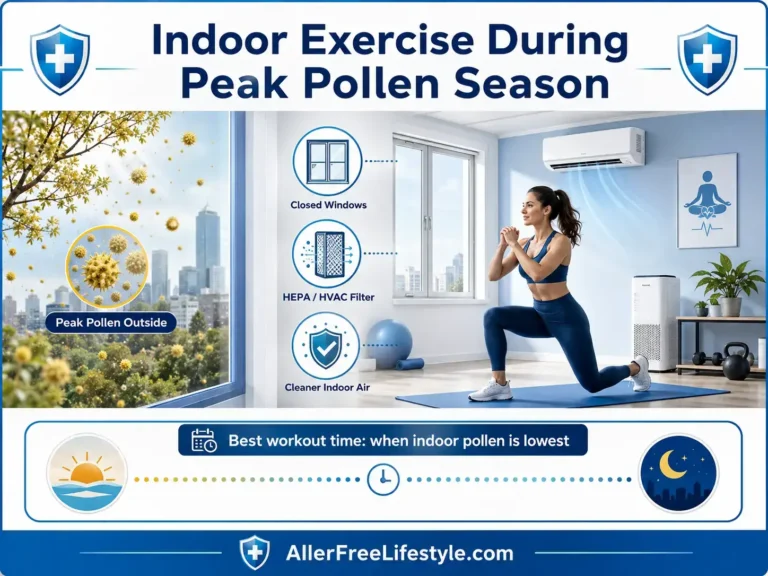
They can—but an indoor space is not automatically pollen-free.
Outdoor pollen may reach a workout room when:
- windows are left open;
- exterior doors open frequently;
- outdoor air enters directly through ventilation;
- pollen is carried indoors on clothing;
- pollen remains on hair or shoes; or
- people or pets repeatedly move between outdoors and indoors.
Imagine two indoor workouts at exactly 8 a.m.
One happens beside an open window facing a pollen-rich garden. The other takes place in a closed room with filtered HVAC air.
Calling both simply “indoor exercise” misses an important exposure difference.
This is why indoor pollen control may matter more than the exact workout hour during peak pollen season.
Does a HEPA Filter Help During an Indoor Workout in Pollen Season?
Air filtration can help reduce airborne particles indoors, but it should not be presented as a guarantee that allergy symptoms will disappear.
A 2024 systematic review and meta-analysis found that air filtration produced modest improvements in daytime and nighttime allergic rhinitis symptoms, while effects on medication use, quality of life, and peak expiratory flow were less convincing (3).
For a pollen-sensitive person exercising indoors, the practical goal is to reduce the amount of allergen in the room.
Useful environmental measures include:
- keeping windows closed during high-pollen periods;
- using a properly sized HEPA air cleaner where appropriate;
- maintaining HVAC filters;
- avoiding direct unfiltered outdoor airflow; and
- changing out of pollen-exposed clothing before exercising indoors.
A HEPA filter is therefore part of an exposure-reduction strategy, not a substitute for controlling obvious routes through which outdoor pollen enters the room.
Should You Check the Pollen Count Before an Indoor Workout?
Yes—especially when your workout space is closely connected to outdoor air.
A pollen forecast can help you decide whether today is a good day to:
- exercise completely indoors;
- keep windows closed;
- avoid an outdoor warm-up or cool-down;
- run your air filtration system; or
- change clothing after being outside before starting your workout.
Whenever possible, look at the specific pollen type, not just a single total pollen number.
Someone sensitized mainly to ragweed does not necessarily need to respond to a high tree-pollen reading in the same way as someone with a major tree-pollen allergy.
Your individual sensitization pattern gives the pollen forecast clinical meaning.
Does the Best Indoor Exercise Time Change for Tree, Grass, and Ragweed Pollen?
Potentially—but there is no reliable rule stating that every tree, grass, or weed pollen always peaks at one particular hour.
Pollen release and atmospheric concentrations are affected by:
- plant biology;
- temperature;
- humidity;
- wind direction and speed;
- distance from the pollen source; and
- long-range atmospheric transport.
Recent intradiurnal pollen research reinforces that daily pollen patterns can differ substantially among pollen types and environmental conditions (1).
For this reason, someone with ragweed allergy should ideally follow local ragweed data, while someone sensitive to grass or tree pollen should pay attention to those specific categories.
A pollen-specific local forecast is usually more useful than relying on an internet rule such as “all pollen is highest at 7 a.m.”
Is a Home Workout Better Than the Gym During Peak Pollen Season?
Not necessarily.
The better choice is the indoor environment with lower pollen infiltration and better-controlled air.
A home workout may offer more control over windows, clothing, and air filtration. However, a well-maintained fitness center with effective HVAC filtration may provide excellent indoor conditions too.
Before choosing, consider:
At home
- Are windows open?
- Is the air cleaner running?
- Did you recently come inside wearing pollen-exposed clothing?
At the gym
- Are large exterior doors frequently open?
- Is outdoor air entering directly?
- Does the building appear to have effective ventilation and filtration?
The label “indoors” alone does not tell you how much pollen is present.
Bottom Line
The best time of day to exercise indoors during peak pollen season is not a fixed morning, afternoon, or evening hour.
Once you are inside, the quality of the indoor environment becomes the more useful consideration. A closed workout space with controlled airflow and effective filtration reduces the importance of outdoor hourly pollen peaks.
For the most practical approach, combine:
- your specific pollen sensitivity;
- local pollen data;
- recent outdoor exposure;
- closed windows and doors; and
- appropriate indoor air filtration.
If outdoor pollen can readily enter the room, timing your indoor workout away from your local pollen peak may still help. If the space is well controlled, choose the workout time you can follow consistently rather than chasing a universal “best hour.”
Medical Disclaimer
This article is for educational purposes only and does not replace professional medical advice, diagnosis, or treatment. If exercise triggers significant allergy, breathing, or asthma symptoms, consult a qualified healthcare professional or allergist.
Frequently Asked Questions(FAQs)
1. What is the best time to exercise indoors during pollen season?
There is no single best hour. A closed, well-filtered indoor environment usually matters more than morning versus evening.
2. Is morning or evening better for indoor exercise with allergies?
It depends on your pollen trigger and local conditions because daily pollen patterns vary by species and weather.
3. Should I exercise indoors when pollen counts are high?
Yes, if pollen triggers your allergies. Moving indoors can reduce direct exposure when the indoor space is well controlled.
4. Can outdoor pollen still affect an indoor workout?
Yes. Pollen can enter through windows, doors, ventilation, clothing, hair, shoes, and pets.
5. Does a HEPA filter help during indoor exercise?
It may help reduce airborne particles and can modestly improve allergic rhinitis symptoms, although it cannot guarantee a pollen-free room.
6. Should I check pollen levels before an indoor workout?
Yes. Local pollen data can help you decide whether to close windows, use filtration, and keep the entire workout indoors.
References
- de Gálvez-Montañez E, Trigo MM, Recio M, Picornell A. A new methodological approach to analyse intradiurnal pollen patterns in protected areas: the case of Sierra de las Nieves National Park (southern Iberian Peninsula). Journal of Forestry Research.2026;37:51. DOI: 10.1007/s11676-026-01997-1.
- Luyten A, Bürgler A, Glick S, Kwiatkowski M, Gehrig R, Beigi M, et al. Ambient pollen exposure and pollen allergy symptom severity in the EPOCHAL study. Allergy.2024;79(7):1908–1920. DOI: 10.1111/all.16130.
- Shih MY, Hsu HW, Chen SY, Su MJ, Lo WC, Chen C. Effectiveness of Air Filters in Allergic Rhinitis: A Systematic Review and Meta-Analysis. Indoor Air.2024;2024:8847667. DOI: 10.1155/2024/8847667.