

When Does Ragweed Pollen Season End in the US?
Written by: Dr. Muhammad Ihsan Ullah, PhD (Pharmacology)
Medically reviewed by: Dr. Asma Fareed Khan, PhD (Clinical Pharmacy)
Last updated on August 16, 2026
Ragweed pollen season does not end on the same date everywhere in the United States. Across much of the country, pollen levels decline during fall as colder temperatures bring active ragweed pollination to an end. The timing varies with latitude, local climate, elevation, and year-to-year weather.
In the United States, ragweed pollen generally fades in fall after cold temperatures stop active pollen release. The exact end date varies by local climate, so regional freeze timing and measured pollen levels are more reliable than using one nationwide calendar date.
What Month Does Ragweed Season Usually End?
For much of the United States, October is the main transition month when ragweed pollen begins to decline substantially. However, October 31 is not a biological cutoff.
Colder northern areas usually reach the end of the season sooner, while mild autumn weather can allow ragweed pollen to remain airborne later in southern states.
A useful regional pattern is:
- Northern states:ragweed often fades earlier as freezing weather arrives.
- Central states:a substantial decline commonly occurs during October.
- Southern states:pollen may persist into November during a warm fall.
- Very warm coastal areas:the end of the season can be less predictable because significant freezing conditions may arrive much later.
Pollen-season timing is strongly influenced by temperature, rainfall, humidity, plant phenology, and other meteorological conditions rather than by the calendar alone. Recent research continues to show that climate variability can alter both the beginning and end of pollen seasons (1).
Does the First Frost End Ragweed Season?
The first frost is a useful sign that ragweed season is approaching its end, but one light frost does not necessarily stop pollen production throughout an entire area.
Frost can be highly localized. Ragweed growing in an exposed rural area may be damaged while plants only a few miles away remain active in a warmer urban or sheltered environment.
That means the first cold morning should be viewed as a signal that the season is winding down—not as proof that airborne ragweed pollen has disappeared.
A sustained freeze is generally a stronger indication that actively pollinating annual ragweed plants are reaching the end of their growing season.
Does a Hard Freeze Kill Ragweed and Stop New Pollen Production?
A sufficiently severe freeze can kill annual ragweed plants and bring active local production of new pollen to an end.
Even then, pollen levels may not immediately fall to zero.
Several factors can explain lingering pollen:
- nearby areas may not have experienced the same cold conditions;
- some plants may survive a brief or uneven frost;
- wind can carry pollen from surrounding locations;
- pollen measurements naturally fluctuate from day to day.
The strongest evidence that ragweed season has ended is therefore a combination of sustained cold weather and consistently low local weed or ragweed pollen counts.
When Does Ragweed Season End in Different US Regions?
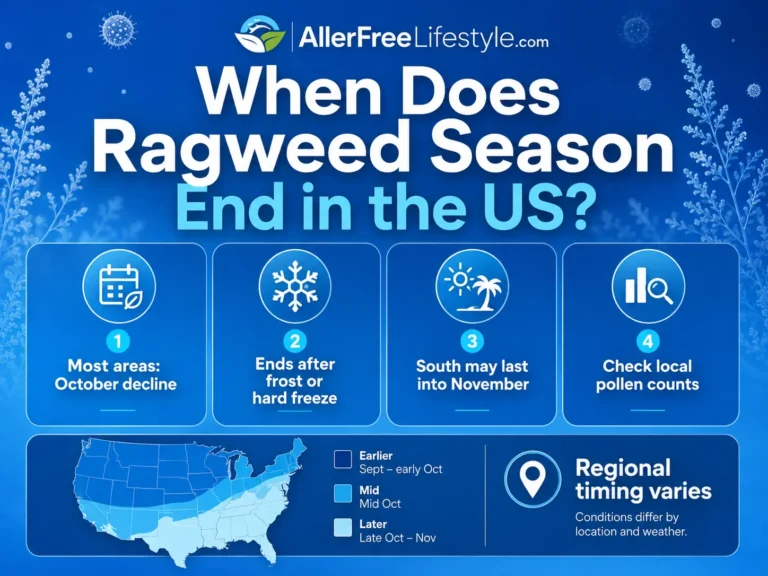
Regional climate makes a major difference.
U.S. Region | Typical Late-Season Pattern |
Upper Midwest | Earlier autumn freezes usually bring an earlier shutdown |
Northeast | Ragweed declines as colder fall conditions become established |
Mid-Atlantic | End timing varies with latitude, elevation, and yearly weather |
Central U.S. | October is commonly an important decline period |
Southeast | Mild fall temperatures can allow pollen to persist later |
Gulf Coast/Far South | Weed pollen may continue well into late fall |
Western U.S. | Elevation and local climate strongly influence the endpoint |
These are regional tendencies rather than fixed dates.
Research modeling pollen across the continental United States suggests that warming conditions can change both pollen-season timing and duration, with substantial geographic differences across the country (2).
This is why the answer for Florida or Texas may be very different from the answer for Minnesota, Wisconsin, or New York.
Is Ragweed Pollen Still Present in October?
Yes. October can still be part of ragweed pollen season in many areas of the United States.
Although ragweed typically reaches its highest activity earlier in fall, pollen production does not automatically stop when October begins.
An early period of sustained cold can shorten the season. In contrast, a warm October may delay the decline.
Ragweed-specific long-term research has found that warmer summer and autumn conditions can be associated with a prolonged pollen season and a later seasonal endpoint (3).
October is therefore better understood as a declining phase in many regions, rather than a guaranteed pollen-free month.
Can Ragweed Season Continue Into November?
Yes, particularly in warmer regions where significant freezing conditions arrive late.
November ragweed pollen is more plausible in the southern United States than in colder northern areas.
This does not mean pollen levels remain high everywhere throughout November. Instead, it means that the environmental conditions needed to end active ragweed pollination may develop later in warmer climates.
The same location may also experience a noticeably different endpoint from one year to the next. A warm autumn can extend the season, while an early freeze may shorten it.
For this reason, statements such as “ragweed always ends in October” are too rigid to be medically or environmentally accurate.
Can Ragweed Pollen Remain After the First Frost?
Yes. Detectable pollen can remain after an initial frost, especially when the cold event is brief, patchy, or limited to one area.
Local microclimates play an important role. Cities may remain warmer than nearby rural areas, while coastal and sheltered locations can avoid temperatures reached elsewhere in the same region.
Wind transport also matters. Ragweed pollen is lightweight and can travel beyond the immediate location where it was produced.
The practical implication is simple: one frost does not necessarily equal zero pollen.
How Can You Tell When Ragweed Pollen Is Actually Gone Near You?
The most useful approach is to combine local weather conditions with local pollen measurements.
Near the end of the season:
- Check whether your area has experienced sustained freezing conditions.
- Look specifically at weed or ragweed pollen counts, rather than only the total pollen level.
- Follow the trend for several days instead of relying on one low reading.
- Watch for temporary increases during another spell of warm, dry, or windy weather.
- Consider the season effectively over when cold conditions and persistently low pollen readings agree.
This approach is particularly valuable in warm southern climates where a traditional frost date may be unreliable.
Is Ragweed Season Ending Later Than It Used To?
Evidence increasingly suggests that warmer conditions can lengthen pollen seasons.
A 2026 scientific review concluded that climate variability and long-term climate change can influence pollen production, flowering patterns, atmospheric transport, and overall season duration (1).
U.S.-focused modeling also projects shifts in pollen emission timing and longer pollen seasons under warmer future conditions (2).
Ragweed-specific long-term research published in 2024 similarly found that warmer seasonal conditions were associated with a prolonged Ambrosia artemisiifolia pollen season and a delayed endpoint (3).
This does not mean every location will experience a later ending every year. Natural weather variability remains important. The broader concern is that longer warm periods can allow pollen-producing plants to remain biologically active later into fall.
For a broader month-by-month overview of tree, grass, weed, and ragweed pollen, see the 2026 Pollen Allergy Season Calendar.
Bottom Line
There is no single national date when ragweed pollen season ends.
Across much of the United States, ragweed declines during October, while colder regions may finish earlier and warmer southern locations may continue experiencing pollen into November.
Rather than relying on a fixed date, look for two signs together:
- sustained cold or freezing conditions; and
- consistently low local ragweed or weed pollen measurements.
That combination gives a much more reliable indication that the ragweed pollen season has actually ended where you live.
Medical Disclaimer
This article is for educational purposes only and does not replace professional medical advice, diagnosis, or treatment. Consult a qualified healthcare professional or allergist for personalized guidance.
Frequently Asked Questions(FAQs)
1. When does ragweed season usually end in the US?
Ragweed season commonly declines during October, although warmer southern regions may continue into November.
2. Does the first frost end ragweed season?
A first frost may reduce ragweed activity, but sustained freezing conditions are a stronger sign that active pollen production has ended.
3. Can ragweed pollen still be present in October?
Yes. October remains part of ragweed season in many areas, particularly when fall temperatures stay mild.
4. Can ragweed season continue into November?
Yes. In warmer regions with delayed freezing weather, ragweed pollen may remain present into November.
5. How do I know when ragweed season is over near me?
Check local ragweed or weed pollen counts together with recent freezing conditions. Persistently low counts after sustained cold weather are the best indicator.
References
- Augustin J, Gilge S, Appel H, et al. Climate Change, Air Quality, and Pollen Allergies—State of the Art and Recommendations for Research and Public Health. Allergy.2026;81(3):663–683. DOI: 10.1111/all.70159.
- Zhang Y, Steiner AL. Projected climate-driven changes in pollen emission season length and magnitude over the continental United States. Nature Communications.2022;13:1234. DOI: 10.1038/s41467-022-28764-0.
- Ščevková J, Štefániková N, Dušička J, Lafférsová J, Zahradníková E. Long-term pollen season trends of Fraxinus(ash), Quercus (oak) and Ambrosia artemisiifolia (ragweed) as indicators of anthropogenic climate change impact. Environmental Science and Pollution Research. 2024;31:43238–43248. DOI: 10.1007/s11356-024-34027-w.