

How to Treat a Clogged Eustachian Tube at Home Safely Without Steam
Written by: Dr. Muhammad Ihsan Ullah, PhD
Medically reviewed by: Dr Ali Raza Dogar ,MBBS,ENT
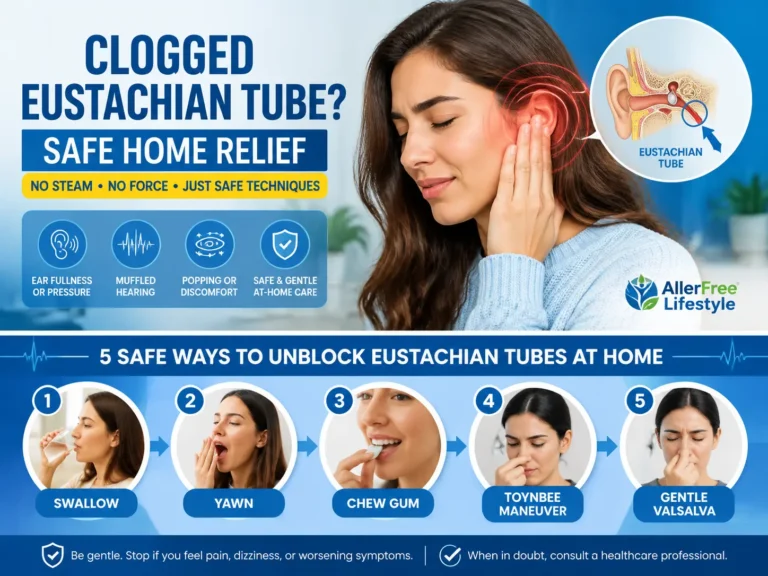
A clogged Eustachian tube can leave your ear feeling frustratingly full, muffled, or difficult to “pop.” The good news is that mild pressure blockage can often be managed with gentle pressure-equalizing techniques at home without steam.A clogged Eustachian tube can leave your ear feeling frustratingly full, muffled, or difficult to “pop.” The good news is that mild pressure blockage can often be managed with gentle pressure-equalizing techniques at home without steam.
Quick Answer:
A mildly clogged Eustachian tube may respond to repeated swallowing, yawning, chewing gum, the Toynbee maneuver, or a carefully performed gentle Valsalva maneuver. Nasal saline can be useful when nasal congestion is present. Avoid forceful ear popping and boiling-water steam inhalation.
How to Unclog a Eustachian Tube at Home Safely
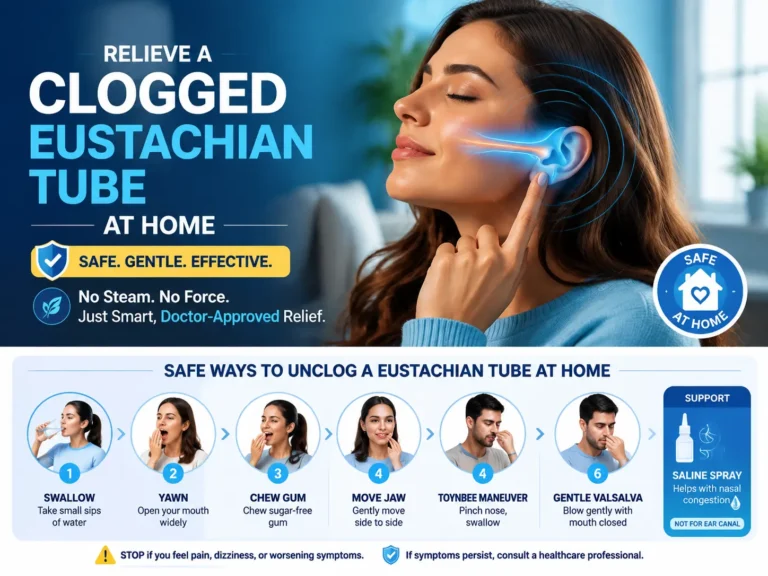
Start with the gentlest methods. Swallowing and yawning naturally activate muscles around the Eustachian tube and can briefly open it, allowing pressure on both sides of the eardrum to equalize.
Try these steps in order:
- Take several small sips of water and swallow slowly.
- Yawn naturally or open your mouth widely as though you are yawning.
- Chew sugar-free gum for several minutes.
- Move your jaw gently from side to side.
- If pressure remains, try the Toynbee maneuver.
- Use a gentle Valsalva maneuver only if the simpler methods do not help.
You may notice a faint click or soft pop when pressure equalizes. You do not need to produce a loud pop. Trying harder when the ear does not open immediately may cause more discomfort rather than faster relief.
What Is the Fastest Safe Way to Unblock Eustachian Tubes?
There is no guaranteed instant treatment, but swallowing and gentle pressure equalization are usually the most practical first steps.
If swallowing and yawning do not help, try the Toynbee maneuver:
- Close your mouth.
- Pinch your nostrils gently.
- Swallow
This combines swallowing—which normally helps open the Eustachian tube—with a temporary change in pressure behind the nose.
It is often a sensible technique to try before intentionally blowing pressure toward the middle ear.
How to Do the Valsalva Maneuver for a Blocked Eustachian Tube
A gentle Valsalva maneuver may help equalize middle-ear pressure, but technique matters.
To perform it:
- Close your mouth.
- Pinch your nostrils closed.
- Take a normal breath.
- Gently try to breathe out through your closed nose.
- Stop when you feel mild pressure or a soft movement in the ear.
The word gently is important. Do not blow as hard as possible or continue until the ear pops.
If you develop sharp ear pain, significant dizziness, or worsening hearing, stop. Repeated forceful pressure is not a safe way to open a blocked Eustachian tube.
Does Saline Nasal Spray Help a Blocked Eustachian Tube?
Saline nasal spray can be useful when a clogged ear occurs alongside nasal congestion, but it is important to understand what saline actually does.
It does not directly flush or drain the Eustachian tube. Instead, saline helps moisturize nasal tissues and loosen nasal secretions. Because the Eustachian tube opens into the nasopharynx behind the nose, improving nasal comfort may make pressure equalization easier when congestion is contributing.
Options include:
- isotonic saline nasal spray;
- commercially prepared saline rinses;
- correctly prepared nasal-irrigation solutions.
Do not put saline, oil, hydrogen peroxide, or other liquids into the ear canal expecting them to reach the Eustachian tube. An intact eardrum separates the external ear canal from the middle ear.
Do Chewing Gum, Yawning and Jaw Movements Open Eustachian Tubes?
They can. The Eustachian tube normally opens intermittently during swallowing and yawning, which is why simple movements can sometimes relieve ear pressure.
Helpful options include:
- chewing gum;
- taking frequent small sips of water;
- deliberately yawning;
- slowly opening and closing your mouth;
- gently moving your jaw from side to side.
These approaches are particularly useful when you want a gentle way to relieve Eustachian tube pressure without forceful popping.
A warm compress around the ear may also feel soothing, although it should be considered a comfort measure rather than a proven method of physically draining the Eustachian tube.
Can You Massage a Eustachian Tube to Help It Drain?
“Eustachian tube massage” is widely discussed online, but strong clinical evidence that external massage reliably drains or opens the tube is limited.
Gentle jaw movement is reasonable, but there is no need for vigorous pressure behind the ear or deep massage of the neck.
If massage causes pain, dizziness, or increasing ear pressure, stop.
Does Autoinflation Help a Clogged Eustachian Tube?
Autoinflation uses controlled positive pressure to help ventilate the middle ear. Some devices use a nasal balloon or another pressure-generating system.
Research is strongest in children with otitis media with effusion (glue ear) rather than uncomplicated adult Eustachian tube blockage. A 2023 Cochrane review found that autoinflation may improve some short-term outcomes in children, although certainty varies and its benefits should not automatically be generalized to every adult with a clogged ear (2).
An autoinflation device may therefore be appropriate in selected situations, but it should not be considered a guaranteed home cure.
Do Nasal Steroid Sprays Quickly Unclog Eustachian Tubes?
Not reliably.
Intranasal corticosteroid sprays may be prescribed when there is a separate nasal condition that warrants treatment, but they should not be presented as an instant Eustachian tube opener.
A 2024 systematic review and meta-analysis of randomized controlled trials found no significant overall advantage of intranasal corticosteroids in normalizing tympanometry for Eustachian tube dysfunction (1).
This does not mean nasal steroids are never appropriate. It means their use should be based on the underlying clinical situation rather than automatically treating every feeling of ear blockage.
The same principle applies to antihistamines and decongestants: they are medicines with specific indications, precautions, and potential adverse effects—not universal remedies for a clogged Eustachian tube.
How Can You Relieve Eustachian Tube Pressure Without Steam?
Steam is not required to equalize middle-ear pressure.
The Eustachian tube is opened by muscular activity and pressure changes, so swallowing, yawning, chewing, Toynbee, gentle Valsalva, and appropriate nasal care can all be attempted without inhaling steam.
This also avoids the risks associated with bowls or containers of very hot water. A 2026 study reported severe pediatric scald injuries associated with homemade steam-inhalation devices, reinforcing concerns about this preventable hazard (3).
If warmth feels comforting, use a comfortably warm compress rather than placing your face over boiling water.
What Should You Avoid When Trying to Pop a Blocked Eustachian Tube?
Avoid turning a mild blocked-ear sensation into an injury.
Do not:
- blow forcefully during Valsalva;
- repeatedly force the ear to pop;
- insert cotton swabs or other objects deep into the ear;
- use ear candles;
- pour unprescribed liquids into the ear;
- use dangerously hot compresses;
- inhale steam from bowls of boiling water;
- repeatedly use medicated nasal sprays beyond their recommended duration.
The aim is gentle pressure equalization, not creating the strongest possible pressure.
When Should You Stop Home Treatment?
Do not continue treating a “clogged ear” at home indefinitely.
Seek medical assessment if you develop:
- sudden or rapidly worsening hearing loss;
- severe or increasing ear pain;
- discharge or bleeding from the ear;
- significant vertigo or dizziness;
- symptoms after ear trauma;
- persistent or one-sided blockage that does not improve.
Sudden hearing loss is particularly important because it may initially feel like an ordinary blocked ear. Prompt medical evaluation is safer than repeatedly attempting to pop an ear when the cause is uncertain.
Medical Disclaimer
This article is for educational and informational purposes only and is not a substitute for professional medical advice, diagnosis, or treatment. If ear pressure is severe, persistent, worsening, or associated with sudden hearing loss, discharge, or significant dizziness, seek evaluation from a qualified healthcare professional.
Frequently Asked Questions(FAQs)
1. Can a clogged Eustachian tube clear on its own?
Yes. Mild blockage may improve naturally as pressure equalizes. Swallowing, yawning, and gentle jaw movement may help the tube open normally.
2. What is the safest way to pop a blocked ear?
Start with swallowing or yawning. If necessary, try the Toynbee maneuver or a very gentle Valsalva maneuver rather than forceful blowing.
3. Can saline nasal spray unblock the Eustachian tube?
Saline may help when nasal congestion is present, but it does not directly flush or drain the Eustachian tube.
4. Is steam necessary for a clogged Eustachian tube?
No. Pressure can often be equalized without steam by swallowing, yawning, chewing gum, or using gentle pressure-equalization techniques.
5. Can I force my Eustachian tube to open?
No. Forceful ear popping can cause pain or injury. Pressure-equalization techniques should always be performed gently.
6. When should I see a doctor for a clogged Eustachian tube?
Seek medical care for sudden hearing loss, severe or worsening pain, ear discharge, significant dizziness, or persistent symptoms that do not improve.
References
- Nibhanupudy TJ, Patel A, Trinh CP, Jenkins E, Weber PC, Levi JR. Efficacy of intranasal corticosteroid sprays in relieving clinical signs of Eustachian tube dysfunction: a systematic review and meta-analysis of randomised, controlled trials.Journal of Laryngology & Otology. 2024;138(11):1065–1072. DOI: 10.1017/S0022215124000756.
- Webster KE, Mulvaney CA, Galbraith K, et al. Autoinflation for otitis media with effusion (OME) in children.Cochrane Database of Systematic Reviews. 2023;9(9):CD015253. DOI: 10.1002/14651858.CD015253.pub2.
- Tobalem B, Serror K, et al. Homemade Steam Inhalation Therapy Devices: A Neglected Cause of Severe Pediatric Burns—An Urgent Call for Education and Safety Measures.Journal of Burn Care & Research. 2026;47(1):190–197. DOI: 10.1093/jbcr/iraf135.