

How to Clear a Blocked Nose and Ear Pressure before Getting on a Flight
Written by: Dr. Muhammad Ihsan Ullah, PhD
Medically reviewed by: Dr Ali Raza Dogar ,MBBS, ENT
Last updated on August 20, 2026

Flying with a blocked nose can make it harder for the Eustachian tubes to balance pressure between the middle ear and the aircraft cabin. If your ears already feel full or blocked before boarding, dealing with congestion gently and checking that your ears can equalize may reduce the risk of painful airplane ear (ear barotrauma).
Quick Answer
Before flying, gently clear nasal congestion, use saline if helpful, stay hydrated, and make sure you can equalize your ears by swallowing or yawning. A medically appropriate decongestant may help some travelers. If an ear remains completely blocked or painful despite gentle measures, seek medical advice before flying.
How to Clear a Blocked Nose before Flying
Start with simple measures that improve nasal airflow without irritating already swollen tissues.
Before boarding:
- Blow your nose gently, preferably one nostril at a time.
- Use a saline nasal spray or saline rinseif mucus or dryness is contributing to the blockage.
- Drink enough water to avoid unnecessary dryness of the nasal passages.
- Continue any regular allergy treatmentthat has already been recommended for you.
- Avoid repeatedly forceful nose blowing, which does not necessarily improve Eustachian-tube function.
The goal is not just to make the nostrils feel clearer. Congestion around the nasopharynx, where the Eustachian tubes open, can make pressure regulation in the middle ear more difficult.
Relieving Ear Pressure before Takeoff
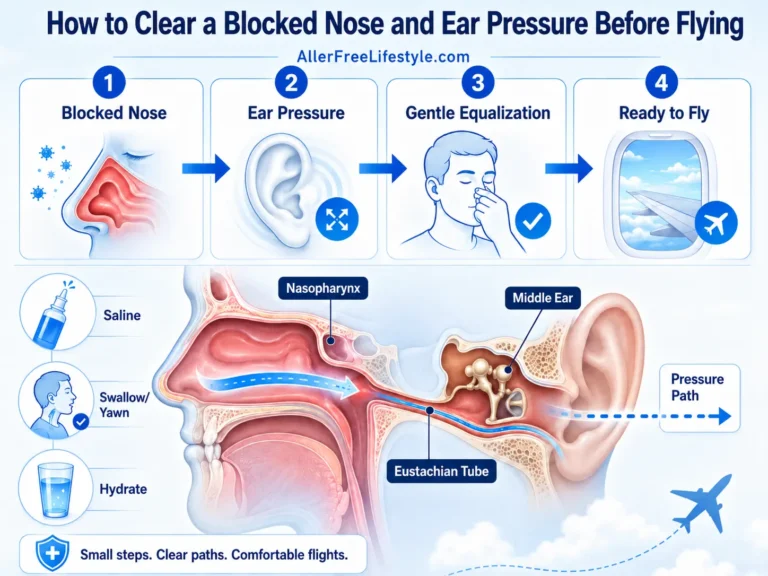
If your ears already feel full, begin with gentle pressure-equalization techniques rather than trying to force them open.
You can try:
- Swallowing several times
- Yawning deliberately
- Sipping water
- Chewing gum
- Performing the Toynbee maneuverby pinching the nose and swallowing gently
- Using a gentle Valsalva maneuverif necessary
For a gentle Valsalva maneuver, close your mouth, pinch your nostrils, and blow very softly against the closed nose. A mild pop or reduction in pressure may indicate that the Eustachian tube has opened.
Swallowing, yawning, and other gentle pressure-equalization techniques are commonly used to help balance pressure across the eardrum during changes in altitude. Evidence for several additional preventive devices and interventions remains less certain (2).
Do not blow forcefully. Excessive pressure can injure delicate structures of the ear rather than improve the blockage.
How to Open the Eustachian Tubes Before Flying
The Eustachian tubes are narrow passages connecting each middle ear with the back of the nose. They normally open briefly when you swallow or yawn, allowing pressure on both sides of the tympanic membrane (eardrum) to equalize.
You cannot hold the tubes open manually, but repeated swallowing, yawning, and gentle pressure maneuvers may encourage them to open temporarily.
A useful practical check before boarding is whether both ears can equalize without pain.
If one ear remains completely blocked despite gentle attempts, rapid cabin-pressure changes during ascent or descent may become considerably more uncomfortable.
Using Saline or Nasal Spray Before a Flight
A saline nasal spray and a medicated nasal decongestant spray work differently.
Saline contains no vasoconstrictor medication. It can:
- Loosen thick nasal secretions
- Moisturize dry nasal passages
- Make gentle nose clearing easier
- Improve nasal comfort before travel
A topical decongestant such as oxymetazoline temporarily constricts swollen blood vessels in the nasal lining. This may improve nasal airflow in some people, but it should not be assumed that every nasal spray will reliably prevent airplane ear.
Medicated decongestant sprays should also not be overused. Repeated or prolonged use can lead to rebound congestion, potentially making nasal blockage worse.
Can a Decongestant Help With Blocked Ears Before Flying?
For some adults, oral pseudoephedrine may reduce the risk of flight-related ear barotrauma.
A 2026 systematic review and meta-analysis of randomized clinical trials found that oral pseudoephedrine reduced the risk of otic barotrauma compared with placebo. The benefit observed with intranasal oxymetazoline was smaller and less consistent. However, the included randomized trials were older, so the overall evidence base remains limited (1).
This does not mean pseudoephedrine is suitable for everyone.
Extra caution is required in people with conditions such as:
- High blood pressure
- Certain heart or rhythm disorders
- Hyperthyroidism
- Pregnancy
- Medication interactions
- Other conditions in which sympathomimetic drugs may be unsuitable
If you are unsure whether an oral or topical decongestant is safe for you, ask a doctor or pharmacist rather than using it simply as a travel precaution.
When to Use a Nasal Decongestant Before Flying
Timing depends on the individual product.
Some topical decongestants are commonly used around 30–60 minutes before a major pressure change, but the correct timing, dose, and frequency should follow the product label or individualized medical advice.
Do not take additional doses simply because an ear still feels blocked. More medication does not guarantee better Eustachian-tube function and can increase the likelihood of adverse effects.
If congestion is primarily caused by allergies, continue the allergy management plan already recommended for you rather than relying entirely on a last-minute decongestant.
What to Do if Your Ears Are Already Blocked Before Boarding
An ear that feels mildly full is different from one that cannot equalize at all.
If your ears are blocked before boarding:
- Swallow and yawn several times.
- Clear nasal secretions gently.
- Use saline if it helps.
- Try a gentle Toynbee or Valsalva maneuver.
- Use a decongestant only when medically appropriate.
- Keep water or chewing gum available for takeoff and landing.
If the ear remains completely blocked, do not repeatedly perform forceful Valsalva maneuvers. Increasing pressure is not always the solution.
You should be particularly cautious if the blockage is accompanied by severe pain, sudden hearing reduction, significant dizziness, ear discharge, or bleeding.
Is It Safe to Fly With a Blocked Nose and Ear Pressure?
Mild congestion does not automatically mean you cannot fly. The greater concern is severe congestion that prevents normal middle-ear pressure equalization.
Consider seeking medical advice or postponing air travel when possible if:
- One or both ears remain completely blocked
- You have severe ear pain before boarding
- You have a significant acute cold or sinus infection
- You have an active ear infection
- You recently underwent ear surgery
- You have a known eardrum problem
- Previous flights caused severe barotrauma
- You develop sudden hearing loss, severe dizziness, bleeding, or ear discharge
If your ears cannot equalize while you are still on the ground, treating that as a warning sign is safer than waiting for cabin-pressure changes to make the problem worse.
The Bottom Line
A blocked nose and ear pressure before a flight are usually best approached with gentle nasal clearing, saline when useful, hydration, and careful Eustachian-tube pressure equalization. Some adults may benefit from an appropriate decongestant, but oral pseudoephedrine and topical nasal sprays are not equally supported by evidence and are not suitable for everyone.
The most important rule is simple: equalize gently and early rather than waiting for severe pressure and then forcing the ears to pop.
If an ear remains completely blocked or painful before takeoff, especially with significant congestion or other ear symptoms, medical advice may be more appropriate than trying increasingly aggressive home measures.
Frequently Asked Questions(FAQs)
1. How can I clear a blocked nose before flying?
Gently clear your nose, use saline spray or rinse if helpful, stay hydrated, and continue any regular allergy treatment already recommended for you.
2. How can I relieve ear pressure before takeoff?
Try swallowing, yawning, chewing gum, sipping water, or using a gentle Toynbee or Valsalva maneuver to help equalize middle-ear pressure.
3. Should I use a nasal spray before flying?
Saline may help loosen mucus and improve nasal comfort. Medicated decongestant sprays may help some people but should be used only as directed.
4. Can a decongestant help prevent blocked ears on a flight?
Oral pseudoephedrine may reduce flight-related ear barotrauma in some adults, but it is not suitable for everyone.
5. Is it safe to fly with a blocked nose and ear pressure?
Mild congestion may be manageable, but severe blockage, significant ear pain, or inability to equalize the ears may warrant medical advice before flying.
6. What if my ears will not pop before boarding?
Do not force them repeatedly. If an ear remains completely blocked or painful despite gentle equalization, consider medical assessment before flying.
References
- AlGhamdi MA, Katib RI, Bawazir RO, et al. Efficacy of Pseudoephedrine and Oxymetazoline in Preventing Otic Barotrauma: A Systematic Review and Meta-Analysis. Otology & Neurotology. 2026. doi:10.1097/MAO.0000000000004905
- Ryan P, Treble A, Patel N, Jufas N. Prevention of Otic Barotrauma in Aviation: A Systematic Review. Otology & Neurotology. 2018;39(5):539–549. doi:10.1097/MAO.0000000000001779