

What Allergy Medicine Is Completely Non-Drowsy for Students and Drivers?
Written by: Dr. Muhammad Ihsan Ullah, PhD (Pharmacology)
Medically reviewed by: Dr. Asma Fareed Khan, PhD (Clinical Pharmacy)
Last reviewed: August 22, 2026

When allergies strike during exams, long study sessions, work, or driving, symptom relief is only part of the equation. The medicine also needs to preserve alertness, concentration, reaction time, and mental performance. Although several modern antihistamines are marketed as “non-drowsy,” their sedating potential is not identical, and individual responses can vary.
No oral antihistamine can guarantee zero drowsiness in every person. Second-generation antihistamines are generally less sedating than older drugs, but sleepiness, fatigue, or dizziness can still occur.
Fexofenadine (Allegra) has particularly strong evidence for minimal sedation at recommended doses, making it a reasonable option to discuss with a healthcare professional when staying alert for studying, work, or driving is especially important.
Why Do Some “Non-Drowsy” Antihistamines Still Affect Alertness?
Antihistamines work primarily by blocking histamine H1 receptors. Older first-generation drugs such as diphenhydramine readily enter the central nervous system and can interfere with wakefulness, attention, memory, and psychomotor performance.
Newer second-generation antihistamines have less penetration across the blood-brain barrier, but the degree varies between medicines. Fexofenadine has very limited central nervous system penetration and has shown minimal effects on cognition and psychomotor performance at therapeutic doses (1).
That pharmacological difference matters when choosing an allergy medicine for activities that require sustained attention rather than simply looking for a “non-drowsy” claim on the package.
Is Fexofenadine 180 mg (Allegra) a Good Choice When Alertness Matters?
Fexofenadine (Allegra) is among the best-supported low-sedating oral antihistamines. A common U.S. labeled dose for adults and adolescents aged 12 years and older is 180 mg once daily.
A 2024 systematic review evaluating clinical and central nervous system evidence concluded that fexofenadine has minimal brain penetration and does not typically impair cognitive or psychomotor performance at recommended doses (1).
For a student who needs to concentrate through lectures or exams—or an adult whose work requires sustained vigilance—this pharmacological profile makes fexofenadine particularly relevant. It still should not be assumed to be completely non-drowsy for every individual.
Allegra vs Claritin: How Does Loratadine 10 mg Compare?
Loratadine (Claritin) 10 mg once daily is another commonly used second-generation antihistamine with relatively low sedating potential.
Both loratadine and fexofenadine are commonly chosen for daytime use. However, when the specific priority is minimizing central sedation, fexofenadine has especially strong evidence supporting minimal effects on alertness and psychomotor performance.
Desloratadine (Clarinex) 5 mg once daily, the active metabolite of loratadine, is also considered a low-sedating second-generation option. Individual response remains more important than the brand name alone.
Does Cetirizine 10 mg (Zyrtec) or Levocetirizine 5 mg (Xyzal) Cause Sleepiness?
Yes, both can.
Cetirizine (Zyrtec) 10 mg once daily is widely used and effective, but drowsiness occurs in some people. Someone who notices reduced concentration, fatigue, or slower mental performance after cetirizine should not treat its second-generation classification as proof that driving or studying will be unaffected.
Levocetirizine (Xyzal) is commonly taken at 5 mg once daily in the evening in adults and adolescents for whom that dose is appropriate. Somnolence is a recognized adverse effect, so extra caution is sensible when maximum daytime alertness is essential.
Which Antihistamine Is Least Drowsy? A Quick Comparison
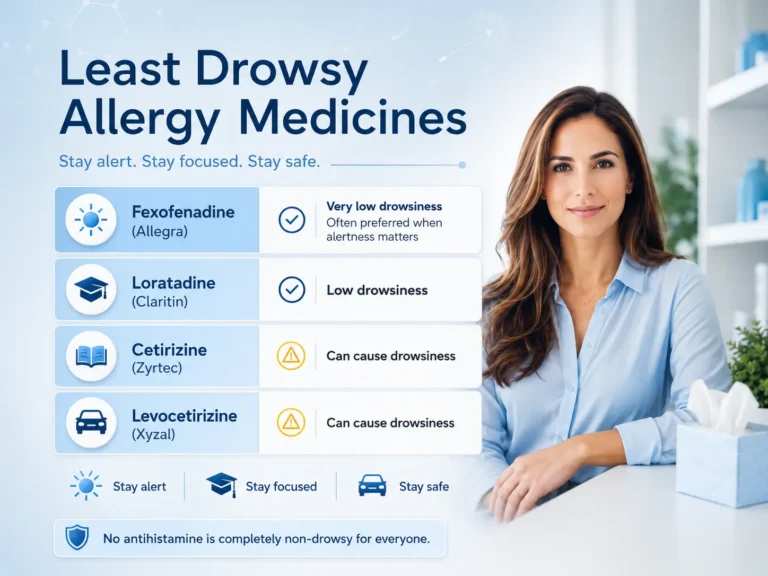
Antihistamine | Common Brand | Common U.S. Adult/Adolescent Dose* | Sedation Consideration |
Fexofenadine | Allegra | 180 mg once daily | Very low sedating potential; strong evidence for minimal CNS effects |
Loratadine | Claritin | 10 mg once daily | Generally low-sedating |
Desloratadine | Clarinex | 5 mg once daily | Generally low-sedating |
Cetirizine | Zyrtec | 10 mg once daily | Drowsiness occurs in some users |
Levocetirizine | Xyzal | 5 mg once daily, usually evening | Somnolence can occur |
*Doses are included for general comparison and should not be interpreted as individualized prescribing instructions. Age, kidney or liver function, pregnancy, other medicines, and local product labeling can affect appropriate dosing.
What Is the Best Non-Drowsy Allergy Medicine for Students?
For students, the practical issue is not only feeling awake but maintaining attention, memory, concentration, and daytime functioning.
A useful approach is to:
- Prefer a lower-sedating second-generation antihistamine when medically appropriate.
- Avoid trying an unfamiliar antihistamine immediately before an important examination.
- Never exceed the recommended dose in an attempt to obtain stronger relief.
- Avoid alcohol or other sedating substances that can worsen impairment.
- Pay attention to personal effects such as fatigue, mental slowing, or difficulty concentrating.
Fexofenadine may be particularly suitable when minimizing sedation is the main concern, but treatment should still be individualized.
Can You Drive After Taking a Non-Drowsy Antihistamine?
The word “non-drowsy” should not be treated as permission to drive regardless of how you feel.
Research examining second-generation antihistamines suggests that their overall effect on driving performance is generally much smaller than that associated with older sedating antihistamines. However, a 2024 study identified potential impairment when antihistamine exposure was combined with a cognitively demanding calling task (2). More recent driving-simulator research found a small overall class effect but observed a concerning trend when drivers performed simultaneous subtasks such as conversation (3).
Before driving:
- Know how the medicine affects you personally.
- Do not drive if you feel sleepy, dizzy, slowed, or unfocused.
- Avoid combining antihistamines with alcohol or other CNS depressants unless medically advised.
- Give full attention to driving rather than relying on a medicine’s “non-drowsy” label.
Medical Disclaimer
This article is for educational purposes only and does not replace advice from a physician or pharmacist. Antihistamine choice and dosing may vary with age, kidney or liver function, pregnancy, other medicines, and individual response. Seek professional advice if you are unsure which medicine is appropriate, particularly when driving or operating machinery.
Frequently Asked Questions(FAQs)
1. Which allergy medicine is least likely to cause drowsiness?
Fexofenadine (Allegra) is generally considered one of the least sedating commonly used oral antihistamines at recommended doses.
2. Is any antihistamine completely non-drowsy?
No. Even low-sedating antihistamines can occasionally cause sleepiness, dizziness, or fatigue.
3. Is Allegra less drowsy than Zyrtec?
Fexofenadine generally has lower sedating potential than cetirizine, although individual responses vary.
4. What allergy medicine is suitable when studying?
A low-sedating second-generation antihistamine such as fexofenadine may be considered when maintaining concentration is important.
5. Can I drive after taking a non-drowsy antihistamine?
Only if the medicine does not make you sleepy, dizzy, slowed, or less alert. Be particularly cautious when taking it for the first time.
6. Does Claritin cause less drowsiness than Zyrtec?
Loratadine generally has lower sedating potential than cetirizine, although either medicine can affect individuals differently.
References
- Ansotegui IJ, Bousquet J, et al. Why fexofenadine is considered as a truly non-sedating antihistamine with no brain penetration: a systematic review. Current Medical Research and Opinion.2024. DOI: 10.1080/03007995.2024.2378172.
- Sagara A, Nagahama A, Aki H, et al. Usefulness of driver’s eye movement measurement to detect potential risks under combined conditions of taking second-generation antihistamines and calling tasks. Journal of Pharmaceutical Health Care and Sciences.2024;10:62. DOI: 10.1186/s40780-024-00383-5.
- Nagahama A, Sagara A, Aki H, et al. Effects of second generation antihistamines on daily driving with and without subtasks measured in a driving simulator. Discover Applied Sciences.2026;8:123. DOI: 10.1007/s42452-025-08123-6.