

Why Does Sinus Pressure From Allergies Make My Teeth Hurt?
Written by: Dr. Muhammad Ihsan Ullah, PhD
Medically reviewed by: Dr Ali Raza Dogar ,MBBS, ENT
Last updated on August 20, 2026

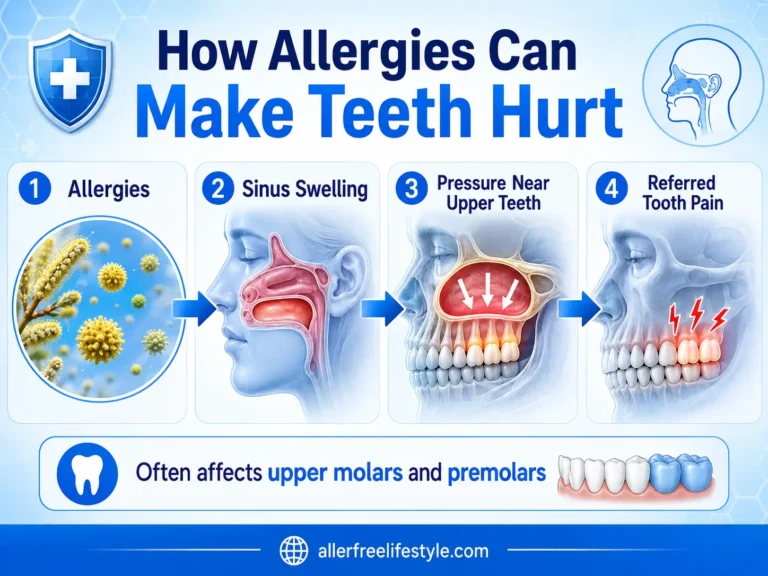
If your teeth start aching when your allergies flare, the pain may not actually be coming from the teeth themselves. The maxillary sinuses sit just above the upper back teeth, and inflammation or congestion in this area can sometimes create discomfort that feels surprisingly similar to a real toothache.
Quick Answer
Sinus pressure associated with allergies can make your upper teeth hurt because allergic inflammation causes nasal congestion and tissue swelling, while the maxillary sinuses lie close to the roots and sensory nerves of the upper molars and premolars. The brain may therefore perceive discomfort from the sinus region as referred tooth pain, even when the teeth themselves are healthy (1, 2).
Allergies do not directly damage the teeth. The connection is usually indirect, which is why persistent or strongly localized tooth pain should never automatically be blamed on sinus pressure.
Why Do My Upper Teeth Hurt During Allergy Season?
Allergic rhinitis occurs when the immune system reacts to airborne allergens such as pollen, dust mites, mold or animal dander. This reaction can trigger inflammation, swelling of the nasal lining, increased secretions and significant nasal congestion (1).
When allergy-related swelling affects the tissues surrounding normal sinus drainage pathways, some people experience pressure or discomfort around the cheeks and upper jaw.
The maxillary sinuses are especially relevant because they lie directly above the upper dental arch. Their close position to the upper tooth roots means discomfort from the sinus region may be perceived as pain in nearby teeth.
You may notice:
- a dull ache across the upper back teeth
- pressure involving several teeth at once
- heaviness in the upper jaw
- tooth discomfort appearing alongside congestion
- temporary sensitivity during a seasonal allergy flare
Lower teeth are less commonly affected by sinus-related referred pain because they are much farther from the maxillary sinuses.
Why Do My Upper Molars Hurt When My Allergies Act Up?
The upper molars have an especially close anatomical relationship with the maxillary sinus floor.
Imaging studies show that the roots of maxillary molars can lie very close to the floor of the sinus, although the exact distance varies considerably from one person to another. In some people, only a small amount of bone separates these structures (2).
This helps explain why upper molar pain during allergy season may feel deep and difficult to pinpoint.
The sensation can include:
- aching in the upper back teeth
- pressure rather than sharp pain
- heaviness around several molars
- discomfort spreading into the cheek or upper jaw
- temporary sensitivity that changes with congestion
Sinus pressure should not be imagined as simply “pushing directly on the tooth roots.” The real relationship is more complex and involves nearby inflammation, anatomy and shared sensory pathways.
How Shared Nerves Can Make Sinus Pain Feel Like a Toothache
They can. The Eustachian tube normally opens intermittently during swallowing and yawning, which is why simple movements can sometimes relieve ear pressure.
Helpful options include:
- chewing gum;
- taking frequent small sips of water;
- deliberately yawning;
- slowly opening and closing your mouth;
- gently moving your jaw from side to side.
These approaches are particularly useful when you want a gentle way to relieve Eustachian tube pressure without forceful popping.
A warm compress around the ear may also feel soothing, although it should be considered a comfort measure rather than a proven method of physically draining the Eustachian tube.
The upper teeth receive sensation through branches connected to the maxillary division of the trigeminal nerve, one of the major sensory nerves of the face.
The upper jaw, teeth and maxillary sinus occupy closely related sensory territory. When inflammation or pressure stimulates nerves around the sinus region, the brain may not always identify the exact source of the signal.
This is called referred pain.
In simple terms, irritation begins near the sinus, but the pain may feel as though it is coming from an upper premolar or molar.
That is why sinus pressure can make otherwise healthy teeth hurt, even when a dental examination does not reveal an obvious cavity, fracture or infection.
Why Can Several Upper Teeth Hurt at the Same Time?
The pattern of pain can provide an important clue.
A maxillary sinus extends above several upper posterior teeth rather than a single tooth. When discomfort originates from this wider area, the sensation may spread across several premolars and molars.
People often describe:
- several teeth aching together
- poorly localized pressure
- discomfort that seems to shift between teeth
- upper-jaw aching during congestion
- pain that becomes less noticeable as sinus symptoms improve
A broad ache across multiple upper teeth can fit a sinus-related pattern better than intense pain centered on one specific tooth.
However, this distinction is not absolute. Dental disease can also produce referred or radiating pain.
Why Does Tooth Pressure Sometimes Feel Worse When Bending Forward?
Some people notice that facial or upper-tooth pressure becomes stronger when they bend over or lower their head.
A change in head position can alter how congestion and pressure are perceived within inflamed sinonasal tissues. If the maxillary sinus area is already uncomfortable, the sensation may become temporarily more noticeable in the upper jaw and teeth.
So, sinus pressure tooth pain that feels worse when bending forward can occur.
However, this symptom alone cannot diagnose a sinus-related toothache. It should be considered alongside the overall pattern of congestion, allergy symptoms and dental findings.
Can Pollen Allergies Make Your Teeth Hurt?
Pollen itself does not injure the teeth.
Instead, pollen can trigger seasonal allergic rhinitis in susceptible people. The resulting inflammatory response may cause nasal swelling and congestion, which can contribute to pressure around the maxillary sinus region (1).
For some people, this explains why the upper teeth hurt during pollen season and feel normal again when their allergies settle.
A pattern may include:
- tooth discomfort during high-pollen periods
- congestion occurring at the same time
- several upper teeth aching together
- improvement as the allergy flare improves
Seasonal timing can be useful information, but it does not prove that allergies are the only cause.
Can Sinus Pressure Make Healthy Teeth Hurt?
Yes. A healthy tooth can genuinely feel painful because of referred sensory signals from nearby tissues.
This is one reason someone may experience significant upper-tooth discomfort even though a dentist cannot find an obvious dental problem.
Sinus-related referred pain is more plausible when:
- several upper teeth hurt together
- the discomfort feels dull or pressure-like
- nasal congestion or facial pressure is present
- symptoms fluctuate with allergy severity
- the pain improves as congestion settles
There is also an important reverse relationship to understand.
Dental disease can sometimes spread inflammation into the maxillary sinus. This is known as odontogenic maxillary sinusitis. Current expert consensus emphasizes that dental and sinus conditions can closely overlap and sometimes require coordinated assessment by dental and ENT professionals (3).
This is why persistent tooth pain should never simply be labeled as an allergy problem.
When Pain in One Tooth Needs More Attention
Allergy-associated discomfort may occasionally feel stronger around one tooth, but persistent pain isolated to a single tooth deserves careful evaluation.
A dental cause becomes more concerning if you have:
- strong pain when biting or chewing
- prolonged sensitivity to hot or cold
- pain that keeps worsening
- swelling around the gum
- facial swelling
- drainage or an unpleasant taste
- pain that continues after congestion improves
A cracked tooth, inflamed dental pulp, periodontal disease or dental infection can all resemble sinus-related discomfort.
Persistent one-sided sinus pressure with tooth pain also deserves professional assessment because dental disease affecting the maxillary sinus can sometimes be missed (3).
The Key Clinical Takeaway
When allergies flare, inflammation and congestion can affect the region around the maxillary sinuses. Because these sinuses lie close to the upper molars, premolars and their sensory nerve pathways, discomfort may be interpreted by the brain as tooth pain.
A dull ache affecting several upper teeth during significant allergy congestion is more compatible with referred sinus discomfort than persistent, sharply localized pain in one tooth.
Still, the symptoms of dental disease and sinus-related pain can overlap. Persistent, severe, localized or worsening tooth pain should be evaluated rather than assumed to be caused by allergies.
Medical Disclaimer
This article is for educational purposes only and does not replace professional medical or dental advice, diagnosis or treatment. Persistent, severe or worsening tooth or sinus pain should be evaluated by a qualified healthcare professional.
Frequently Asked Questions(FAQs)
1. Can allergies make your teeth hurt?
Yes. Allergy-related congestion and pressure around the maxillary sinuses can cause referred pain that feels as though it is coming from the upper teeth.
2. Why do my upper teeth hurt during allergy season?
The roots of the upper molars and premolars lie close to the maxillary sinuses. Inflammation and pressure in this region may therefore be perceived as tooth discomfort.
3. Can sinus pressure make several teeth hurt at once?
Yes. Sinus-related referred pain can affect several upper teeth because the maxillary sinus extends above multiple premolars and molars.
4. Why does sinus tooth pain feel worse when bending forward?
Changing head position may make congestion and pressure in the sinus region more noticeable, temporarily increasing discomfort in the upper jaw or teeth.
5. Can sinus pressure make healthy teeth hurt?
Yes. Healthy teeth can feel painful because nearby sinus tissues and the upper teeth have closely related sensory nerve pathways.
6. When should tooth pain not be blamed on allergies?
Persistent pain in one tooth, pain when biting, swelling, worsening symptoms or prolonged hot or cold sensitivity should be evaluated by a dentist.
References
- Bernstein JA, Bernstein JS, Makol R, Ward S. Allergic Rhinitis: A Review. JAMA.2024;331(10):866–877. doi: 10.1001/jama.2024.0530
- Yanık D, Nalbantoğlu AM. Anatomic relationship between the root apex of maxillary molars and maxillary sinus in the presence of antagonist teeth: A Kwak’s method with divisions. Archives of Oral Biology.2024;165:105998. doi: 10.1016/j.archoralbio.2024.105998
- Lin J, Wang C, Wang X, et al. Expert consensus on odontogenic maxillary sinusitis multi-disciplinary treatment. International Journal of Oral Science.2024;16(1):11. doi: 10.1038/s41368-024-00278-z