

Air Purifier vs. Dehumidifier for Singapore Allergy Relief
Written by: Dr. Muhammad Ihsan Ullah, PhD (Pharmacology)
Medically reviewed by: Dr. Jamal ud Din Khan, FCPS (Pulmonology)
Last updated on August 24, 2026
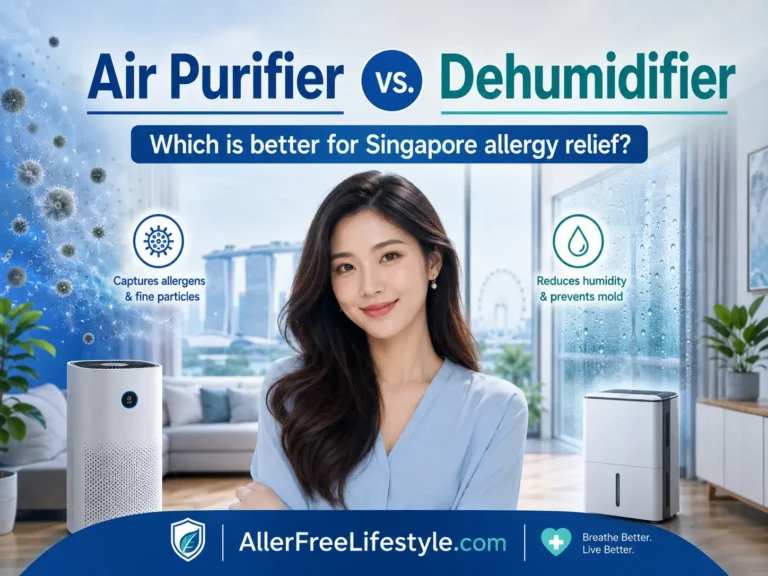
Choosing between an air purifier and a dehumidifier can be confusing when allergies seem worse at home in Singapore. Both devices can improve the indoor environment, but they solve different problems. An air purifier filters selected airborne particles, while a dehumidifier removes excess moisture. The better choice depends on whether your main exposure comes from airborne allergens, persistent humidity, or a combination of both.
The Bottom Line for Singapore Homes
For allergy relief, choose the appliance according to the indoor condition you need to change, not simply the allergy label. Air purification and humidity control work through different mechanisms, so the right choice depends on the dominant environmental exposure in your home.
Air Purifier or Dehumidifier: Which Is Better for Allergies in Singapore?
Neither appliance is universally better.
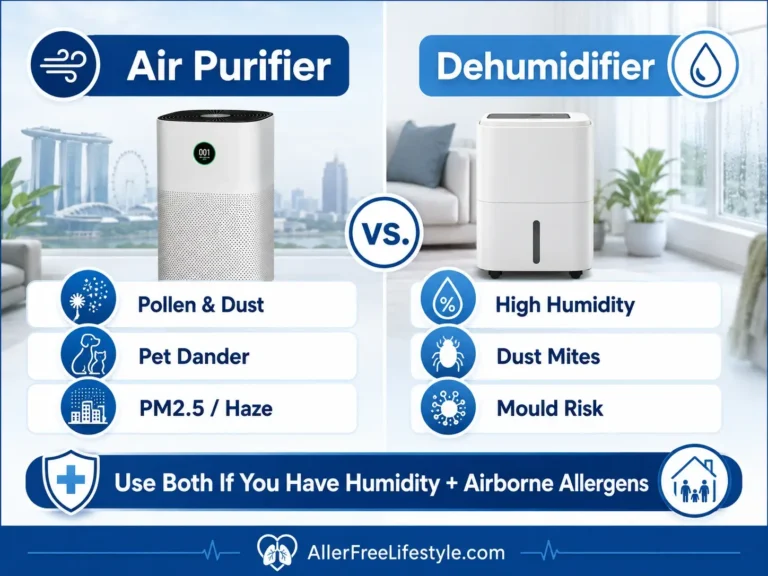
A HEPA air purifier is generally more useful when the main concern is airborne pollen, pet dander, mould spores, fine dust, PM2.5, or haze particles.
A dehumidifier becomes more relevant when excessive moisture contributes to dust-mite-friendly conditions, dampness, condensation, or mould growth.
A practical comparison is:
Main Indoor Problem | More Relevant Option |
Dust mites with high humidity | Dehumidifier + source control |
Dampness or active mould growth | Moisture control/dehumidifier |
Airborne mould spores | HEPA air purifier as support |
Pollen | HEPA air purifier |
Pet dander | HEPA air purifier |
PM2.5 or haze | Air purifier |
High humidity plus airborne allergens | Both may be useful |
Neither device treats the underlying allergic condition. Their role is to reduce environmental exposure.
Is a Dehumidifier or Air Purifier Better for Dust-Mite Allergies?
In a humid Singapore home, moisture control usually deserves greater attention when house dust mites are the main concern.
Dust mites depend strongly on environmental humidity. Keeping indoor relative humidity around 40–50% when achievable makes the environment less favorable for mite proliferation.
A dehumidifier therefore targets an important environmental factor supporting dust mites. An air purifier has a different role. Some dust-mite allergen particles can become airborne when bedding, carpets, or upholstered furniture are disturbed, but a purifier does not remove the mites or the larger allergen reservoir embedded in household fabrics.
A 2025 meta-analysis of randomized clinical trials found that house dust mite avoidance measures can reduce household dust and major Dermatophagoides allergen concentrations, supporting a broader exposure-reduction strategy rather than reliance on filtration alone (2).
For dust-mite control, combine:
- humidity management;
- regular bedding washing;
- allergen-impermeable mattress and pillow covers;
- effective cleaning of dust reservoirs;
- air filtration where appropriate.
Which Works Better for Mould Allergies: an Air Purifier or Dehumidifier?
When mould is being driven by dampness or excessive humidity, moisture control comes first.
A dehumidifier can help make the environment less favorable for further mould growth when high relative humidity is part of the problem. However, leaks, water intrusion, or persistent condensation also need to be corrected.
A HEPA purifier may capture some airborne mould spores, but it cannot stop mould growing on a damp wall, ceiling, wardrobe, or other surface.
The distinction is simple:
Dehumidification helps control the environment supporting mould.
HEPA filtration helps reduce some airborne particles released from that environment.
Using an air purifier without addressing persistent moisture leaves the underlying source unchanged.
When Is a HEPA Air Purifier the Better Choice?
A HEPA air purifier makes more sense when the target is something that spends meaningful time suspended in room air.
This may include:
- pollen;
- pet dander;
- airborne fungal spores;
- fine particulate matter;
- haze-related PM2.5;
- resuspended household dust;
- some airborne dust-mite allergen particles.
Filter type is only part of the decision. Clean Air Delivery Rate (CADR) and room size also matter because an excellent filter inside an undersized machine may not clean the room effectively enough.
A 2024 systematic review and meta-analysis found that air filtration may improve daytime and nighttime symptoms in people with allergic rhinitis, although improvements were not consistently demonstrated for every clinical outcome studied (1).
That is why air purifiers should be presented as exposure-reduction tools, not as a cure for allergies.
When Does a Dehumidifier Make More Sense in Singapore?
A dehumidifier becomes more useful when indoor moisture is clearly excessive.
Look for measurable or visible signs such as:
- consistently high humidity readings;
- condensation on windows or surfaces;
- damp bedrooms or wardrobes;
- slow-drying fabrics;
- recurrent moisture-related mould;
- conditions favorable to house dust mites.
Do not rely only on how a room feels. An air-conditioned bedroom can feel cool while relative humidity remains high.
A simple digital hygrometer can show whether moisture is actually under control.
This is particularly relevant in tropical environments because persistent warmth and humidity support year-round house dust mite proliferation. A 2026 tropical-region review identified approximately 25–30°C and 75–80% relative humidity as highly favorable ecological conditions for house dust mites (3).
Do You Need Both an Air Purifier and Dehumidifier for Allergies?
Sometimes, yes.
A humid home may contain both excess moisture and airborne allergens. In that situation, each device addresses a different part of the environment:
Dehumidifier → lowers excess moisture.
Air purifier → reduces selected airborne particles.
Using both can make sense when there is a clear reason for each. It is less useful to buy both simply because they are marketed as “allergy appliances.”
The stronger strategy is always to identify the main exposure first and then use the appliance that directly addresses it.
Can You Run an Air Purifier and Dehumidifier Together?
Yes. They can operate in the same room because they perform different functions.
For effective use:
- monitor relative humidity with a hygrometer;
- match purifier CADR to room size;
- keep airflow around both devices unobstructed;
- clean and maintain the dehumidifier regularly;
- replace purifier filters as recommended;
- fix obvious moisture sources rather than relying entirely on appliances.
The aim is measurable environmental improvement, not simply having more machines running.
Are a 2-in-1 Air Purifier and Dehumidifier Worth Considering?
A combined unit can be convenient where space is limited, but “2-in-1” does not guarantee strong performance in both functions.
Check:
- moisture-removal capacity;
- recommended room size;
- filtration type;
- CADR;
- filter replacement cost;
- noise level;
- energy consumption;
- whether both functions can operate effectively when needed.
A combined appliance is worthwhile only if both its dehumidification and filtration performance suit the room.
Which Should You Choose for Singapore Allergy Relief?
Choose a HEPA air purifier when airborne pollen, pet dander, mould spores, haze, or fine particulate pollution is the main concern.
Choose a dehumidifier when persistent humidity, dust-mite-friendly conditions, dampness, or moisture-driven mould is the main problem.
Consider both when excessive humidity and airborne allergens occur together.
The most useful question is not whether an air purifier or dehumidifier is universally “better for allergies.” It is:
Which part of your indoor environment needs to change?
Once that is clear, the choice becomes far more practical and medically defensible.
Medical Disclaimer
This article is for educational purposes only and is not a substitute for professional medical advice, diagnosis, or treatment. If allergy symptoms persist, worsen, or affect breathing, consult a qualified healthcare professional.
Frequently Asked Questions(FAQs)
1. Is an air purifier or dehumidifier better for allergies in Singapore?
It depends on the trigger. Air purifiers target airborne particles, while dehumidifiers reduce excess moisture that can support dust mites and mould.
2. Is a dehumidifier better for dust-mite allergies?
It can be more useful when indoor humidity is high because drier conditions are less favorable for dust mites.
3. Can an air purifier help with mould allergies?
A HEPA purifier may reduce airborne mould spores, but it cannot correct dampness or stop mould growth without moisture control.
4. Do I need both an air purifier and dehumidifier?
You may benefit from both if your home has excessive humidity as well as significant airborne allergens such as pollen, pet dander, or haze particles.
5. Can I run an air purifier and dehumidifier together?
Yes. They perform different functions and can be used together when both moisture and airborne particles need attention.
6. Is a 2-in-1 air purifier and dehumidifier worth it?
It can be, but evaluate its CADR, filtration quality, room-size rating, and moisture-removal capacity instead of relying on the “2-in-1” label.
References
- Shih MY, Hsu HW, Chen SY, Su MJ, Lo WC, Chen C. Effectiveness of Air Filters in Allergic Rhinitis: A Systematic Review and Meta-Analysis.Indoor Air. 2024;2024:8847667. doi:10.1155/2024/8847667
- Sobczak M, Kowal K, Pawliczak R. Are There Effective Methods to Reduce Exposure to House Dust Mite Allergens? A Meta-Analysis of Randomized Clinical Trials.International Forum of Allergy & Rhinology. 2025;15(8):792–802. doi:10.1002/alr.23565
- Tahir HM, Nik Kamarudin NAA, Ahamad M, Che Lah EF. A narrative review of house dust mite allergy: species distribution and allergen sensitisation patterns across tropical regions.Frontiers in Allergy. 2026;7:1813656. doi:10.3389/falgy.2026.1813656