

Can Sudden Shifts in Humidity Cause an Allergic Rhinitis Flare-Up?
Written by: Dr. Muhammad Ihsan Ullah, PhD
Medically reviewed by: Dr Ali Raza Dogar ,MBBS,ENT
Last updated on August 22, 2026
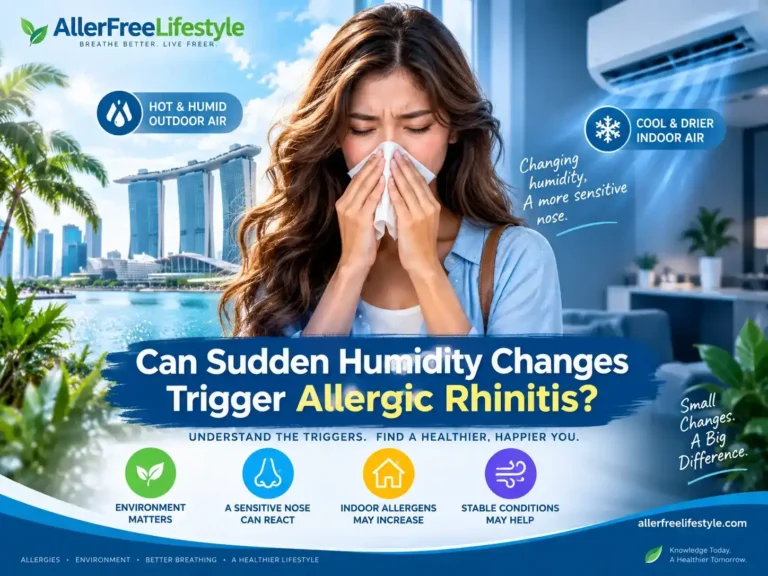
Yes. A sudden shift in humidity can make rhinitis symptoms flare in a sensitive nose, but that does not necessarily mean humidity itself has caused a new allergic reaction. Rapid changes between humid and dry air can provoke nasal hyperactivity, while longer periods of dampness may indirectly increase exposure to allergens such as house dust mites and mold.
At a Glance
The pattern matters more than a single humidity reading. A flare that begins during a rapid environmental transition may involve weather-sensitive nasal reactivity, while symptoms that build during persistently damp conditions may be more closely related to changing allergen exposure.
Can Sudden Humidity Changes Trigger an Allergic Rhinitis Flare?
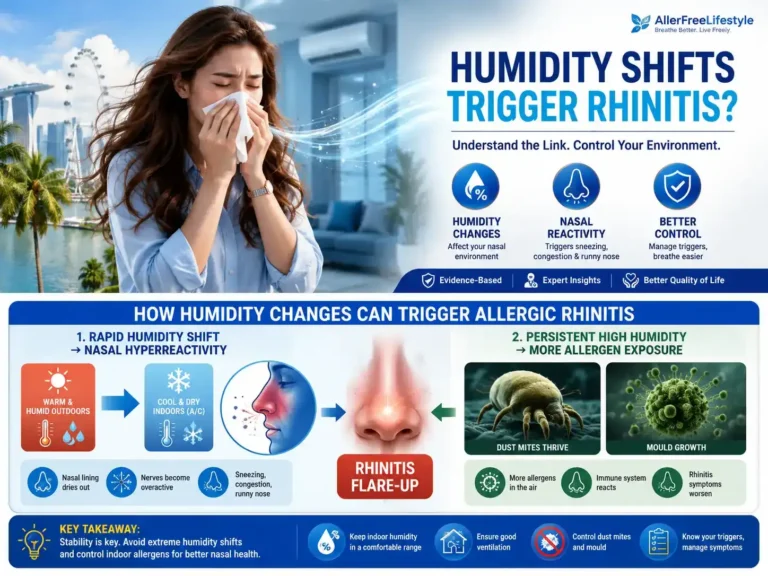
They can aggravate rhinitis, although the relationship is more complex than “high humidity makes allergies worse.”
Allergic rhinitis is an immune-mediated response to allergens such as house dust mites, pollen, or mould. Humidity itself is not an allergen. However, changing relative humidity can influence both the nasal environment and the allergens surrounding you.
A recent systematic review and meta-analysis found that meteorological factors, including relative humidity, are associated with allergic rhinitis, but the direction and strength of the relationship vary according to climate and population. Interestingly, higher relative humidity was associated with a modestly lower overall allergic-rhinitis risk in the pooled analysis, showing that humidity should not be treated as a universally harmful exposure (1).
The more useful clinical question is therefore whether a rapid humidity shift, prolonged dampness, or unusually dry air is affecting your already sensitive nose.
Why Does My Nose React When Humidity Changes Quickly?
Your nasal lining constantly conditions inhaled air by warming, filtering, and humidifying it.
When environmental conditions change abruptly, the nasal mucosa has to adapt quickly. In people with nasal hyperactivity, this transition can affect blood vessels, sensory nerves, mucus production, and surface hydration.
The result may feel exactly like an allergy flare even when no new allergen has appeared.
Recent research supports this broader weather-sensitive pattern. A 2026 study found that dry, cold, and transitional weather conditions were associated with substantially worse sino-nasal symptom scores, reinforcing the idea that changing environmental conditions can influence nasal symptoms independently of a single allergen exposure (2).
Is Humidity Triggering My Allergy or Nonallergic Rhinitis?
Sometimes it is difficult to separate the two.
If changing humidity increases exposure to an allergen you are sensitized to, the resulting reaction can involve allergic rhinitis.
If the environmental change itself stimulates a sensitive nasal lining without an allergen-specific immune reaction, the mechanism is more consistent with nonallergic or vasomotor rhinitis.
Some people experience both. Current rhinitis guidance recognizes that allergic and nonallergic mechanisms can overlap, with environmental triggers such as changes in temperature and humidity provoking symptoms even in people who also have genuine allergic sensitization (3).
This mixed pattern explains why avoiding one allergen does not always eliminate weather-related flares.
Can Moving From Humid Air to Dry Air Trigger Rhinitis?
Yes, especially when the transition is abrupt.
A common example is moving from warm, humid outdoor air into a strongly air-conditioned room. The temperature drops quickly, and the moisture content of the air around the nose may also change.
Very dry air can reduce hydration at the surface of the nasal mucosa. In a sensitive nose, that may increase irritation and make the lining more reactive to particles already present in the environment.
This does not necessarily represent a new allergy. It may instead reflect weather-sensitive nasal hyperactivity occurring alongside allergic rhinitis.
Can High Humidity Make Allergic Rhinitis Worse?
High humidity can contribute indirectly by changing the indoor allergen environment.
Persistent dampness may favor:
- house dust mites in mattresses, pillows, bedding, carpets, and upholstery;
- mold growth in poorly ventilated or moisture-damaged areas;
- higher exposure to certain fungal allergens.
In this situation, humidity is not directly triggering IgE antibodies. Instead, it is helping create conditions in which relevant allergens may become more abundant.
This distinction is important because simply blaming humidity can hide the actual exposure that needs attention.
Can Low Humidity Irritate an Allergy-Prone Nose?
Yes. Excessively dry air creates a different problem.
When the nasal surface loses moisture, mucus becomes less effective at maintaining a comfortable protective layer. The nose may become more sensitive to airflow, irritants, and existing allergens.
So the two extremes can affect rhinitis through different pathways:
Persistent high humidity → may support moisture-dependent allergens.
Very dry air → may irritate and dehydrate the nasal lining.
A person who repeatedly moves between these environments may notice more symptoms than someone exposed to relatively stable indoor conditions.
Why Can Air Conditioning Trigger Rhinitis After Humid Outdoor Air?
Air conditioning can produce several environmental changes simultaneously.
When you enter a strongly cooled room:
- temperature falls rapidly;
- humidity may shift;
- airflow around the nose increases;
- indoor allergens may differ from those outdoors.
In tropical climates such as Singapore, moving repeatedly between humid outdoor air and cool indoor environments can therefore create frequent environmental transitions.
If you also have dust-mite or mold sensitization, the nasal response may reflect both an allergic trigger and sensitivity to the environmental shift itself.
That is why symptoms after entering an air-conditioned room should not automatically be labeled an “air-conditioning allergy.”
Can Allergic Rhinitis and Weather-Sensitive Rhinitis Occur Together?
Yes.
A person can react immunologically to dust mites or pollen while also having a nose that responds strongly to cold air, humidity changes, perfume, smoke, or rapid weather shifts.
In that situation:
Allergens activate the allergic pathway.
Environmental changes activate nasal hyperactivity.
Recognizing this overlap can explain why symptoms sometimes occur even when allergen exposure seems unchanged.
What Indoor Humidity Is Best for a Sensitive Nose?
There is no single perfect humidity level for every person with rhinitis.
A more useful goal is to maintain a reasonably stable indoor environment and avoid prolonged extremes.
Practical steps include:
- use a hygrometer to monitor relative humidity;
- avoid persistent indoor dampness and condensation;
- avoid excessively dry, strongly air-conditioned environments;
- do not direct cold airflow straight toward the face;
- control known indoor allergens;
- notice whether flares occur after rapid environmental transitions.
If symptoms repeatedly follow sudden humidity changes, keeping a short record of indoor humidity, weather conditions, and exposure patterns may help identify whether the trigger is mainly environmental, allergenic, or mixed.
The bottom line is that sudden shifting humidity can aggravate rhinitis, but humidity itself is not an allergen. A rapid change may provoke nasal hyperreactivity, while prolonged humid conditions can modify exposure to dust mites, mould, and other allergens. For many people with allergic rhinitis, both mechanisms can occur together.
Medical Disclaimer
This article is for educational purposes only and is not a substitute for professional medical advice, diagnosis, or treatment. If rhinitis symptoms are persistent, worsening, or affecting breathing, consult a qualified healthcare professional.
Frequently Asked Questions(FAQs)
1. Can sudden humidity changes trigger allergic rhinitis?
They can aggravate rhinitis symptoms, although the immediate reaction may involve nasal hyperactivity rather than a new allergic response.
2. Can high humidity make allergic rhinitis worse?
It can indirectly worsen allergies by supporting indoor allergens such as dust mites and mold.
3. Can low humidity also trigger rhinitis?
Yes. Very dry air may irritate the nasal lining and make a sensitive nose more reactive.
4. Can air conditioning trigger rhinitis after humid outdoor air?
Yes. Rapid movement from humid outdoor air to cooler, drier indoor conditions may provoke weather-sensitive nasal symptoms.
5. Is humidity-triggered rhinitis always an allergy?
No. Humidity and temperature changes can also trigger nonallergic or vasomotor rhinitis.
6. Can allergic and nonallergic rhinitis occur together?
Yes. Some people have overlapping allergic sensitization and sensitivity to nonspecific environmental triggers.
References
- Li Q, Gu W, Feng H, et al. Association of meteorological factors with allergic rhinitis: a systematic review and meta-analysis.BMC Public Health. doi:10.1186/s12889-025-26078-6
- Dobrow SS, Davis RE, Mattos JL. Climate and sino-nasal symptoms.International Journal of Biometeorology. 2026;70:165. doi:10.1007/s00484-026-03154-z
- Solé D, et al. V Brazilian Consensus on Rhinitis – 2024.Brazilian Journal of Otorhinolaryngology. 2025;91(1):101500. doi:10.1016/j.bjorl.2024.101500