

Can Allergies Cause Fluid Behind the Eardrum Without an Infection?
Written by: Dr. Muhammad Ihsan Ullah, PhD
Medically reviewed by: Dr Ali Raza Dogar ,MBBS, ENT
Last updated on August 20, 2026

Fluid behind the eardrum does not always mean you have an ear infection. In some people, allergic rhinitis and seasonal allergies can interfere with normal Eustachian-tube function, allowing fluid to collect in the middle ear even when there is no acute bacterial or viral infection.
Quick Medical Answer
Yes. Allergies can contribute to fluid behind the eardrum without an acute ear infection. This fluid is commonly called middle-ear effusion or otitis media with effusion (OME). Allergy may be one contributing factor, but it should not automatically be assumed to be the cause of every middle-ear effusion.
Can You Have Fluid Behind the Eardrum Without an Ear Infection?
Yes. Fluid behind the eardrum without an ear infection is a well-recognized medical condition.
In otitis media with effusion (OME), fluid collects in the middle-ear space without the acute inflammatory findings typically associated with acute otitis media.
A person may experience:
- Ear pressure or fullness
- A blocked or “underwater” feeling
- Popping or crackling sensations
- Temporary reduction in hearing
- Fluid visible behind the eardrum during examination without having an active bacterial or viral ear infection.
This distinction is important because the presence of middle-ear fluid alone does not automatically mean antibiotics are needed.
Can Allergies Cause Fluid in the Middle Ear?
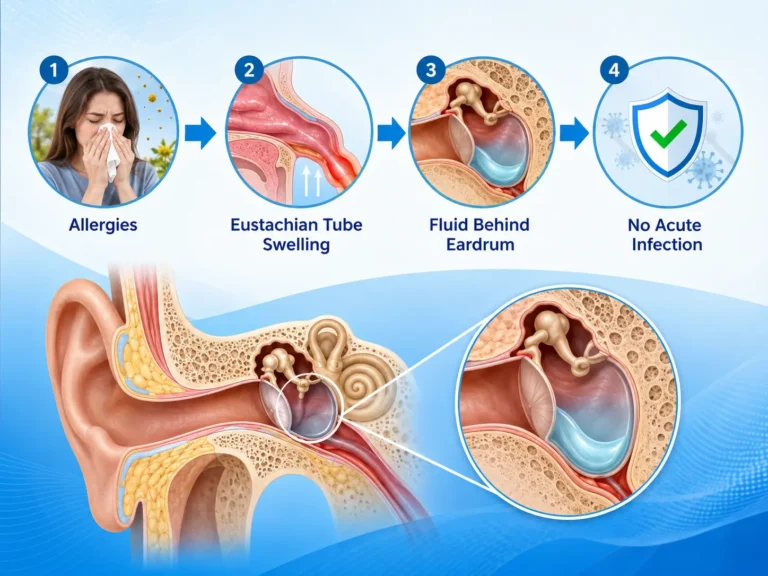
Yes, allergies can contribute to middle-ear fluid by interfering with the normal function of the Eustachian tube.
The Eustachian tube connects the middle ear to the back of the nose and helps regulate air pressure and drainage. When allergic inflammation affects the nasal passages and tissues surrounding its opening, the tube may not ventilate the middle ear effectively.
The process can be summarized as:
Allergic rhinitis → Eustachian-tube dysfunction → reduced middle-ear ventilation → pressure changes → middle-ear effusion.
Recent evidence supports an association between allergic rhinitis, Eustachian-tube dysfunction and otitis media with effusion. Proposed mechanisms include local allergic inflammation, impaired Eustachian-tube function and type-2 immune responses. However, allergy is best viewed as a contributing factor rather than the explanation for every middle-ear effusion (1, 2).
Can Allergic Rhinitis Cause Fluid Behind the Eardrum?
Allergic rhinitis may increase the likelihood of middle-ear dysfunction in susceptible individuals.
Inflammation in the nose and nasopharynx can affect the tissues surrounding the Eustachian-tube opening. If pressure regulation and drainage become less efficient, fluid may gradually accumulate behind the tympanic membrane, or eardrum.
A 2023 clinical study of 126 people with allergic rhinitis found that 49.2% had some form of middle-ear dysfunction. Eustachian-tube dysfunction was among the abnormalities identified, while a smaller proportion had OME. The findings support an association between allergic rhinitis and altered middle-ear function, although they do not prove that allergy directly caused every abnormality (3).
Can Seasonal Allergies Cause Fluid Behind the Eardrum Without Infection?
They can contribute to it.
Seasonal allergens such as pollen may trigger inflammation in people with seasonal allergic rhinitis. Swelling around the Eustachian-tube opening can temporarily make pressure equalization and drainage less effective.
As a result, some people may develop allergy-related fluid behind the eardrum without an acute infection.
However, persistent ear fluid should not automatically be blamed on pollen or hay fever. Fluid that continues, repeatedly returns or affects hearing deserves proper medical assessment.
Can Allergies Block the Eustachian Tube and Cause Fluid Behind the Eardrum?
Allergic inflammation can contribute to Eustachian-tube dysfunction, although the tube is not necessarily completely “blocked.”
Normally, the Eustachian tube opens during swallowing and yawning to:
- Equalize pressure in the middle ear
- Provide ventilation
- Help clear middle-ear secretions
When inflammation interferes with this process, pressure within the middle ear may become abnormal and fluid can accumulate.
This explains how allergies and Eustachian-tube dysfunction can lead to fluid behind the eardrum without the person necessarily developing an acute ear infection.
Can Allergies Cause Otitis Media With Effusion Without Infection?
Allergy may contribute to otitis media with effusion, which by definition occurs without the signs and symptoms of acute middle-ear infection.
OME is sometimes called middle-ear effusion, serous otitis media, or “glue ear,” particularly when the fluid becomes thick.
Current research supports a relationship between allergic disease and OME, but the connection is complex. Allergic inflammation may increase the likelihood of Eustachian-tube dysfunction in some patients, while other cases of OME may develop for completely different reasons.
The most medically accurate interpretation is:
Allergy may contribute to the conditions that allow middle-ear fluid to develop, but it is not responsible for every case of OME (1,2).
Is Fluid Behind the Eardrum Always an Infection?
No.
This is one of the most important distinctions to understand.
Acute otitis media involves acute inflammation and usually infection, whereas otitis media with effusion involves middle-ear fluid without the clinical features of an acute ear infection.
Middle-ear fluid can also remain for a period after a previous infection has already resolved.
Therefore, noninfectious fluid behind the eardrum should not automatically be treated as an active ear infection.
Can Hay Fever or Pollen Allergies Cause Middle-Ear Effusion?
Hay fever is another name for seasonal allergic rhinitis, so it may contribute to middle-ear effusion in susceptible people.
Pollen does not enter the middle ear and directly create fluid. Instead, pollen exposure can trigger allergic inflammation in the upper airway. That inflammation may interfere with Eustachian-tube ventilation, creating conditions that favor middle-ear effusion.
This is why pressure, fullness ear or fluid may sometimes accompany significant seasonal allergy symptoms even when there is no fever or acute infection.
Does Treating Allergies Clear Fluid Behind the Eardrum?
Not necessarily.
Treating confirmed allergic rhinitis may improve nasal congestion, sneezing and other allergy symptoms, but established middle-ear effusion does not always disappear immediately when the allergy is treated.
Evidence supporting antihistamines, decongestants or corticosteroids specifically for clearing uncomplicated OME remains limited. Management should therefore distinguish between controlling an underlying allergy and deciding how persistent middle-ear fluid itself should be handled (1).
Persistent effusion may need observation, hearing assessment or specialist evaluation depending on its duration and clinical context.
Can Allergies Really Cause Fluid Behind the Eardrum Without an Infection?
Yes—but the relationship is indirect and should be described carefully.
Allergies, particularly allergic rhinitis, can produce inflammation that interferes with Eustachian-tube function. Reduced ventilation of the middle ear can then promote fluid accumulation behind the eardrum, resulting in otitis media with effusion without an acute infection.
The most accurate sequence is:
Allergic rhinitis → Eustachian-tube dysfunction → impaired middle-ear ventilation → middle-ear effusion.
Research supports this relationship, but it does not justify assuming that every case of ear fluid is caused by allergies.
Persistent, recurrent or unexplained fluid—especially when hearing is affected or when persistent one-sided middle-ear effusion occurs in an adult—should be medically evaluated rather than self-diagnosed as an allergy or infection.
Medical Disclaimer
This article is for educational purposes only and is not a substitute for professional medical advice, diagnosis or treatment. Consult a qualified healthcare professional for persistent ear fluid, hearing changes, and pain or other concerning symptoms.
Frequenlty Asked Questions(FAQs)
1. Can allergies cause fluid behind the eardrum without an infection?
Yes. Allergic inflammation may interfere with Eustachian-tube function and contribute to middle-ear fluid without an acute ear infection.
2. Is fluid behind the eardrum always an ear infection?
No. Otitis media with effusion (OME) involves fluid behind the eardrum without the signs of an acute middle-ear infection.
3. Can allergic rhinitis cause middle-ear fluid?
Yes. Allergic rhinitis may contribute to Eustachian-tube dysfunction, which can reduce middle-ear ventilation and allow fluid to accumulate.
4. Can seasonal allergies cause fluid behind the eardrum?
They can. Seasonal allergic inflammation may affect Eustachian-tube function and contribute to middle-ear effusion in susceptible individuals.
5. Do antihistamines clear fluid behind the eardrum?
Not necessarily. Treating allergy symptoms does not automatically clear established middle-ear effusion.
6. When should persistent ear fluid be checked by a doctor?
Medical assessment is appropriate when fluid persists, repeatedly returns, affects hearing or remains predominantly in one ear, particularly in an adult.
References
- Klimek L, Brough HA, Arasi S, et al. Otitis Media With Effusion (OME) and Eustachian Tube Dysfunction: The Role of Allergy and Immunity—An EAACI Position Paper. Allergy. 2025;80(9):2429–2441. doi:10.1111/all.16554
- Vlastos IM, Tsotsiou N, Almomani M, Doulaptsi M, Karatzanis A, Prokopakis E. Is Allergic Rhinitis Related to Otitis Media with Effusion in Adults and Children? Applying Epidemiological Guidelines for Causation. Cells. 2025;14(11):805. doi:10.3390/cells14110805
- Sidam S, P AM, Khurana U, Gupta V, Bhan BD. Evaluation of the Association Between Allergic Rhinitis and Middle Ear Dysfunction: A Clinicopathological Study. Cureus. 2023;15(6):e40913. doi:10.7759/cureus.40913