

Can Seasonal Allergies Cause Temporary Ringing in the Ears (Tinnitus)?
Written by: Dr. Muhammad Ihsan Ullah, PhD
Medically reviewed by: Dr Ali Raza Dogar ,MBBS,ENT
Last updated on August 19, 2026
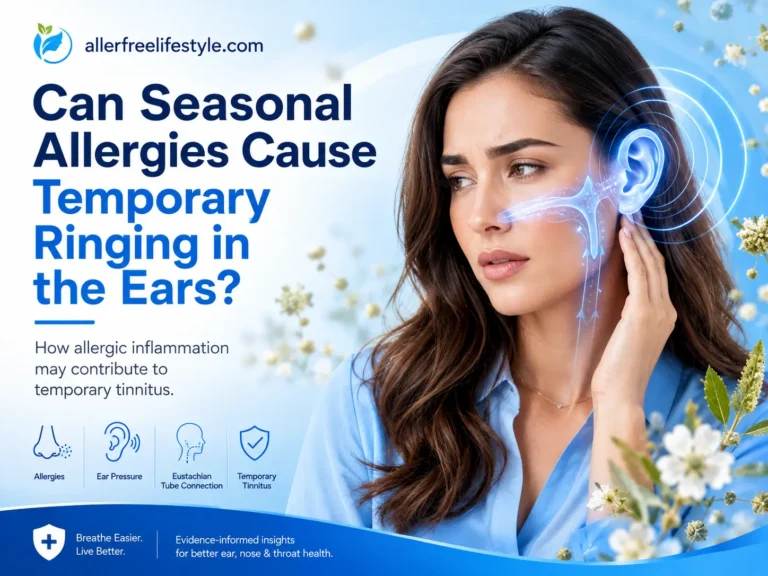
That faint ringing, buzzing, humming, or whistling in your ears may seem completely unrelated to sneezing and pollen exposure. Yet if it appears when seasonal allergies flare and eases as the season settles, there may be a connection.
Seasonal allergic rhinitis can affect structures involved in middle-ear pressure and hearing, potentially triggering temporary tinnitus or making existing tinnitus more noticeable. Importantly, allergies are only one possible explanation for ear ringing, so timing and accompanying ear symptoms matter.
Quick Answer
Yes, seasonal allergies may contribute to temporary ringing in the ears (tinnitus), particularly when allergic inflammation interferes with Eustachian tube function and middle-ear pressure regulation. The ringing may improve as congestion and inflammation subside, but persistent, one-sided, pulsatile, or sudden tinnitus should not automatically be attributed to allergies.
What Does the Latest Research Say About Allergic Rhinitis and Tinnitus?
Recent evidence strengthens the suspected link between allergic rhinitis and tinnitus, although it does not prove that allergies directly cause every case of ringing in the ears.
A large nationwide study published in Scientific Reports in 2026 compared 138,361 adults with tinnitus with 384,895 matched controls. Pre-existing allergic rhinitis was more common among people with tinnitus, and after adjustment for multiple health and demographic factors, allergic rhinitis remained significantly associated with tinnitus (1).
The researchers specifically cautioned that the retrospective design establishes an association rather than causation. In practical terms, seasonal allergies can be a plausible contributor to temporary tinnitus, but ringing should not automatically be blamed on pollen or hay fever.
A 2025 systematic review and meta-analysis adds another layer to the evidence. Across five studies involving 432 participants, people with allergic rhinitis had higher hearing thresholds at 4000 Hz and 8000 Hz, suggesting that allergic rhinitis may influence high-frequency auditory function in some individuals (2).
Why Do My Ears Ring During Allergy Season?
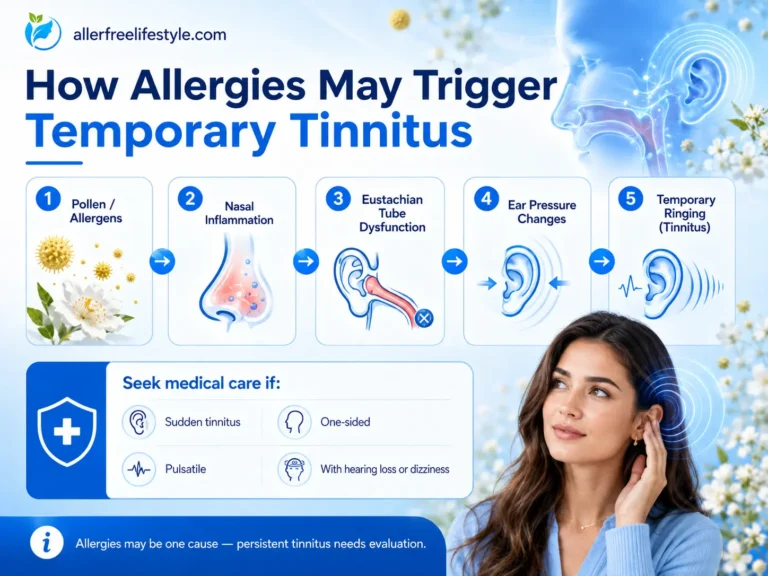
The most plausible explanation lies in the close anatomical relationship between the nose and middle ear.
Seasonal allergens such as tree pollen, grass pollen, and ragweed can trigger an immunoglobulin E (IgE)-mediated inflammatory response. Histamine and other inflammatory mediators contribute to swelling of the nasal and nasopharyngeal tissues.
The Eustachian tube connects the middle ear with the back of the nose and helps:
- Equalize pressure across the eardrum
- Ventilate the middle ear
- Clear secretions from the middle-ear space
When inflammation affects the area around this tube, pressure equalization may become less efficient. The result can be a sensation of blocked ears, popping, fullness, muffled sound, or tinnitus.
A 2025 review of allergic rhinitis and middle-ear disease identified Eustachian tube dysfunction, type-2 inflammatory responses, and inflammatory mediators as biologically plausible links between nasal allergy and middle-ear changes (3).
So, the relationship is better understood as:
allergen exposure → allergic inflammation → impaired ear-pressure regulation → altered hearing input → temporary perception or worsening of tinnitus
This pathway is plausible, but it should not be interpreted as proof that every episode of tinnitus during allergy season originates from allergies.
Can Pollen Allergies Trigger Temporary Ear Ringing?
A particularly suggestive pattern is temporary ringing in the ears during high-pollen periods that occurs alongside nasal congestion, ear pressure, or a blocked-ear sensation and then improves when the allergic flare settles.
Spring tree pollen, summer grass pollen, and fall ragweed exposure may therefore coincide with tinnitus in susceptible individuals.
What matters clinically is the pattern over time. If ringing consistently begins during allergy flares and improves when those flares resolve, an allergy-related mechanism becomes more plausible. However, seasonal timing alone cannot confirm the diagnosis because hearing loss, noise exposure, earwax, medications, temporomandibular disorders, and other conditions can also produce tinnitus.
Is Allergy-Related Tinnitus Usually Temporary?
When tinnitus is genuinely related to transient nasal inflammation or Eustachian tube dysfunction, it may be temporary.
As inflammation decreases and middle-ear ventilation normalizes, the abnormal pressure or muffled auditory input may resolve, allowing the ringing to become less noticeable or disappear.
However, describing allergy-related tinnitus as always temporary would be medically inaccurate. Persistent tinnitus may have another cause or may reflect more than one contributing factor.
A useful clue is whether the ringing:
- Appears mainly during seasonal allergy flares
- Occurs with ear fullness or popping
- Changes as nasal congestion improves
- Has a recurring seasonal pattern
These features can support an allergy connection, but none is diagnostic on its own.
How Long Does Tinnitus From Seasonal Allergies Last?
There is no scientifically established number of hours or days that allergy-related tinnitus should last.
Duration depends on how long the inflammatory episode persists, how strongly Eustachian tube function is affected, continued allergen exposure, and whether another ear condition is present.
For some people, temporary ear ringing may fade as congestion and ear pressure improve. If tinnitus continues well beyond the allergy flare, becomes progressively more noticeable, or is associated with a change in hearing, it deserves further assessment rather than repeated assumption that pollen is responsible.
Can Seasonal Allergies Cause Tinnitus Without Obvious Hearing Loss?
Yes. A person may notice ringing or buzzing without recognizing any meaningful loss of hearing.
Small or temporary changes in middle-ear sound transmission can be subtle. In addition, the 2025 meta-analysis found differences at higher frequencies in allergic rhinitis even though consistent abnormalities were not demonstrated across all tested frequencies or brainstem auditory responses (2).
This means normal everyday conversation does not necessarily rule out subtle auditory changes. If tinnitus persists, formal audiometry can provide more information than subjective hearing impressions alone.
Why Can Existing Tinnitus Feel Worse When Seasonal Allergies Flare?
Someone who already experiences tinnitus may notice that it becomes more prominent during periods of congestion or ear pressure.
Temporary changes in sound transmission can reduce the amount or clarity of external sound reaching the auditory system. In a quieter or muffled auditory environment, an existing internal sound may become more noticeable.
Sleep disruption, discomfort, and the stress associated with a significant allergy flare may also increase awareness of tinnitus, even when the underlying tinnitus itself has not permanently worsened.
When Does Ear Ringing Need More Than an Allergy Explanation?
Do not assume tinnitus is allergy-related simply because it occurs during pollen season.
Seek medical assessment promptly if ringing is:
- Sudden and accompanied by sudden hearing loss
- Persistent mainly in one ear
- Pulsatile, meaning it seems synchronized with your heartbeat
- Associated with significant dizziness, imbalance, weakness, or other neurological symptoms
- Accompanied by ear drainage or substantial ear pain
- Persistent after the allergy flare has resolved
An otolaryngologist (ENT specialist) and/or audiologist can assess hearing and middle-ear function and determine whether another cause needs investigation.
Medical Disclaimer
This article is for educational purposes only and is not a substitute for personalized medical advice, diagnosis, or treatment. Persistent, one-sided, pulsatile, or sudden tinnitus—especially when accompanied by hearing loss, dizziness, ear pain, or neurological symptoms—should be evaluated by a qualified healthcare professional.
Frequently Asked Questions(FAQs)
1. Does tinnitus that appears only during pollen season prove that allergies are causing it?
No. A recurring seasonal pattern makes an allergy-related contribution more plausible, particularly when ringing occurs with nasal congestion or ear pressure, but timing alone cannot establish causation. Other causes of tinnitus may coexist.
2. Can allergy medication cure ringing in the ears?
Allergy medicines are not tinnitus treatments. If allergic inflammation and Eustachian tube dysfunction are contributing to the ringing, appropriately managing the underlying allergic rhinitis may help associated ear pressure in some people. Persistent tinnitus should still be evaluated on its own merits rather than treated indefinitely as an allergy symptom.
3. Can pollen directly damage the inner ear and cause tinnitus?
Current evidence does not establish that ordinary pollen exposure directly damages the cochlea. Research instead points toward inflammatory, middle-ear, Eustachian tube, and possibly auditory effects associated with allergic rhinitis. The precise mechanisms linking allergy and tinnitus remain under investigation.
4. Should I see an allergist, audiologist, or ENT for seasonal tinnitus?
If tinnitus repeatedly accompanies clearly defined seasonal allergy flares, an allergy specialist may help evaluate allergic rhinitis. An audiologist can assess hearing, while an ENT specialist is particularly appropriate for persistent, unilateral, pulsatile, sudden, or otherwise unexplained tinnitus.
References
- Yang TH, Chung SD, Lin HC, Liu TC. Associations of chronic rhinosinusitis and allergic rhinitis with tinnitus. Scientific Reports. 2026;16:8169. doi:10.1038/s41598-026-39016-2.
- de Melo Lima TRC, Araújo BCL, Simões SM, Martins-Filho PR. Auditory function and brainstem responses in allergic rhinitis: systematic review and meta-analysis. CoDAS. 2025;37(5):e20240307. doi:10.1590/2317-1782/e20240307en.
- Vlastos IM, Tsotsiou N, Almomani M, Doulaptsi M, Karatzanis A, Prokopakis E. Is Allergic Rhinitis Related to Otitis Media with Effusion in Adults and Children? Applying Epidemiological Guidelines for Causation. Cells. 2025;14(11):805. doi:10.3390/cells14110805.