

Why Are My Allergies Worse During Singapore’s Rainy Seasons?
Written by: Dr. Muhammad Ihsan Ullah, PhD (Pharmacology)
Medically reviewed by: Dr. Jamal ud Din Khan, FCPS (Pulmonology)
Last updated on August 24, 2026

If your allergies seem to flare whenever Singapore turns wetter and more humid, the weather may be influencing your exposure to allergens. Rain itself is not usually the allergen. Instead, prolonged humidity, damp indoor conditions, house dust mites, fungal spores, and changes in airborne pollen can all affect people who are already sensitized to these triggers.
Singapore Rainy-Season Allergy Answer
Singapore’s rainy seasons can worsen allergies by changing the indoor and outdoor allergen environment. Persistent humidity, monsoon weather, and damp conditions can increase exposure to allergens that matter in tropical climates, especially in people with allergic rhinitis. The exact trigger depends on what each person is sensitized to.
Allergic rhinitis is particularly relevant in Singapore’s tropical environment, where sensitization to house dust mites is common. In a large Singapore/Malaysia young-adult cohort, sensitization to Blomia tropicalis or Dermatophagoides pteronyssinus was identified in 66.5% of participants, highlighting the importance of indoor allergens in this population (1).
Why Are My Allergies Worse During Singapore’s Rainy Season?
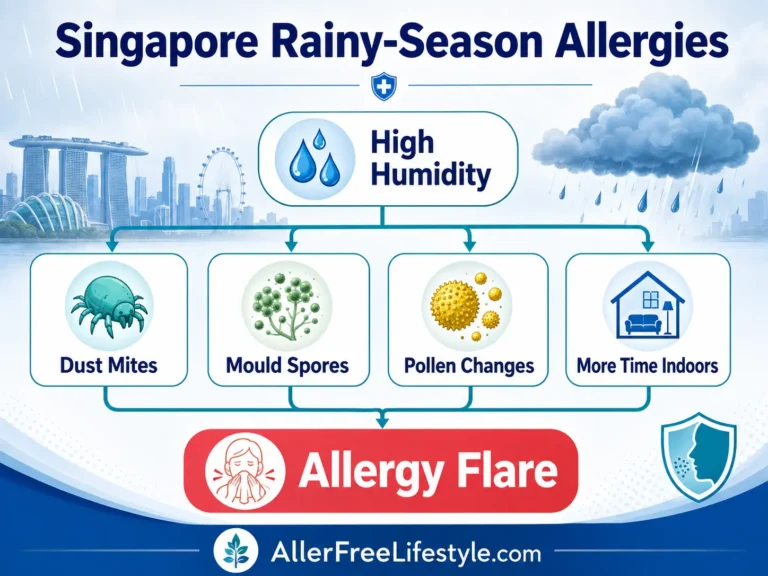
Singapore’s rainy periods do not create one single allergy trigger. Instead, they alter several environmental conditions at the same time.
During prolonged wet weather:
- Relative humidity stays high, which can support house dust mite survival.
- Indoor spaces may remain damp for longer, creating conditions that can encourage mould growth.
- People may spend more time indoors, increasing contact with allergens in bedding, mattresses, carpets, sofas, and curtains.
- Airborne fungal spores may become more relevantin a humid tropical environment.
- Rain and thunderstorms can change the way pollen and other aeroallergens move through the air.
This is why rainy-season allergies in Singapore should not be understood in the same way as seasonal hay fever in countries with four distinct seasons. In Singapore, allergic rhinitis is often present throughout the year, but environmental conditions can make certain exposures more noticeable during wetter periods.
Does Rain Make Allergies Worse in Singapore?
For some people, yes—but not because rain itself causes an allergic reaction.
Rain can temporarily clear some pollen from the air, particularly during sustained rainfall. However, wet weather also increases environmental moisture and may change exposure to indoor allergens and fungal particles.
Fungal allergens are especially relevant in humid climates. Research involving Singaporean and Malaysian adults found that sensitization to airborne fungal allergens was associated with allergic rhinitis, supporting the clinical importance of fungal exposure in this region (2).
So, if your allergies flare after rain in Singapore, the explanation may be a changing mix of humidity, indoor allergen exposure, fungal spores, and altered airborne particles, rather than rain acting as the direct trigger.
Does Humid Weather Make Allergies Worse in Singapore?
High humidity can make the environment more favorable for certain allergens, particularly house dust mites.
Dust mites depend on environmental moisture for survival. Singapore’s consistently warm, humid climate already provides favorable conditions, and prolonged wet periods may make indoor humidity harder to control.
It is important to distinguish between being “allergic to humidity” and having allergies that worsen in humid conditions. Humidity itself is not an allergen. Instead, it can influence the organisms and particles that trigger allergic inflammation.
For someone sensitized to dust mites, a humid bedroom or poorly ventilated living space may increase exposure to mite allergens in:
- mattresses
- pillows
- bedding
- upholstered furniture
- carpets
- fabric curtains
This is one reason humid weather allergies in Singapore are often closely linked with indoor allergen exposure.
Why Are Indoor Allergies Worse During Rainy Weather in Singapore?
Rainy periods often mean more time indoors, but the problem is not simply being inside.
Indoor spaces can contain large reservoirs of allergens. In Singapore, house dust mites are particularly important, especially Blomia tropicalis and Dermatophagoides pteronyssinus. Damp corners, poorly ventilated rooms, and moisture-prone areas may also support mould growth.
A person who is sensitized to these allergens may therefore notice that symptoms become more troublesome when wet weather keeps them indoors for longer.
However, not every humid home has high allergen levels, and not everyone reacts in the same way. The degree of exposure depends on several factors, including:
- indoor humidity
- ventilation
- building condition
- cleaning practices
- bedding and furnishings
- the individual’s specific allergen sensitization
That is why two people living in the same home can experience very different allergy patterns during rainy weather.
Why Do My Allergies Flare Up After It Rains?
The effect of rainfall on airborne allergens is complex.
Moderate or prolonged rain can remove pollen from the air. In contrast, some storm conditions can break larger pollen grains into smaller allergenic particles that are more easily carried by wind and inhaled.
This process has been studied in relation to thunderstorm-associated allergic respiratory reactions. It does not mean that every Singapore thunderstorm will worsen allergies, but it helps explain why some people notice symptoms shortly after stormy weather.
The timing also matters. Symptoms that worsen immediately after a storm may involve different exposures from symptoms that become more noticeable after several humid, rainy days.
Are Allergies Worse during Singapore’s Northeast Monsoon?
For some allergy sufferers, the Northeast Monsoon can coincide with more noticeable symptoms because it brings extended periods of rainfall and high humidity.
Singapore’s climate is influenced by two major monsoon periods:
- Northeast Monsoon:approximately December to early March
- Southwest Monsoon:approximately June to September
The Northeast Monsoon is often associated with prolonged wet spells, especially during monsoon surges.
These weather patterns can influence indoor humidity, fungal growth, dust mite exposure, and airborne allergen distribution. However, rainfall alone does not prove that allergy severity will rise in every individual.
The more useful question is whether a person’s known allergens are affected by the environmental changes occurring during the monsoon period.
Does Rain Make Pollen Allergies Better or Worse in Singapore?
Rain may temporarily reduce pollen levels, but Singapore’s tropical pollen environment is different from the spring-pollen pattern seen in temperate countries.
One relevant local example is oil palm pollen.
A recent study involving Singapore/Malaysia populations found sensitization to oil palm pollen and reported high atmospheric oil palm pollen abundance in Singapore, particularly during the Northeast Monsoon period (3).
This means pollen allergy in Singapore should not be dismissed simply because the country does not have a traditional spring allergy season.
Depending on rainfall intensity, wind, storms, and pollen type, airborne pollen exposure may rise or fall at different times.
Why Am I Sneezing More During Rainy Weather in Singapore?
If sneezing becomes more frequent during wet weather, the most likely explanation is an increase or change in exposure to allergens you are already sensitive to.
In Singapore, that may include:
- house dust mites
- mould and fungal spores
- indoor allergens
- tropical pollen
- storm-related aeroallergen particles
Sneezing, nasal itching, congestion, and watery eyes can all occur when the immune system recognizes a harmless environmental substance as a threat and releases inflammatory mediators such as histamine.
The key point is that rainy weather is usually an environmental amplifier, not the underlying allergy itself.
If the same pattern happens repeatedly during wet or monsoon periods, identifying the actual sensitizing allergen may be more useful than simply blaming the weather.
What This Means for Allergy Sufferers in Singapore
Singapore’s tropical climate creates a unique allergy environment. Rather than having one short pollen season, people may experience year-round exposure to indoor and outdoor allergens, with symptoms fluctuating according to humidity, rainfall, ventilation, and changing aeroallergen levels.
The rainy season can therefore make allergies feel worse, especially in people sensitized to house dust mites, fungal allergens, or certain pollens.
If your symptoms repeatedly worsen during Singapore’s rainy seasons, the pattern may offer an important clue about the type of allergen exposure affecting you.
Medical Disclaimer
This article is for educational purposes only and is not a substitute for personalized medical advice, diagnosis, or treatment. Allergy triggers and severity vary between individuals. Consult a qualified healthcare professional if symptoms are persistent, worsening, or affecting breathing.
Frequently Asked Questions(FAQs)
1. Can rainy weather trigger allergic rhinitis in Singapore?
Rainy weather can contribute to allergy flares by changing humidity, indoor allergen exposure, fungal spores, and airborne pollen. Rain itself is not usually the allergen.
2. Are dust mite allergies worse during humid weather?
They can be. House dust mites depend on environmental moisture, so persistently humid indoor conditions may favor their survival and increase allergen exposure.
3. Can mould allergies become worse during Singapore’s rainy season?
Yes. Damp, poorly ventilated spaces can support mould growth, and fungal allergens are clinically relevant in tropical environments.
4. Does rain wash pollen out of the air?
Rain can temporarily lower airborne pollen levels, but storms may also redistribute or fragment allergenic particles. The effect depends on weather conditions and pollen type.
5. Why do my allergies get worse during the Northeast Monsoon?
The Northeast Monsoon can bring prolonged rainfall and high humidity, which may alter exposure to dust mites, fungal spores, indoor allergens, and tropical pollen.
References
- Wong QYA, Lim JJ, Ng JY, Malipeddi P, Teo WY, Lim YYE, et al. Allergic rhinitis in Chinese young adults from the Singapore/Malaysia cross-sectional genetics epidemiology study (SMCGES) cohort: Prevalence, patterns, and epidemiology of allergic rhinitis.World Allergy Organization Journal. 2022;15(10):100704. doi:10.1016/j.waojou.2022.100704
- Sio YY, Pang SL, Say YH, Teh KF, Wong YR, Shah SMR, Reginald K, Chew FT. Sensitization to Airborne Fungal Allergens Associates with Asthma and Allergic Rhinitis Presentation and Severity in the Singaporean/Malaysian Population. 2021;186(5):583–588. doi:10.1007/s11046-021-00532-6
- Sio YY, Victoria Nanong GA, Lim JA, Matta SA, Say YH, Teh KF, et al. Sensitization to oil palm pollen associates with risks and severity of allergic diseases.World Allergy Organization Journal. 2024;17(1):100853. doi:10.1016/j.waojou.2023.100853