

How to Prepare for an Allergy Skin Prick Test: Medications You Must Stop Taking 7 Days Before
Written by: Dr. Muhammad Ihsan Ullah, PhD
Medically reviewed by: Dr. Hafiz Muhammad Kashif, MD
Last updated on September 16, 2026
Preparing for an allergy skin prick test is an important step to ensure your results are as accurate as possible. Many patients are surprised to learn that common allergy medicines can interfere with testing by reducing the skin’s normal response to allergens. Proper preparation involves reviewing your medications, understanding which medicines may affect results, and following your allergist’s instructions before your appointment.

An allergy skin prick test, also called skin prick testing (SPT), works by introducing tiny amounts of suspected allergens into the skin and measuring the body’s immune response. Because this response depends partly on histamine activity, medications that block histamine can make reactions weaker and may affect interpretation.
Quick Answer
The medicines most commonly paused before an allergy skin prick test are antihistamines, including cetirizine (Zyrtec), loratadine (Claritin), fexofenadine (Allegra), levocetirizine (Xyzal), diphenhydramine (Benadryl), and hydroxyzine. These medications can reduce the skin reaction needed for accurate testing, so many allergy clinics recommend stopping them several days before the appointment based on the specific medication and patient situation.
Before your allergy skin prick test, review every medication with your healthcare provider
A medication review is one of the most important parts of preparing for allergy testing. Patients often focus only on prescription medicines and forget that many over-the-counter products, including cold medicines and sleep aids, may contain ingredients that affect skin testing.
Your allergist may ask about:
- Prescription medicines
- Over-the-counter allergy medicines
- Cold and flu products
- Sleep medications
- Nasal sprays and eye drops
- Herbal supplements
Never stop a prescribed medication without medical advice, especially medicines used for asthma, heart conditions, blood pressure, mental health conditions, or other chronic diseases.
What medications should you stop before an allergy skin prick test?
The main medications that interfere with allergy skin testing are antihistamines. These medicines work by blocking histamine receptors, which are involved in the skin’s reaction during testing.
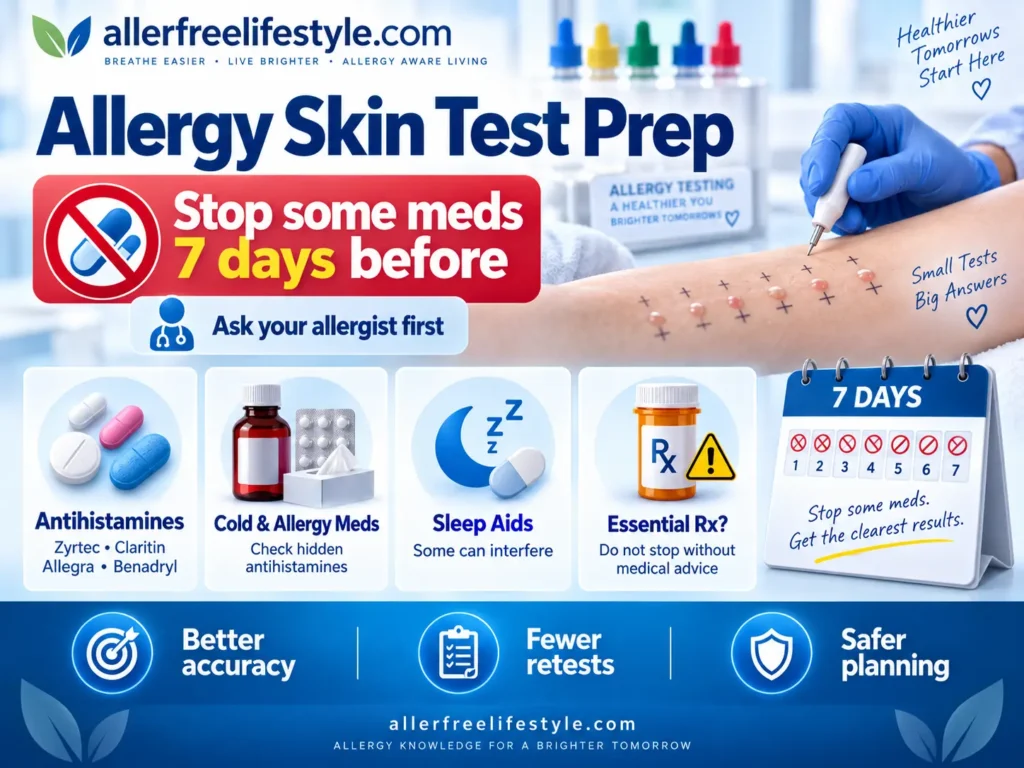
When histamine activity is suppressed, the expected wheal-and-flare response (raised bump and redness) may become smaller, making it more difficult for the allergist to interpret the results accurately,
Medications that may affect allergy skin prick test results
Medication category | Common examples | Why they may affect testing | Typical preparation guidance |
H1 antihistamines | Cetirizine (Zyrtec), Loratadine (Claritin), Fexofenadine (Allegra), Levocetirizine (Xyzal) | Reduce histamine response during skin testing. | Often stopped about 5–7 days before testing |
First-generation antihistamines | Diphenhydramine (Benadryl), Hydroxyzine | A strong antihistamine effect may suppress skin reactions. | May require several days depending on medicine |
H2 antihistamines | Famotidine, Cimetidine | May influence histamine-related responses | Usually discussed individually |
Combination cold/allergy medicines | Products containing antihistamines | Hidden antihistamine ingredients may interfere. | Review ingredients before testing |
Some sleep medicines | Diphenhydramine or doxylamine-containing products | Can block histamine activity | Discuss with the healthcare provider. |
Certain psychiatric medications | Some tricyclic antidepressants | May have antihistamine properties | Medical guidance required |
The exact medication-free period depends on the medicine, dose, and your allergy clinic’s protocol.
How long should antihistamines be stopped before allergy testing?
The time required to stop antihistamines depends on how long the medication remains active in the body and how strongly it blocks histamine receptors.
Many second-generation antihistamines, such as cetirizine, loratadine, and fexofenadine, are commonly stopped several days before testing. Some allergy clinics recommend approximately one week without these medicines to minimize interference, while others adjust the timing according to the specific drug and clinical situation (2).
Examples:
- Cetirizine (Zyrtec): commonly stopped several days before testing
- Loratadine (Claritin): may require several days of discontinuation
- Fexofenadine (Allegra): often requires advance planning before testing
- Diphenhydramine (Benadryl): may need a shorter interruption period depending on timing and dosage
Your allergist will provide the safest recommendation based on your medication history.
How long should you stop Zyrtec, Claritin, or Allegra before an allergy test?
Common allergy medicines such as Zyrtec (cetirizine), Claritin (loratadine), and Allegra (fexofenadine) are frequently used to control symptoms such as sneezing, itching, and runny nose. However, because they block histamine pathways, they may reduce the reaction measured during skin prick testing.
If you regularly use one of these medications, contact your allergy clinic before your appointment to confirm when it should be stopped.
Which medications can interfere with allergy skin testing?
Although antihistamines are the most common cause of interference, other products may also influence test results.
These include:
- Some antihistamine-containing cold medicines
- Certain over-the-counter sleep aids
- Some medicines with antihistamine-like effects
- Selected psychiatric medications
- Certain biologic therapies, such as omalizumab (Xolair), which may require specialist consideration
A complete medication review helps prevent inaccurate or inconclusive results.
What happens if you forget to stop antihistamines before testing?
Taking antihistamines before an allergy skin prick test does not usually create a safety problem, but it may affect the accuracy of the results.
Possible outcomes include:
- Reduced skin reaction
- Difficulty interpreting the test
- Need to repeat testing after medication withdrawal
If you accidentally take an allergy medicine before your appointment, inform your allergy specialist rather than cancelling the test on your own.
Can you continue asthma medications before an allergy skin prick test?
Many patients with asthma worry that they must stop all medicines before allergy testing. In most cases, important asthma treatments should not be stopped without medical guidance.
Controller inhalers and other asthma medicines are usually evaluated individually. Your allergist will determine which medicines can continue based on your asthma control and the type of testing being performed.
Maintaining good asthma control is important because uncontrolled asthma may increase health risks during allergy evaluation.
Allergy skin prick test preparation checklist before your appointment
Several days before testing:
- Confirm which medications need to be stopped
- Review all prescription and non-prescription medicines
- Check cold and flu products for hidden antihistamines
- Ask about supplements or herbal products
- Follow your clinic’s preparation instructions
Avoid stopping without medical advice:
- Asthma medications
- Heart medications
- Blood pressure medicines
- Antidepressants
- Other essential prescription treatments
A safe preparation plan is more important than stopping every possible medication.
Medical Disclaimer
This article is for educational purposes only and does not replace medical advice from a qualified healthcare professional. Medication instructions before an allergy skin prick test can vary depending on your health condition, current medicines, and testing protocol. Always consult your allergist or physician before stopping or changing any medication.
Frequently Asked Questions
How long should I stop antihistamines before an allergy skin prick test?
Most antihistamines are stopped several days before testing, often around 3–7 days depending on the medication and medical advice.
Can I take Zyrtec before an allergy skin prick test?
Zyrtec (cetirizine) may affect skin test responses, so your healthcare provider may recommend stopping it before testing.
What happens if I forget to stop allergy medication before testing?
The medication may weaken the skin response and make results harder to interpret. Your allergist will decide the best approach.
Which medications can interfere with allergy skin testing?
Antihistamines, some cold medicines, certain sleep aids, and some other medications may interfere with results.
Can I continue my asthma medications before an allergy skin prick test?
Many asthma medicines can be continued, but always confirm with your healthcare provider before testing.
Can allergy testing be done if I cannot stop my medication?
If stopping medication is not safe, your doctor may consider alternative options such as blood-based specific IgE testing.
References
- Ansotegui IJ, Melioli G, Canonica GW, et al. IgE allergy diagnostics and other relevant tests in allergy, a World Allergy Organization position paper. World Allergy Organization Journal. 2020;13(2):100080.
doi: 10.1016/j.waojou.2019.100080 - Wise SK, Lin SY, Toskala E, et al. International Consensus Statement on Allergy and Rhinology: Allergic Rhinitis – 2023. International Forum of Allergy & Rhinology. 2023;13(4):293–859.
doi: 10.1002/alr.23090 - Cox L, Nelson H, Lockey R, et al. Allergen immunotherapy: a practice parameter third update. Journal of Allergy and Clinical Immunology. 2011;127(1 Suppl):S1–S55.
doi: 10.1016/j.jaci.2010.09.034