

Why Does Zyrtec Make Me So Tired and How Long Does Drowsiness Last?
Written by: Dr. Muhammad Ihsan Ullah, PhD (Pharmacology)
Medically reviewed by: Dr. Asma Fareed Khan, PhD (Clinical Pharmacy)
Last reviewed: September 16, 2026

Zyrtec can control allergy symptoms well, but some people are surprised by how sleepy or drained they feel after taking it. That reaction is medically plausible: Zyrtec contains cetirizine, a second-generation H1 antihistamine that is less sedating than older antihistamines but can still reduce alertness in susceptible people.
Quick Answer:
Zyrtec can make you tired because cetirizine may reach the brain in small amounts and block histamine H1 receptors that help maintain wakefulness. Drowsiness may last for several hours and, in some people, may still be noticeable the next morning. How long it lasts depends on individual sensitivity, dose, age, kidney function, and other sedating substances.
Why Does Zyrtec Make Me So Tired?
Cetirizine hydrochloride blocks H1 receptors. Most of its antihistamine effect occurs outside the brain, which is why it is classed as a second-generation antihistamine. However, “less sedating” does not mean “incapable of causing sedation.”
PET imaging has shown dose-dependent brain H1-receptor occupancy after cetirizine. In one study, average occupancy was 12.6% after cetirizine 10 mg and 25.2% after 20 mg, compared with 67.6% after hydroxyzine 30 mg. This provides a biological explanation for why some users experience noticeable sleepiness even at a standard cetirizine dose (1).
Histamine in the central nervous system supports wakefulness and attention. When enough central H1 receptors are blocked, the result may be somnolence, fatigue, mental slowing, or a heavy sleepy feeling. A 2024 pharmacovigilance analysis also identified somnolence and disturbance in attention among notable adverse-event signals reported with cetirizine (3).
How Long Does Zyrtec Drowsiness Last?
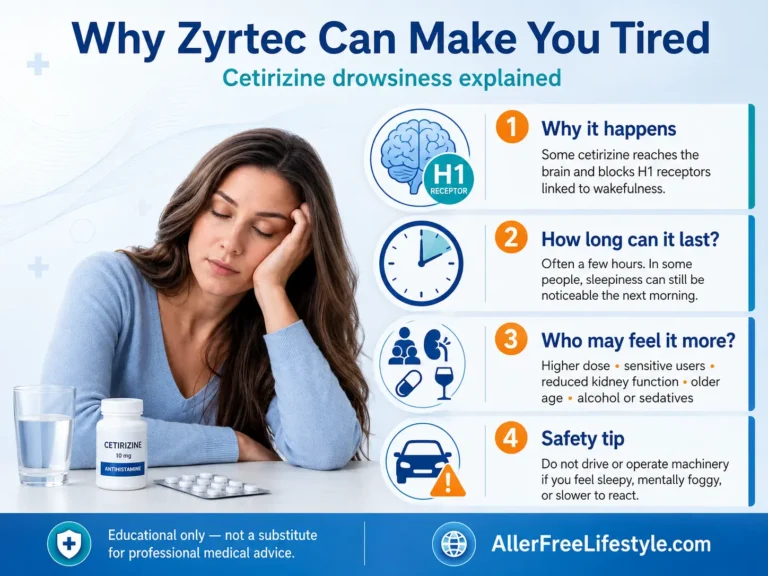
There is no fixed number of hours that applies to everyone. Cetirizine has a mean elimination half-life of about 8.3 hours in adults and provides antihistamine activity for roughly 24 hours (2).
A half-life is not the same as the duration of drowsiness. It simply describes how long it takes for the amount of drug in the body to fall by approximately half.
In practical terms:
- Some people feel sleepy for only a few hours.
- Others remain tired through much of the day.
- Sensitive users may notice residual grogginess the following morning.
Feeling drowsy for 24 hours is not required for cetirizine to provide 24-hour allergy control. The therapeutic effect and the sedating effect do not have identical time courses.
Can Zyrtec Make You Tired the Next Day?
Yes. Zyrtec next-day drowsiness can occur, particularly when someone is sensitive to cetirizine or clears the drug more slowly.
Cetirizine is eliminated largely through the kidneys, so reduced renal function can prolong drug exposure (2). Age, dose, concurrent medications, and individual pharmacodynamic sensitivity can also influence how strong the tiredness feels.
Repeatedly waking with marked next-morning grogginess after Zyrtec deserves attention, especially when it affects driving, studying, work, or activities requiring quick reactions.
Why Am I More Tired From Zyrtec Than Other People?
Two people can take the same dose of cetirizine and feel very different. The sedating response depends on more than the number of milligrams printed on the package.
Greater Zyrtec tiredness may occur with:
- stronger individual sensitivity to central H1 blockade;
- slower drug clearance;
- older age or impaired kidney function;
- alcohol use;
- sedatives, tranquilizers, sleep medicines, or other drugs that reduce alertness.
Do not assume that severe fatigue means you simply need to “push through it.” If a usual dose repeatedly causes substantial impairment, discuss the reaction with a pharmacist or clinician rather than changing the dose on your own.
Does Zyrtec Drowsiness Go Away Over Time?
It may become less noticeable in some people, but there is no reliable number of days after which everyone develops tolerance.
If the sleepiness is mild, you may find that it becomes less intrusive with continued use. Persistent daytime fatigue, however, should not be dismissed simply because cetirizine is a newer-generation antihistamine.
The practical issue is whether Zyrtec drowsiness is interfering with your alertness or daily functioning. If it continues to make you excessively sleepy, a healthcare professional can review the dose, timing, kidney function, and other medicines or substances that may be contributing.
How Long After Taking Zyrtec Can I Drive?
There is no evidence-based universal rule such as “wait four hours” or “wait eight hours” and then drive. The safer approach is to judge your individual response before doing anything that requires full alertness.
Do not drive or operate machinery if you feel:
- sleepy or unusually fatigued;
- mentally foggy;
- slower to react;
- unable to concentrate normally.
Alcohol and other sedating medicines may intensify impairment. If dependable alertness is essential for driving or safety-sensitive work, speak with a pharmacist or clinician before relying on cetirizine.
Medical Disclaimer
This article is for educational and informational purposes only and is not a substitute for professional medical advice, diagnosis, or treatment. If Zyrtec (cetirizine) causes persistent or severe drowsiness, affects driving or daily functioning, or you have concerns about your medication, consult a qualified healthcare professional.
Frequently Asked Questions(FAQs)
1. Can 5 mg of Zyrtec Still Make You Sleepy?
Yes. Even 5 mg of cetirizine can cause drowsiness in someone who is particularly sensitive to its central effects. Do not change your dose solely to manage sleepiness without following the product directions or professional medical advice.
2. Does Taking Zyrtec at Night Prevent Daytime Drowsiness?
Not necessarily. Evening dosing may shift some sleepiness into nighttime, but cetirizine remains in the body for many hours. Some people may therefore still experience Zyrtec next-day fatigue or morning grogginess.
3. Can Alcohol Make Zyrtec Drowsiness Worse?
Yes. Alcohol can add to the sedating effects of cetirizine and further reduce alertness. If Zyrtec makes you sleepy, avoiding alcohol is particularly important when driving or performing activities that require concentration.
4. When Should Zyrtec Tiredness Be Medically Reviewed?
Seek professional advice if tiredness is severe, persistent, new or worsening, interferes with normal daily functioning, or makes driving or safety-sensitive work unsafe.
References
- Tashiro M, Kato M, Miyake M, et al. Dose dependency of brain histamine H1 receptor occupancy following oral administration of cetirizine hydrochloride measured using PET with [11C]doxepin. Human Psychopharmacology: Clinical and Experimental.2009;24(7):540–548. doi:10.1002/hup.1051.
- Portnoy JM, Dinakar C. Review of cetirizine hydrochloride for the treatment of allergic disorders. Expert Opinion on Pharmacotherapy.2004;5(1):125–135. doi:10.1517/14656566.5.1.125.
- Kong W, Dong Y, Yi S, Mo W, Yang H. High-risks drug adverse events associated with cetirizine and loratadine for the treatment of allergic diseases: a retrospective pharmacovigilance study based on the FDA Adverse Event Reporting System database. Clinical and Translational Allergy.2024;14(9):e12392. doi:10.1002/clt2.12392.